

 Download PDF
Market Overview
The USA Automotive Filters Market is valued at approximately USD ~ billion, compared with USD ~ billion in the preceding reporting period. Demand is supported by more than 280 million registered light-duty vehicles, approximately 3.3 trillion vehicle-miles travelled, and new light-vehicle sales of roughly 15.9 million units. Recurring oil changes, preventive maintenance, commercial-fleet utilization, longer vehicle retention, and cabin-air-quality requirements sustain replacement demand for oil, engine-air, fuel, cabin, transmission, and emission-control filters. California, Texas, Florida, the Midwest manufacturing corridor, and major Southeast logistics states dominate the USA Automotive Filters Market because they combine large vehicle populations, high road mileage, dense quick-lube and repair networks, and extensive commercial fleets. California also leads electric-vehicle registrations, supporting cabin and battery-cooling filtration, while Texas and Midwest freight corridors create substantial diesel fuel, air, crankcase, coolant, and particulate-filter demand from trucks, construction equipment, agricultural machinery, and logistics fleets. The USA Automotive Filters Market covers filtration products installed in passenger cars, SUVs, pickups, vans, trucks, buses, off-highway machinery, hybrid vehicles, battery-electric vehicles, and fuel-cell vehicles. The product boundary includes engine-air filters, oil filters, fuel filters, cabin-air filters, transmission filters, hydraulic filters, crankcase filters, coolant filters, diesel particulate filters, air-dryer cartridges, and filters used in battery cooling or fuel-cell air systems.
Market Segmentation
By Filter Type
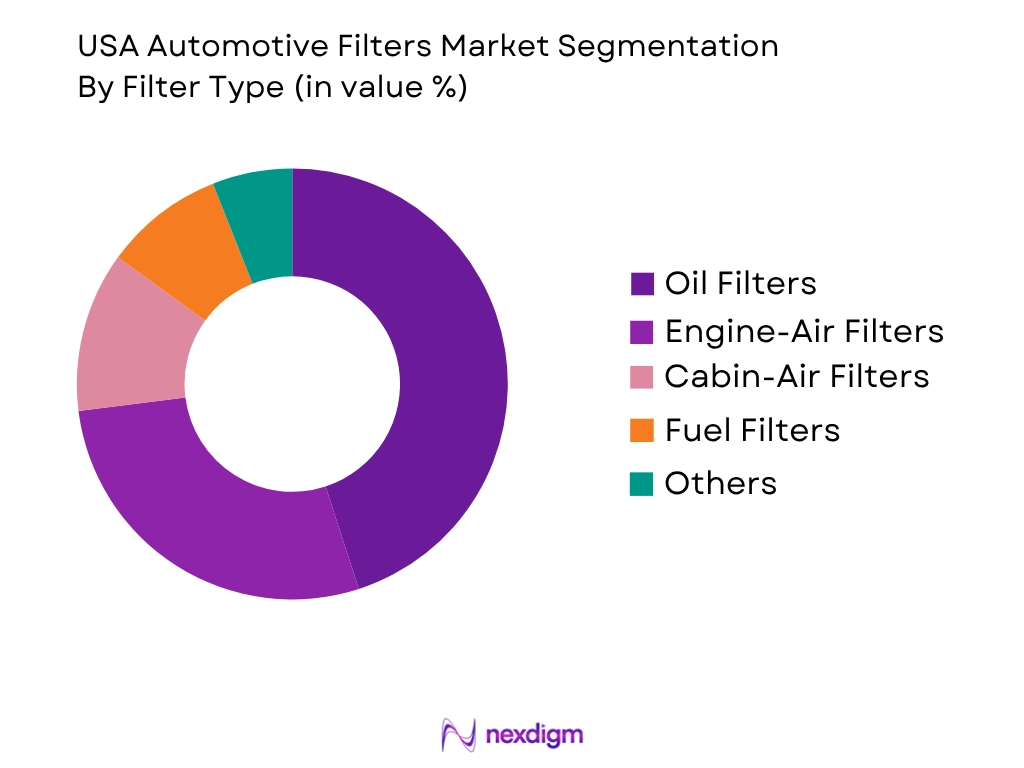
By filter type, the USA Automotive Filters Market is segmented into oil filters, engine-air filters, cabin-air filters, fuel filters, transmission and hydraulic filters, emission-control filters, and other thermal-management or fluid filters. Oil filters hold the dominant market share, supported by the enormous gasoline, diesel, hybrid, pickup, SUV, commercial-truck, and off-highway vehicle population. Oil filters are replaced during scheduled engine-oil service, creating one of the most consistent automotive maintenance events. Demand spans spin-on, cartridge, full-flow, bypass, combination, extended-life, and heavy-duty lube filters. Quick-lube chains and dealerships commonly bundle oil filters with lubricant changes, while DIY consumers purchase filters through auto-parts stores and e-commerce platforms. Heavy-duty fleets require higher dirt-holding capacity, controlled bypass settings, longer service intervals, and compatibility with extended-drain lubricants. Although EV adoption gradually removes engine-oil filters from new battery-electric platforms, the large installed internal-combustion fleet keeps this category central to replacement revenue.
By Sales Channel
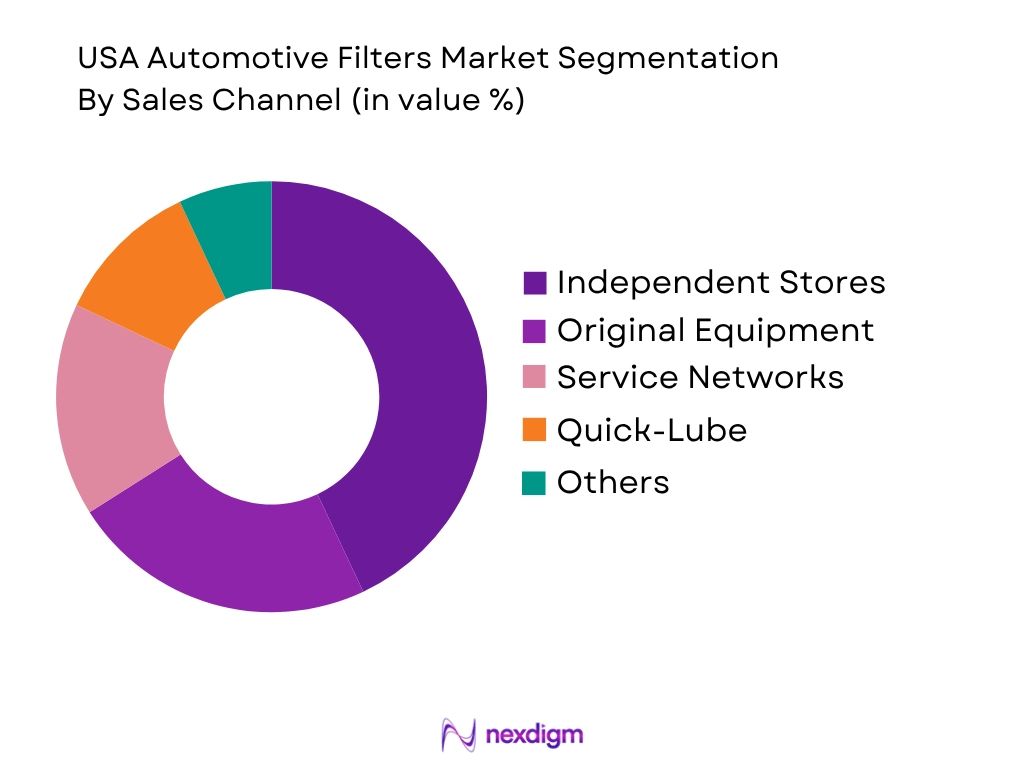
By sales channel, the USA Automotive Filters Market is segmented into national automotive-parts retailers, warehouse distributors and independent parts stores, dealerships, quick-lube and service chains, commercial fleet channels, online retailers, and original-equipment supply. The independent aftermarket distribution channel holds the dominant share, because the majority of replacement transactions occur after vehicles move beyond their initial warranty and dealer-maintenance periods. National retailers and warehouse distributors maintain extensive year–make–model catalogues covering thousands of oil, air, cabin, fuel, transmission, and heavy-duty filter SKUs. They serve DIY consumers, independent repair shops, mobile mechanics, quick-lube outlets, and regional fleets. Fitment availability is critical because an incorrect thread, gasket, bypass valve, filter dimension, or cabin-filter shape can cause installation failure or equipment damage. Online sales are growing through VIN and registration-based search tools, but physical distribution remains important for same-day professional delivery, emergency fleet repairs, and installation support.
Competitive Landscape
The USA Automotive Filters Market is led by diversified filtration groups, automotive component suppliers, heavy-duty specialists, and branded aftermarket businesses. MANN+HUMMEL, Donaldson, Parker Hannifin, Atmus Filtration Technologies, and MAHLE compete through original-equipment engineering, proprietary filter media, integrated filtration modules, replacement catalogues, and commercial-fleet capability. The market remains fragmented at SKU and retail level because national brands compete with OEM genuine products, retailer private labels, economy filters, performance products, and specialized heavy-duty filtration systems.
| Company | Establishment Year | Headquarters | Core Automotive Filters | Vehicle Coverage | Channel Position | Media Capability | Heavy-Duty Capability | EV and Future-Mobility Readiness |
| MANN+HUMMEL | 1941 | Ludwigsburg, Germany | ~ | ~ | ~ | ~ | ~ | ~ |
| Donaldson Company | 1915 | Minneapolis, Minnesota | ~ | ~ | ~ | ~ | ~ | ~ |
| Parker Hannifin | 1917 | Cleveland, Ohio | ~ | ~ | ~ | ~ | ~ | ~ |
| Atmus Filtration Technologies | 1958 heritage | Nashville, Tennessee | ~ | ~ | ~ | ~ | ~ | ~ |
| MAHLE | 1920 | Stuttgart, Germany | ~ | ~ | ~ | ~ | ~ | ~ |

USA Automotive Filters Market Analysis
Growth Drivers
Large Vehicle Parc, High Road Mileage, and Recurring Preventive Maintenance
The scale and utilization of the U.S. vehicle population create a recurring demand base for engine-air, oil, fuel, cabin, transmission, crankcase, and emission-control filters. Federal Highway Administration data show that the United States had approximately 282.2 million registered motor vehicles in 2023, while updated Highway Statistics indicate that the national vehicle base remained above 280 million units in 2024. Vehicles travelled approximately 3.28 trillion miles during 2024, with December alone accounting for 274.4 billion miles, compared with roughly 270.5 billion miles in the same month of 2023. This operating intensity exposes engines and passenger compartments to oil degradation, road dust, pollen, combustion residues, fuel contaminants, and airborne particles. Oil filters are generally replaced during scheduled lubricant service, while engine-air and cabin filters are replaced according to mileage, contamination exposure, or inspection condition. Commercial vans, taxis, ride-hailing vehicles, and delivery fleets create particularly frequent service events because their vehicles complete longer annual distances and operate under stop-start urban conditions. Heavy trucks and off-highway equipment add demand for fuel-water separators, safety air elements, coolant filters, hydraulic filters, and crankcase systems. The macroeconomic environment supports continued vehicle activity: the U.S. Bureau of Economic Analysis recorded 2.8% real GDP growth in 2024 and 2.1% growth in 2025, while first-quarter output increased at an annualized rate of 2.1% in 2026. The IMF projects 2.3% real GDP growth in 2026 for a population of 342.942 million people. Continued consumer spending, investment, freight movement, and vehicle retention therefore sustain aftermarket filter transactions even when new-vehicle demand moderates.
Tighter Emission Requirements and Continued Diesel Fleet Dependence
Federal emission-control requirements and the continued importance of diesel-powered transport are strengthening demand for advanced filtration systems. The Environmental Protection Agency finalized multi-pollutant standards in 2024 for light-duty and medium-duty vehicles, with requirements applying to model-year 2027 and later vehicles. These rules address particulate matter, nitrogen oxides, greenhouse gases, and other pollutants, encouraging the use of cleaner combustion systems, crankcase filtration, enhanced fuel filtration, and, where technically required, gasoline particulate filters. Separate heavy-duty standards cover model-year 2027 trucks and engines and target pollutants that contribute to particulate pollution and ozone formation. Diesel filtration remains particularly important because trucks, buses, construction equipment, agricultural machinery, military vehicles, and freight systems continue to rely heavily on compression-ignition engines. The U.S. Energy Information Administration reports that diesel fuel supplies approximately 22 units of every 100 units of transportation-sector energy consumed, while petroleum products represented roughly 89 units of every 100 units of total transportation energy use in 2025. These operating systems require fuel-water separation, high-efficiency fuel filters, engine-air filters, lube filters, coolant filters, crankcase filters, air-dryer cartridges, and diesel particulate filters. High-pressure common-rail injection systems are especially sensitive to water and microscopic particles, making fuel cleanliness critical to injector and pump protection. EPA-verified diesel particulate-filter technologies can remove substantial particulate mass when correctly installed and maintained, but accumulated ash eventually creates demand for cleaning, flow testing, core exchange, or replacement. The macroeconomic environment reinforces commercial utilization: U.S. real GDP increased 2.8% in 2024, while the IMF projects output of approximately USD 32.38 trillion in 2026. Freight, construction, agriculture, and public-transport activity therefore provide a durable service base for heavy-duty filtration suppliers.
Market Challenges
Battery-Electric Vehicle Expansion and Reduced Engine-Filter Content
The transition toward battery-electric vehicles creates a structural challenge for conventional oil, fuel, engine-air, and emission-control filter suppliers. Battery-electric vehicles eliminate the internal-combustion engine, engine lubricant circuit, gasoline or diesel fuel system, crankcase ventilation architecture, and tailpipe particulate-control system. Consequently, a battery-electric car does not require the recurring oil-filter, fuel-filter, or engine-intake-filter replacement events that support a traditional gasoline or diesel vehicle. Department of Energy registration data show that California alone had approximately 1,843,100 registered electric light-duty vehicles in 2025, together with 490,900 plug-in hybrids and 2,655,000 conventional hybrids. Other large states are also accumulating substantial electric-vehicle populations, gradually changing the national filtration mix. This does not eliminate filtration demand, but it shifts value toward cabin-air filters, battery-cooling air filters, electric-drive lubrication filters, vent protection, desiccant systems, and thermal-management filtration. Suppliers whose portfolios remain concentrated in spin-on oil filters, fuel filters, and conventional engine-air filters face a higher displacement risk than diversified filtration companies. The transition also complicates forecasting because gasoline, diesel, hybrid, plug-in hybrid, and battery-electric vehicles will coexist for an extended period and have different filter counts and replacement cycles. Petroleum products still represented approximately 89% of transportation-sector energy use in 2025, confirming that internal-combustion demand remains large, but product development and capital allocation must increasingly reflect electrified architectures. U.S. GDP grew 2.1% in 2025, while first-quarter 2026 growth reached an annualized 2.1%, supporting vehicle investment but not removing the need for suppliers to rebalance production. Manufacturers must determine which legacy product lines to maintain, which cartridge and module designs to consolidate, and how quickly to invest in EV cabin, battery, fuel-cell, and thermal-management filtration.
Longer Service Intervals, Fitment Complexity, and Deferred Maintenance
Longer vehicle service intervals and increasing filter-SKU complexity can limit replacement frequency and raise operating costs for manufacturers, distributors, and repair channels. Modern synthetic lubricants, improved combustion control, onboard oil-life monitoring, and higher-capacity filter media allow many vehicles to operate longer between oil and filter changes than older vehicles. Extended intervals reduce the number of annual filter transactions per vehicle, even when total road mileage remains high. At the same time, vehicle diversity has expanded the number of filter dimensions, gasket profiles, bypass-valve settings, pressure specifications, sensor interfaces, and housing configurations that distributors must support. The national vehicle parc includes passenger cars, SUVs, pickups, diesel trucks, hybrids, plug-in hybrids, EVs, flex-fuel vehicles, and specialized fleet equipment. A catalogue error involving an oil-filter thread, cartridge height, fuel-filter connector, cabin-filter shape, or bypass pressure can lead to leakage, insufficient lubrication, restricted airflow, warranty claims, or equipment damage. The challenge is magnified across more than 280 million registered vehicles and approximately 3.28 trillion annual vehicle-miles. Consumer behavior adds further pressure. Drivers may defer engine-air or cabin-filter replacement because the component is not visibly associated with an immediate breakdown, while price-sensitive buyers may select unverified or incorrectly specified products. Inflation also affects replacement decisions: the IMF projects average consumer-price growth of 3.2% in 2026, while U.S. economic growth is projected at 2.3%. In this environment, customers may prioritize essential repairs over preventive maintenance, and retailers may increase private-label sourcing to protect margins. Suppliers must therefore invest in VIN-based catalogues, installer training, digital inspection, clear service-interval communication, and product differentiation based on filtration efficiency, dirt-holding capacity, pressure drop, fitment accuracy, and warranty protection.
Market Opportunities
Premium Cabin-Air Filtration for Wildfire Smoke, Allergens, and Urban Pollution
Growing concern about smoke, fine particles, pollen, odors, and airborne contaminants creates a strong opportunity for premium cabin-air filters. The EPA states that wildfire smoke can make outdoor air unhealthy and that smoke can penetrate enclosed indoor environments. Vehicle cabins face a similar exposure pathway whenever outside air enters through the heating, ventilation, and air-conditioning system. Standard particulate cabin filters can capture larger dust and pollen particles, while activated-carbon, biofunctional, antimicrobial, and multilayer filters can also address odors, selected gases, allergens, and finer particles. Wildfire conditions across western and other U.S. regions increase the relevance of these products, particularly for children, older adults, pregnant occupants, and people with heart or lung conditions. The EPA’s 2026 wildfire guidance includes 7 dedicated health and indoor-filtration fact sheets, including documents covering smoke exposure, indoor filtration, and cleaner-air spaces. Although these resources focus primarily on buildings, they reinforce broader public understanding of filtration as a method of reducing airborne-particle exposure. The addressable automotive base is substantial: the United States operates more than 280 million registered vehicles, and California alone had approximately 30,935,500 gasoline vehicles, 1,843,100 EVs, and 2,655,000 hybrids in 2025. Cabin filters are also powertrain-neutral, meaning they remain relevant in gasoline, diesel, hybrid, and battery-electric vehicles. Premium suppliers can develop wildfire-smoke, allergen-reduction, activated-carbon, odor-control, and high-efficiency EV cabin filters supported by digital replacement reminders and vehicle-specific fitment. The IMF projects a U.S. population of 342.942 million in 2026, providing a broad consumer base for health-oriented upgrades. This opportunity is particularly suitable for online retail, dealership service, quick-lube inspection, fleet maintenance, and subscription replacement programmes because cabin filters are lightweight, easy to ship, and frequently neglected until airflow or odor problems become noticeable.
Connected Heavy-Duty Filtration and Predictive Fleet Maintenance
Commercial fleets create a growth opportunity for connected filtration systems that combine physical filter products with sensors, telematics, analytics, and scheduled maintenance. Heavy trucks, buses, construction machinery, agricultural equipment, and delivery fleets operate under high-mileage or high-dust conditions in which filter restriction, fuel contamination, oil degradation, and water accumulation can cause unplanned downtime. The Federal Highway Administration’s long-term forecast indicates that combination-truck vehicle mileage is expected to increase at an average annual rate of 0.9%, while single-unit truck mileage is expected to increase by 2.0%. The current operating base is already substantial: total U.S. road travel exceeded 3.28 trillion miles in 2024, and the FHWA recorded approximately 11.05 million single-unit trucks and 3.24 million combination trucks in the preceding registration dataset. Connected restriction sensors can indicate when an engine-air filter is approaching a service threshold, while fuel-system sensors can detect water or pressure changes and oil-monitoring systems can support condition-based maintenance. These technologies allow fleets to replace filters based on operating condition rather than fixed calendar intervals, helping avoid both premature replacement and failure-related downtime. Suppliers can bundle filters with digital dashboards, automated replenishment, mobile service, and performance contracts covering filtration cost per mile. The opportunity also extends to diesel particulate-filter cleaning, ash monitoring, crankcase ventilation, hydraulic filtration, and air-dryer maintenance. Petroleum products accounted for approximately 89% of transportation energy use in 2025, confirming the continuing importance of combustion-powered freight and equipment. With U.S. GDP increasing 2.1% in 2025 and first-quarter 2026 output rising at an annualized 2.1%, freight, infrastructure, and industrial activity support ongoing fleet utilization. Filtration companies that integrate media technology with telematics and predictive maintenance can therefore move from component sales toward recurring fleet-service revenue.
Future Outlook
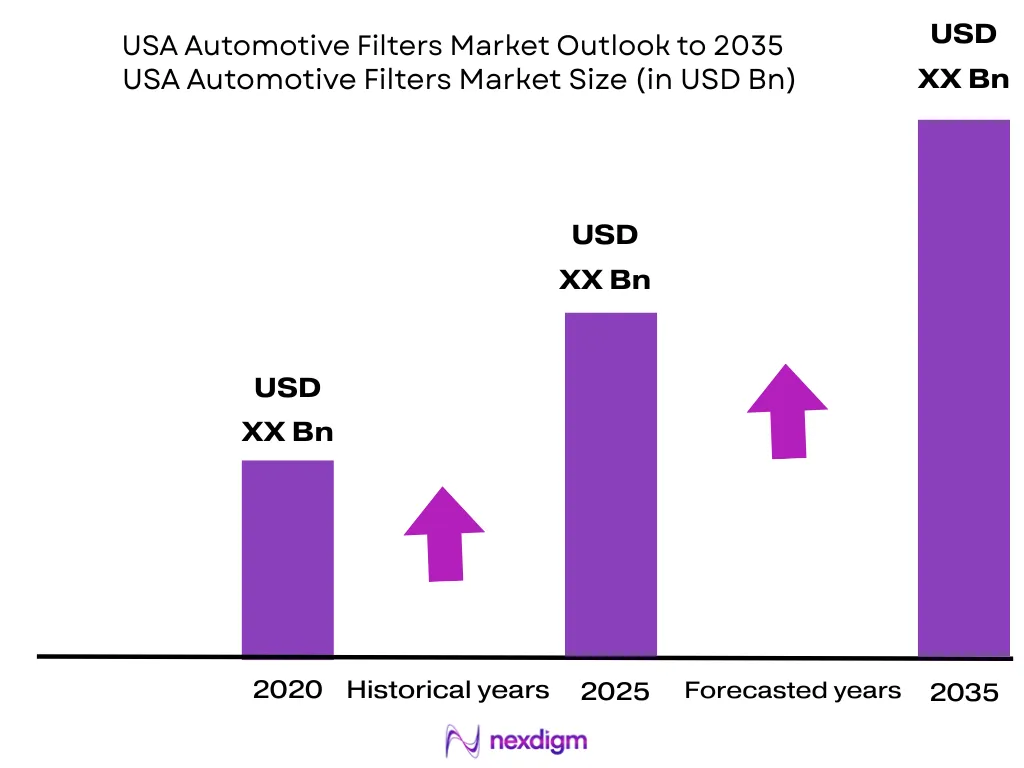
The USA Automotive Filters Market is forecast to expand at approximately ~ CAGR during the forecast period. Growth will be supported by the large installed vehicle parc, high road mileage, longer vehicle ownership, preventive maintenance, commercial-fleet utilization, cabin-air-quality awareness, and increasingly advanced filter media.The product mix will change rather than contract uniformly. Engine oil and fuel filters will face gradual displacement from battery-electric vehicles, but cabin-air, commercial diesel, off-highway, emission-control, and thermal-management filters will provide offsetting opportunities.The replacement market will remain the largest recurring revenue pool. U.S. road travel exceeded 3 trillion vehicle-miles, creating continuous exposure to dust, combustion contaminants, oil degradation, road debris, pollen, smoke, and fuel impurities. High utilization generates repeated service events across passenger vehicles, ride-hailing cars, delivery vans, trucks, buses, and construction equipment.
Major Players
- MANN+HUMMEL
- Donaldson Company
- Parker Hannifin Corporation
- Atmus Filtration Technologies
- MAHLE Aftermarket
- Robert Bosch LLC
- Ahlstrom
- FRAM
- First Brands Group
- K&N Engineering
- DENSO Products and Services Americas
- Hengst Filtration
- UFI Filters USA
- ACDelco
- Baldwin Filters
Key Target Audience
- Automotive filter and filtration-module manufacturers
- Passenger and commercial vehicle manufacturers
- Automotive parts distributors and national retail chains
- Quick-lube, repair, dealership, and service networks
- Trucking, logistics, rental, delivery, and municipal fleets
- Filter-media, activated-carbon, resin, housing, and sensor suppliers
- Investments and venture capitalist firms
- Government and regulatory bodies
Research Methodology
Step 1: Identification of Key Variables
The initial phase constructs an ecosystem map covering filter manufacturers, media suppliers, vehicle OEMs, distributors, retailers, quick-lube operators, workshops, fleets, and recyclers. Critical variables include vehicle parc, vehicle age, annual mileage, filter content per vehicle, service interval, product price tier, propulsion type, and distribution structure.
Step 2: Market Analysis and Construction
Historical vehicle registrations, vehicle miles travelled, new-vehicle sales, maintenance activity, and fleet utilization are compiled. Top-down analysis assesses total filtration revenue, while bottom-up analysis estimates demand using vehicles in operation, replacement frequency, filters per service event, channel markups, and average selling values.
Step 3: Supply-Side Assessment
Manufacturers are evaluated by filter portfolio, OEM relationships, media capability, manufacturing footprint, aftermarket catalogue, commercial-vehicle coverage, and distribution reach. Retail listings, warehouse availability, fleet programmes, and private-label participation are analyzed to reconstruct organized supply.
Step 4: Demand-Side Assessment
Passenger owners, DIY consumers, quick-lube customers, commercial fleets, repair shops, dealerships, and off-highway operators are assessed by annual mileage, maintenance behaviour, duty cycle, brand preference, service interval, and price

- Executive Summary
- Research Methodology (Market Definitions and Assumptions, Automotive Filter Market Boundary, Abbreviations, Market Sizing Approach, Top-Down Analysis, Bottom-Up Analysis, Vehicle Parc–Based Demand Modeling, Filter Replacement Interval Assessment, Vehicle Miles Travelled Analysis, OEM Installation Assessment, Aftermarket Sell-Out Assessment, Fleet Maintenance Assessment, Primary Industry Interviews, Data Triangulation, Forecasting Framework, Limitations and Future Conclusions) Q

- Definition and Scope
- Market Evolution and Industry Genesis
- Timeline of Major Industry Developments
- Automotive Filtration Technology Evolution
- Passenger Vehicle and Commercial Vehicle Filtration Ecosystem
- Internal Combustion, Hybrid and Electric Vehicle Filtration Architecture

- Growth Drivers (Large Aging Vehicle Parc, High Vehicle Miles Travelled, Preventive Maintenance Demand, Quick-Lube Network Expansion, Commercial Fleet Utilization, Cabin Air Quality Awareness)
- Market Challenges (EV Transition, Extended Service Intervals, Private-Label Competition, Counterfeit Risk, Raw Material Volatility, Fitment Complexity)
- Market Opportunities (Cabin Filtration, Connected Filters, EV Thermal Management, Fleet Analytics, High-Efficiency Media, Sustainable Materials)
- Market Trends (Digital Fitment, Premium Cabin Filtration, Connected Maintenance, Longer Service Life, Sustainable Media, Omnichannel Retail)
- Government Regulations (EPA Emission Standards, NHTSA Vehicle Requirements, CARB Compliance, OSHA Exposure Controls, Product Safety, Waste Management)
- SWOT Analysis
Porter’s Five Forces Analysis
PESTLE Analysis

- By Market Value (2020-2025)
- By Filter Unit Sales (2020-2025)
- By Original Equipment Revenue (2020-2025)

- By Filter Type (In Value %)
Engine Air Filters
Oil Filters
Fuel Filters
Cabin Air Filters
Transmission Filters
Coolant Filters - By Vehicle Type (In Value %)
Passenger Cars
Sports Utility Vehicles
Crossovers
Pickup Trucks
Light Commercial Vehicles - By Sales Channel (In Value %)
Vehicle Manufacturers
Tier-One Filtration System Suppliers
Original Equipment Service Networks
Franchised Vehicle Dealerships
National Automotive Parts Retailers - By Geographic Region (In Value %)
Northeast United States
Midwest United States
South United States
West United States

- Market Share of Major Players (By Value, Unit Volume, Filter Type, Vehicle Application, Sales Channel)
- Cross Comparison Parameters (Engine Air–Oil–Fuel–Cabin–Transmission–Emission Filter Portfolio Breadth, Passenger–SUV–Pickup–Commercial–Off-Highway Vehicle Coverage, U.S. OEM Fitment and Integrated Filtration Module Capability, Filtration Efficiency–Pressure Drop–Dirt-Holding Capacity–Service-Life Performance, National Retail–Warehouse Distributor–Heavy-Duty Dealer–E-Commerce Reach, Synthetic–Nanofiber–Activated Carbon–Biofunctional Media Capability, EV Battery Cooling–Fuel Cell–Thermal Management Filtration Readiness, Connected Filter Monitoring–Private-Label–Sustainable Product Innovation)
- SWOT Analysis of Major Players
- Detailed Profiles of Major Companies
MANN+HUMMEL
Donaldson Company
Parker Hannifin Corporation
Cummins Filtration
Robert Bosch LLC
MAHLE Aftermarket
Ahlstrom
FRAM Group
First Brands Group
K&N Engineering
DENSO Products and Services Americas
Hengst Filtration
UFI Filters USA
ACDelco
Baldwin Filters

- Individual Passenger Car Owner Analysis
- SUV and Crossover Owner Analysis
- Pickup Truck Owner Analysis
- Battery Electric Vehicle Owner Analysis
- Hybrid Vehicle Owner Analysis

- By Market Value (2026-2035)
- By Filter Unit Sales (2026-2035)
- By Original Equipment Revenue (2026-2035)


 Request a Sample
 Ask for Customization
 Get a Quote
 Enquire Now