

 Download PDF
Market Overview
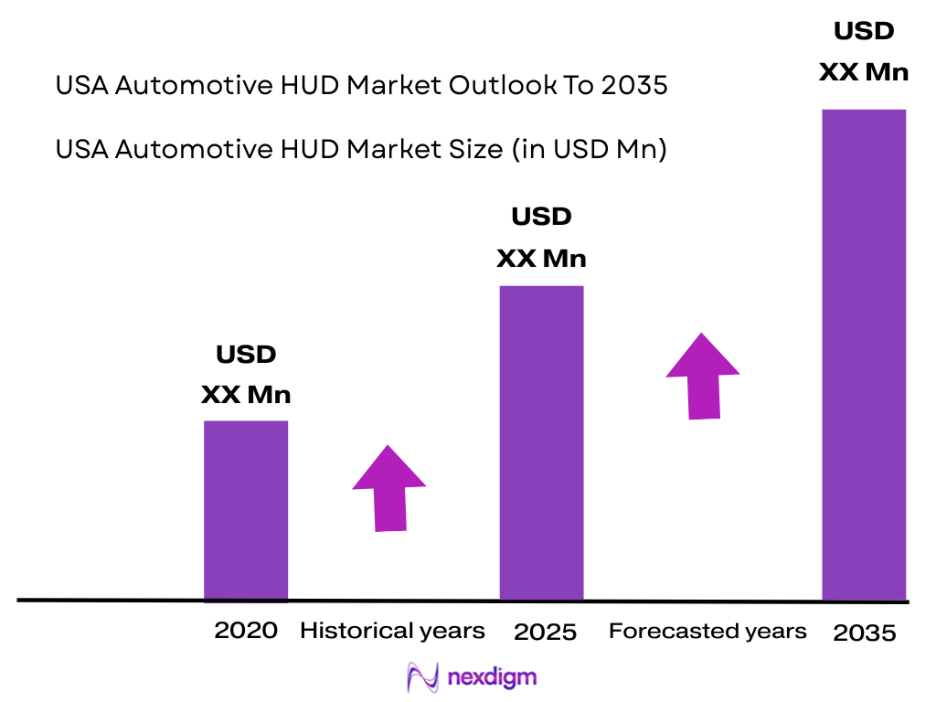
The USA automotive HUD market is valued at ~USD 865.9 billion in 2024, supported by increasing integration of advanced driver assistance systems, premium vehicle adoption, and rising deployment of digital cockpit technologies across passenger vehicles. The market size is driven by OEM investments in enhanced driver interfaces, increasing demand for real-time navigation visualization, and growing adoption of augmented reality-based HUD solutions. Historical industry assessments indicate continued expansion from USD 0.75 billion in 2023 to USD 0.86 billion in 2024, supported by higher installation rates across luxury and electric vehicle platforms.
The USA automotive HUD market is concentrated around automotive technology hubs including Michigan, California, Texas, and North Carolina, driven by the presence of major vehicle manufacturers, Tier-1 suppliers, semiconductor companies, and automotive software developers. Cities such as Detroit benefit from established OEM ecosystems, while California leads through autonomous vehicle technology development and software innovation. Global automotive manufacturing centers in Germany, Japan, South Korea, and China also influence the USA market through technology partnerships and component supply networks.
Market Segmentation
By Technology type
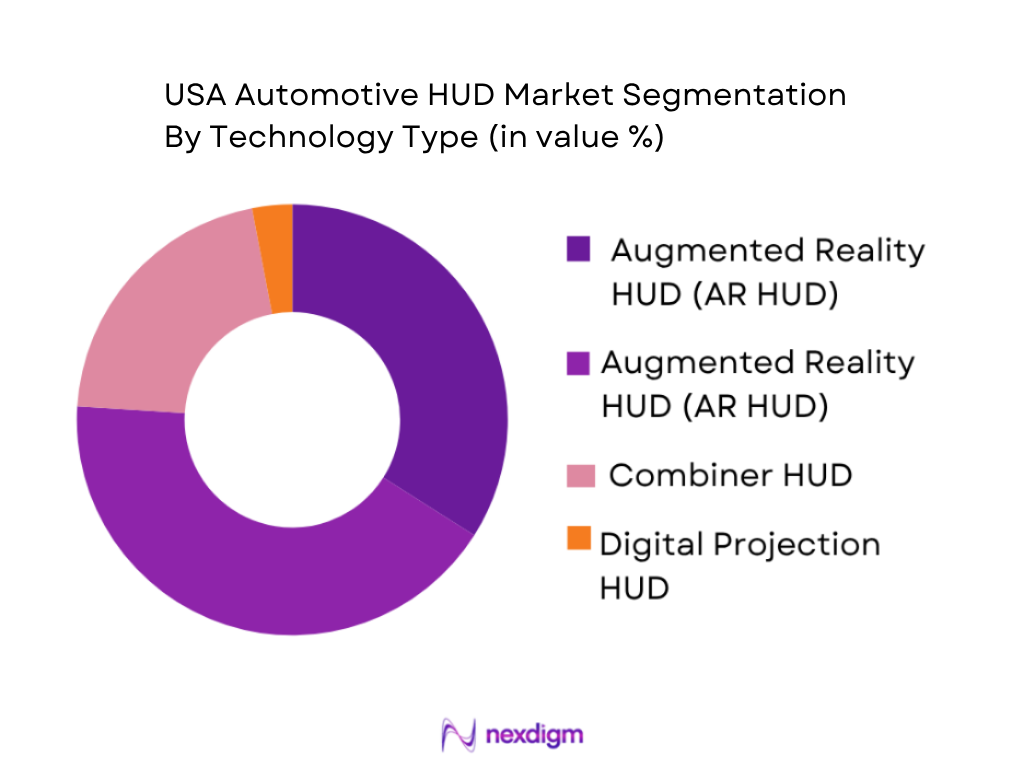
The USA automotive HUD market is segmented by technology type into windshield HUD, combiner HUD, augmented reality HUD (AR HUD), and digital projection HUD. Among these, augmented reality HUD systems represent the dominant segment due to increasing demand for advanced driver assistance visualization and enhanced navigation experiences. AR HUD technology enables projection of dynamic information such as lane guidance, obstacle alerts, and navigation directions directly onto the driver’s field of view. Premium vehicle manufacturers are increasingly adopting AR HUD solutions as part of digital cockpit strategies. The technology is also gaining traction with electric vehicle manufacturers focusing on connected and software-defined vehicle architectures. Improvements in optical systems, projection modules, and sensor integration are further supporting the adoption of advanced HUD technologies.
By Vehicle Type
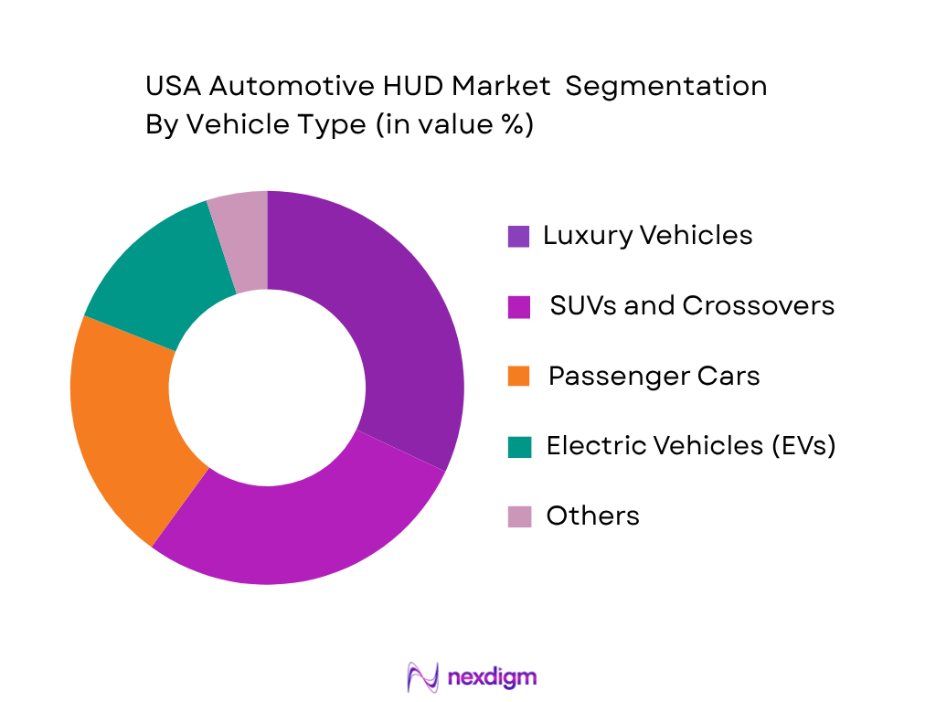
The USA automotive HUD market is segmented by vehicle type into passenger cars, luxury vehicles, SUVs and crossovers, electric vehicles, hybrid vehicles, and commercial vehicles. Luxury vehicles account for the leading market position due to higher availability of advanced cockpit technologies and stronger consumer preference for premium safety and convenience features. Luxury automotive brands integrate HUD systems as part of comprehensive driver assistance packages, enabling navigation projection, vehicle information display, and ADAS alerts. Additionally, the rapid expansion of electric vehicles is accelerating HUD adoption as EV manufacturers emphasize technology-driven interiors and digital user experiences. SUVs and premium crossover segments are also contributing significantly due to increased consumer demand for advanced vehicle features.
Competitive Landscape
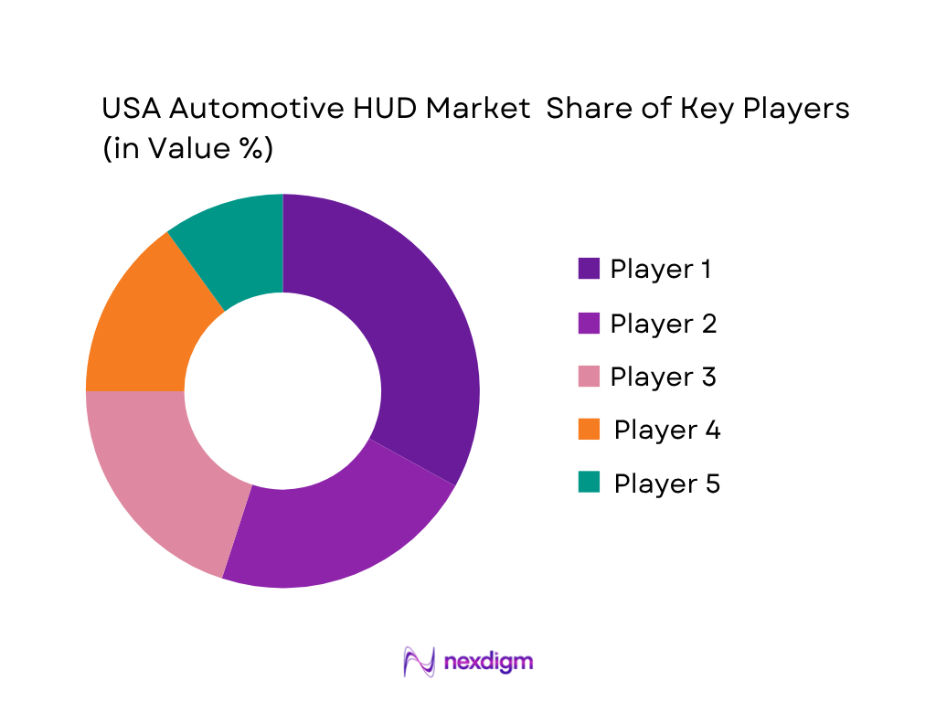
The USA automotive HUD market is characterized by strong competition among global Tier-1 automotive suppliers, display technology companies, and specialized AR display developers. Major players compete through technological innovation, OEM partnerships, optical system capabilities, and integration of HUD solutions with ADAS and connected vehicle platforms. Companies with established automotive supply relationships and advanced display technologies maintain a stronger position in the evolving digital cockpit ecosystem.
| Company | Establishment Year | Headquarters | HUD Technology Focus | OEM Partnerships | AR HUD Capability | Automotive Electronics Expertise | Production Capability |
| Continental AG | 1871 | Germany | ~ | ~ | ~ | ~ | ~ |
| Robert Bosch GmbH | 1886 | Germany | ~ | ~ | ~ | ~ | ~ |
| Panasonic Automotive Systems | 2003 | Japan | ~ | ~ | ~ | ~ | ~ |
| Denso Corporation | 1949 | Japan | ~ | ~ | ~ | ~ | ~ |
| Harman International | 1980 | USA | ~ | ~ | ~ | ~ | ~ |
USA Automotive HUD Market Analysis
Growth Drivers
Increasing ADAS Adoption
The adoption of advanced driver assistance systems (ADAS) is a major growth driver for the USA automotive HUD market as HUD technology increasingly becomes an interface for delivering real-time safety information such as lane departure warnings, adaptive cruise control alerts, collision notifications, and navigation guidance. The National Highway Traffic Safety Administration (NHTSA) reported that 1,730 people were killed in crashes involving vehicles with lane departure-related events in 2022, highlighting the importance of technologies designed to improve driver awareness and accident prevention. Additionally, the Insurance Institute for Highway Safety (IIHS) reported that more than 90% of new passenger vehicles offered at least one ADAS feature as standard equipment in 2024, accelerating integration between vehicle safety systems and digital displays. The increasing deployment of ADAS sensors, including cameras, radar, and LiDAR systems, is creating demand for intuitive visualization platforms where HUDs can communicate safety warnings without requiring drivers to look away from the road. As vehicle manufacturers continue improving Level 2 and Level 3 automated driving capabilities, HUD systems are becoming increasingly important for presenting vehicle status, driver monitoring alerts, and autonomous driving information.
Growth of Electric Vehicles and Digital Cockpit Integration
The expansion of electric vehicles (EVs) in the USA is supporting automotive HUD adoption as EV manufacturers prioritize advanced digital interiors, connected interfaces, and software-driven user experiences. According to the U.S. Energy Information Administration (EIA), electric vehicle registrations in the United States exceeded 3 million units in 2023, reflecting accelerating consumer adoption of electrified mobility. The International Energy Agency (IEA) reported that electric car sales in the United States reached approximately 1.4 million units in 2024, demonstrating continued momentum in EV adoption. EV manufacturers increasingly use digital cockpit systems as a key differentiating factor, integrating HUDs with navigation systems, battery management information, charging guidance, and driver assistance features. The U.S. Department of Energy reported that the country had more than 68,000 public charging locations and over 180,000 charging ports in 2024, supporting broader EV ecosystem development. As EV platforms rely heavily on centralized computing architectures and connected vehicle software, HUD systems are becoming an important component for delivering vehicle information efficiently while reducing dependence on traditional instrument clusters.
Market Challenges
High HUD System Integration Complexity and Optical Calibration Requirements
Complex engineering requirements associated with HUD installation remain a significant challenge for automotive manufacturers, particularly due to optical calibration, windshield design compatibility, and alignment accuracy requirements. Automotive HUD systems require precise synchronization between projection units, optical components, vehicle sensors, and display software to ensure accurate information placement within the driver’s viewing area. The National Highway Traffic Safety Administration (NHTSA) reported that the United States recorded approximately 40,901 roadway fatalities in 2023, increasing focus on driver distraction reduction and safety-related technology performance. HUD systems must comply with strict visibility and distraction-related requirements while maintaining accurate information presentation under different lighting conditions. The Federal Highway Administration (FHWA) reported that the United States had over 4.1 million miles of public roads in 2024, requiring vehicle technologies to operate reliably across diverse driving environments including urban, rural, and highway conditions. These operational requirements increase engineering complexity for HUD manufacturers, as systems must deliver consistent performance across varying windshield angles, vehicle models, weather conditions, and driver seating positions.
Semiconductor Supply Dependency and Vehicle Electronics Integration Challenges
Automotive HUD development faces challenges due to dependence on semiconductor components, embedded processors, display drivers, sensors, and advanced electronics required for real-time data processing. The U.S. Department of Commerce highlighted that semiconductor supply chain resilience remains a strategic priority, with the CHIPS and Science Act allocating USD 52.7 billion for strengthening domestic semiconductor manufacturing and research capabilities. Modern HUD systems require integration with multiple vehicle electronic control units, ADAS platforms, infotainment systems, and vehicle communication networks, increasing software and hardware complexity. The National Institute of Standards and Technology (NIST) emphasized the growing importance of cybersecurity and reliability standards as connected vehicle technologies expand. The U.S. Department of Transportation reported that connected vehicle technologies are being evaluated across multiple transportation safety programs, increasing requirements for secure data exchange between vehicle systems. These integration challenges create technical barriers for widespread HUD deployment, particularly in mass-market vehicles where manufacturers must balance advanced functionality with simplified vehicle architecture and production scalability.
Market Opportunities
AR HUD Commercialization and Autonomous Driving Interface Development
Augmented reality HUD technology represents a major opportunity for the USA automotive HUD market as vehicle manufacturers increasingly require advanced interfaces capable of supporting ADAS and autonomous driving functions. AR HUD systems can project navigation instructions, road information, hazard warnings, and autonomous driving status directly onto the windshield, improving driver understanding of complex vehicle environments. The U.S. Department of Transportation reported continued investment in automated vehicle research and transportation innovation programs, with autonomous driving technologies being evaluated through multiple federal initiatives. The National Highway Traffic Safety Administration (NHTSA) reported that automated driving systems remain a key area of transportation technology development, requiring effective human-machine interfaces for safe vehicle interaction. The growth of connected vehicle infrastructure also supports AR HUD adoption, as the Federal Communications Commission (FCC) reported continued development of vehicle communication technologies using connected spectrum solutions. As vehicles transition toward higher automation levels, AR HUD systems provide an opportunity to become the primary communication layer between automated vehicle systems and drivers by delivering contextual information in real time.
Expansion of Software-Defined Vehicles and AI-Based Driver Information Systems
The transition toward software-defined vehicles is creating opportunities for HUD manufacturers to integrate artificial intelligence, connected services, and personalized driver information systems. Modern vehicles increasingly rely on centralized computing platforms that allow software updates, real-time data processing, and integration of multiple digital functions. The U.S. Department of Energy reported that the United States had more than 276 million registered vehicles in operation, representing a large installed base where advanced vehicle technologies can expand through new vehicle adoption and technology upgrades. The National Artificial Intelligence Initiative Office highlighted continued federal focus on AI development and deployment across industries, supporting advancements in AI-powered automotive applications. AI-enabled HUD systems can analyze driving conditions, prioritize safety alerts, personalize displayed information, and integrate data from navigation, vehicle sensors, and connected services. The expansion of connected mobility ecosystems creates additional opportunities for HUD solutions to evolve from simple information displays into intelligent driver assistance platforms supporting safer and more personalized driving experiences.
Future Outlook
The USA automotive HUD market is expected to demonstrate significant growth during the forecast period, driven by increasing adoption of augmented reality displays, expansion of electric vehicles, and rising integration of advanced driver assistance systems. Automotive manufacturers are focusing on next-generation cockpit technologies that improve safety, personalization, and vehicle interaction. Continuous innovation in display technologies, optical systems, and connected vehicle platforms is expected to accelerate HUD adoption across multiple vehicle segments.
Major Players
- Continental AG
- Robert Bosch GmbH
- Panasonic Automotive Systems
- Denso Corporation
- Harman International
- Visteon Corporation
- LG Electronics
- Samsung Electronics
- Garmin Ltd.
- Nippon Seiki Co., Ltd.
- Yazaki Corporation
- Ficosa International
- MicroVision, Inc.
- WayRay
- Envisics
Key Target Audience
- Automotive Original Equipment Manufacturers (OEMs)
- Tier-1 Automotive Electronics Suppliers
- Automotive Display Technology Manufacturers
- Semiconductor and Optical Component Manufacturers
- Electric Vehicle Manufacturers and Platform Developers
- Investments and Venture Capitalist Firms (Automotive Technology Funds, Mobility Investment Firms, Deep-Tech Venture Capital Funds)
- Government and Regulatory Bodies (National Highway Traffic Safety Administration (NHTSA), Department of Transportation (DOT), Federal Motor Vehicle Safety Standards Authorities)
- Autonomous Driving Technology Companies
Research Methodology
Step 1: Identification of Key Variables
The initial stage involves developing a comprehensive ecosystem map of the USA automotive HUD market covering OEMs, Tier-1 suppliers, display manufacturers, semiconductor providers, and technology developers. Extensive secondary research is conducted using automotive databases, company filings, industry publications, and proprietary market intelligence resources to identify critical market variables.
Step 2: Market Analysis and Construction
This phase focuses on analyzing historical automotive HUD market performance through vehicle installation rates, OEM adoption trends, technology penetration, component pricing, and revenue contribution analysis. Market sizing is developed through a combination of vehicle production data, HUD system pricing analysis, and supplier-level assessments.
Step 3: Hypothesis Validation and Expert Consultation
Market assumptions are validated through interviews with automotive industry professionals, including OEM executives, Tier-1 suppliers, display technology providers, and mobility technology specialists. These discussions provide operational insights related to adoption trends, technology advancements, pricing structures, and competitive dynamics.
Step 4: Research Synthesis and Final Output
The final stage involves integrating primary and secondary research findings to generate a validated assessment of the USA automotive HUD market. Data collected from manufacturers, suppliers, and technology companies is analyzed to ensure accuracy across market sizing, segmentation, competitive analysis, and future outlook.

- Executive Summary
- Research Methodology (Market Definition and Scope, Automotive HUD Classification Framework, Market Sizing Methodology, Revenue Estimation Approach, Volume Assessment Methodology, Top-Down Market Analysis, Bottom-Up Market Analysis, OEM Production-Based Estimation, Vehicle Installation Rate Analysis, HUD Penetration Assessment, Demand-Side Analysis, Supply-Side Analysis, Primary Interviews with Automotive OEMs, Tier-1 Suppliers and Technology Providers, Secondary Research Framework, Data Validation and Triangulation, Forecasting Model, Market Assumptions, Research Limitations)

- Definition and Scope
- Automotive HUD Technology Evolution and Industry Development Timeline
- Automotive HUD Ecosystem Overview
- USA Automotive HUD Value Chain Analysis

- Market Growth Drivers (Increasing ADAS Adoption, Rising Premium Vehicle Demand, Growth of Electric Vehicles, Increasing Driver Safety Requirements, Expansion of Autonomous Driving Technologies, OEM Focus on Digital Cockpit Systems, Rising Consumer Preference for Advanced In-Vehicle Technologies)
- Market Challenges (High HUD System Cost, Complex Optical Calibration Requirements, Limited Mass-Market Adoption, Windshield Compatibility Issues, Supply Chain Dependency on Semiconductor Components, Integration Complexity with Vehicle Electronics Architecture)
- Market Opportunities (AR HUD Commercialization, Expansion into Mid-Segment Vehicles, EV Digital Cockpit Adoption, Autonomous Vehicle Interface Development, AI-Based Driver Information Systems, Software-Defined Vehicle Integration)
- Market Trends (AR Navigation Display Adoption, Large Field-of-View HUD Development, Digital Cockpit Consolidation, MicroLED Display Advancement, Connected Vehicle Data Integration, Personalized Driver Information Display)
- Government and Regulatory Landscape (FMVSS Safety Standards, NHTSA Driver Visibility Requirements, Automotive Display Regulations, ADAS Safety Guidelines, Vehicle Cybersecurity Requirements)
- SWOT Analysis
- Porter’s Five Forces Analysis
- PESTLE Analysis

- By Market Value (2020-2025)
- By Installed HUD Units (2020-2025)
- By Average Selling Price (ASP) (2020-2025)
- By Vehicle Production Penetration Rate (2020-2025)
- By New Vehicle Installation Rate (2020-2025)
- By HUD System Revenue Contribution per Vehicle (2020-2025)

- By HUD Technology Type (In Value %)
Windshield HUD
Combiner HUD
Augmented Reality HUD (AR HUD)
Head-Mounted Display-Based Automotive HUD
Digital Projection HUD - By Display Technology (In Value %)
LCD-Based HUD
DLP-Based HUD
LCoS-Based HUD
MicroLED-Based HUD
OLED-Based HUD - By Vehicle Type (In Value %)
Passenger Cars
Premium Passenger Vehicles
Luxury Vehicles
SUVs and Crossovers
Electric Vehicles (EVs)
Hybrid Electric Vehicles (HEVs)
Commercial Vehicles
Light Commercial Vehicles
Heavy Commercial Vehicles - By Vehicle Price Category (In Value %)
Economy Vehicles
Mid-Range Vehicles
Premium Vehicles
Luxury Vehicles
Ultra-Luxury Vehicles - By Distribution Channel (In Value %)
Direct OEM Supply
Tier-1 Automotive Supplier Channel
Aftermarket Automotive Electronics Channel
Fleet Vehicle Integration Channel - By Region (In Value %)
Northeast USA
Midwest USA
South USA
West USA

- Market Share Analysis of Major Players (By Revenue, HUD Shipments, OEM Partnerships, Vehicle Installations, Technology Segment)
- Cross Comparison Parameters (HUD Product Portfolio Breadth, AR HUD Development Capability, OEM Partnership Network, HUD Installation Volume, Display Technology Capability, Optical System Expertise, R&D Investment Intensity, Automotive Software Integration Capability)
- Pricing Analysis (By HUD Technology Type, Vehicle Segment, Display Size, OEM Application)
- SWOT Analysis of Major Players
- Detailed Profiles of Major Companies
Continental AG
Panasonic Automotive Systems
Denso Corporation
Robert Bosch GmbH
Harman International
Visteon Corporation
LG Electronics
Samsung Electronics
Garmin Ltd.
Nippon Seiki Co., Ltd.
Yazaki Corporation
Ficosa International
MicroVision, Inc.
WayRay
Envisics

- Vehicle Buyer Adoption Analysis
- Consumer Demographic Analysis
- Vehicle Segment Adoption Analysis
- Consumer Willingness-to-Pay Analysis
- HUD Feature Preference Analysis
- Driver Experience Assessment
- Consumer Pain Point Analysis
- Purchase Decision Influence Analysis

- By Market Value (2026-2035)
- By Installed HUD Units (2026-2035)
- By Average Selling Price (ASP) (2026-2035)
- By Vehicle Production Penetration Rate (2026-2035)
- By New Vehicle Installation Rate (2026-2035)
- By HUD System Revenue Contribution per Vehicle (2026-2035)


 Request a Sample
 Ask for Customization
 Get a Quote
 Enquire Now