

 Download PDF
Market Overview
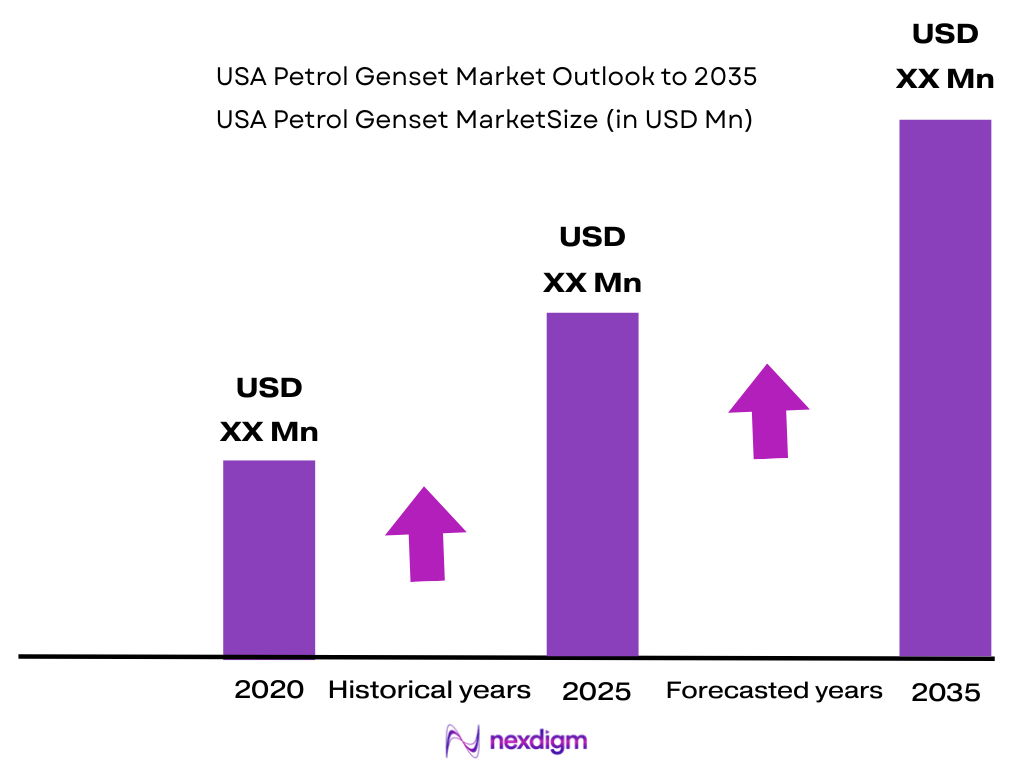
The USA Petrol Genset Market is valued at approximately ~ million, supported by recurring grid disruptions, residential backup requirements, construction activity and recreational power demand. The two latest annual benchmarks show 27 major billion-dollar weather disasters versus 28 in the preceding period, while U.S. electricity customers subsequently experienced approximately 11 hours of interruption in the latest nationwide reliability assessment. Gasoline generators remain relevant because of immediate fuel availability, portability and rapid emergency deployment. Texas, Florida, the Gulf Coast and the broader Southeast represent major demand centres for petrol gensets because hurricanes, severe storms, flooding, heat events and grid disruption increase household and small-business backup requirements. Texas alone was affected by 190 billion-dollar weather and climate disasters between 1980 and 2024, while Florida continues to face substantial tropical-cyclone exposure. These states also contain large populations of detached homes, construction sites, RV users and outdoor-power-equipment dealers supporting generator adoption.
Market Segmentation
By Generator Type
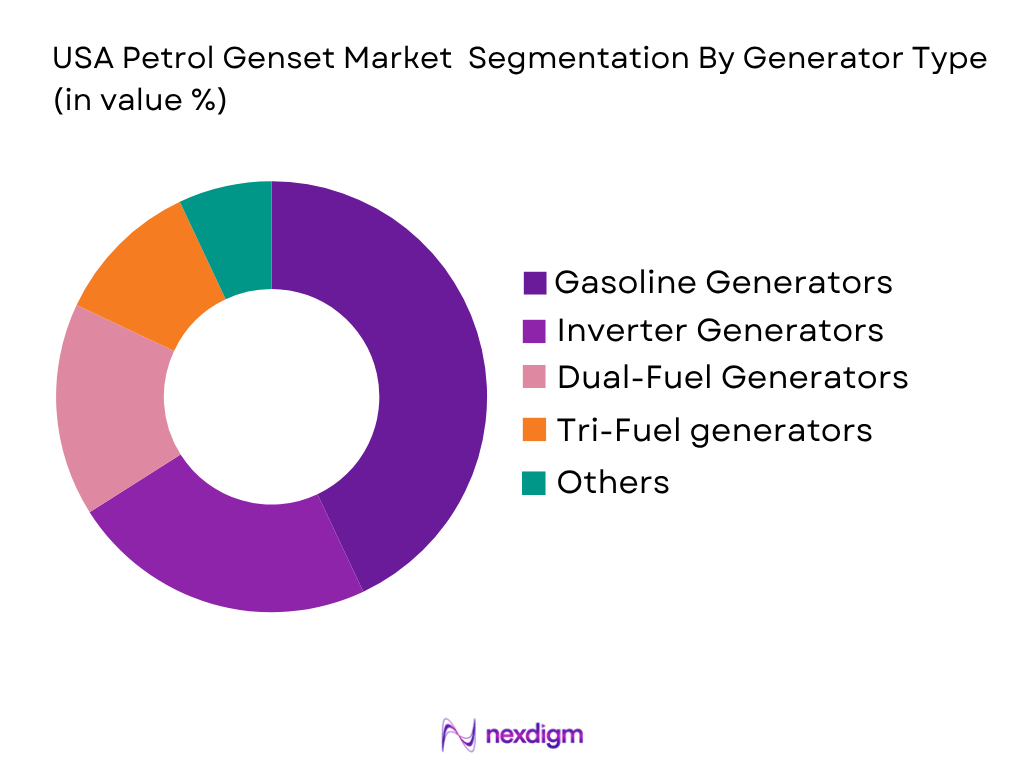
The USA Petrol Genset Market is segmented into conventional portable generators, inverter generators, portable dual-fuel generators with gasoline capability, tri-fuel portable generators with gasoline capability and gasoline-oriented emergency backup units. Conventional portable gasoline generators currently represent the dominant segment because they provide high starting wattage, straightforward engine architecture and broad suitability for emergency residential backup, contractors, workshops and temporary outdoor power. Manufacturers offer products across a wide power range, enabling homeowners to operate refrigerators, pumps, lighting and selected HVAC loads while contractors can power saws, compressors and other tools. However, inverter gensets are becoming increasingly important because they deliver cleaner electricity for electronic devices, lower noise and improved fuel efficiency at partial loads. Generac historically describes portable and inverter generators as serving emergency home backup, construction and recreational applications, illustrating the breadth of U.S. end uses.
By Power Output
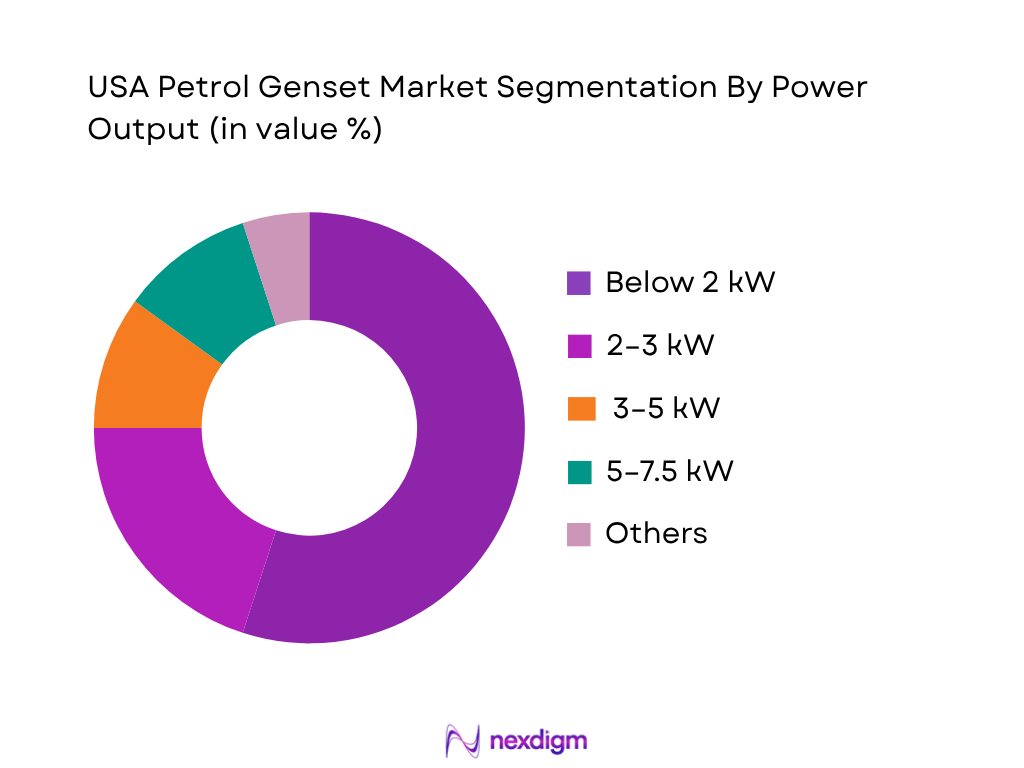
The USA Petrol Genset Market is segmented into below 2 kW, 2–5 kW, 5–10 kW, 10–15 kW and above 15 kW systems. The 5–10 kW category holds the dominant position because it balances portability with sufficient capacity for residential emergency backup, RV loads, jobsite tools and temporary commercial applications. Products within this class can power multiple household circuits while remaining easier to transport and store than larger stationary systems. Champion, for example, offers a gasoline-capable tri-fuel inverter producing 7,250 running watts on gasoline, while conventional portable-generator manufacturers maintain extensive products around similar output bands. Lower-capacity inverter products are particularly relevant for camping and electronics, whereas larger units increasingly compete with propane, natural-gas standby systems and battery-storage alternatives.
Competitive Landscape
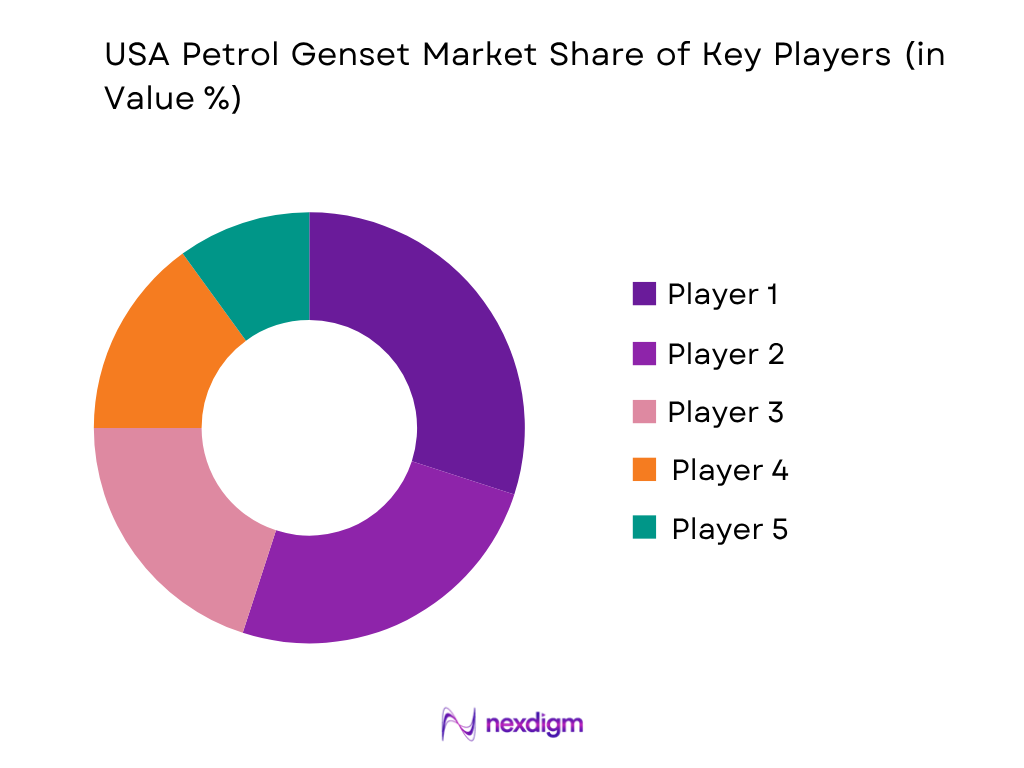
The USA Petrol Genset Market is characterized by established power-equipment manufacturers and specialist portable-generator brands competing through wattage range, inverter architecture, multi-fuel capability, runtime, noise control, carbon-monoxide shutoff technology and nationwide retail availability. Generac has longstanding U.S. power-generation capabilities, Honda competes strongly in premium portable inverter equipment, while Champion has developed a broad portable and multi-fuel range with CO Shield technology. Westinghouse, Briggs & Stratton and other brands create substantial competitive pressure in home-centre and online channels.
| Major Player | Establishment Year | Headquarters | Gasoline Portfolio | Inverter Capability | Typical Power Coverage | Multi-Fuel Capability | CO-Safety Features | Primary Market Position |
| Generac | 1959 | Wisconsin, USA | ~ | ~ | ~ | ~ | ~ | ~ |
| Honda Power Equipment | 1948 | Tokyo, Japan / U.S. Power Equipment Operations | ~ | ~ | ~ | ~ | ~ | ~ |
| Champion Power Equipment | 2003 | Las Vegas, Nevada | ~ | ~ | ~ | ~ | ~ | ~ |
| Westinghouse Outdoor Power Equipment | Westinghouse heritage from 1886 | USA Operations | ~ | ~ | ~ | ~ | ~ | ~ |
| Briggs & Stratton | 1908 | Wisconsin, USA | ~ | ~ | ~ | ~ | ~ | ~ |
USA Petrol Genset Market Analysis
Growth Drivers
Rising Grid Outage Exposure and Extreme Weather-Driven Backup Power Requirements
Power reliability disruptions are one of the strongest structural drivers of the USA Petrol Genset Market because portable gasoline generators provide rapidly deployable electricity during hurricanes, severe storms, winter events and localized grid failures. U.S. Energy Information Administration data shows that electricity customers experienced an average of approximately 11 hours of interruptions during 2024, nearly double the annual average recorded during the preceding decade. Major weather events accounted for most of those interruption hours. Hurricane Beryl alone left approximately 2.6 million electricity customers without power in Texas, while Hurricane Helene disrupted electricity service for approximately 5.9 million customers across 10 states, including at least 1.2 million customers in South Carolina. NOAA also identified 27 separate billion-dollar weather and climate disasters affecting the United States during 2024, including 17 severe-storm events, multiple tropical cyclones, floods, wildfires and winter-weather events. At least 1,735 tornadoes were confirmed during the year, creating repeated localized risks to transmission lines, substations, distribution poles and residential electricity connections. These conditions directly support purchases and replacement demand for portable petrol gensets because residential users can deploy gasoline-powered equipment without establishing permanent fuel-piping infrastructure. Small businesses, repair facilities, mobile service operators, agricultural users, roadside operations and emergency-response teams similarly benefit from portable units that can be transported between locations. The demand foundation is particularly large because EIA recorded approximately 143 million residential electricity customers in the United States during 2024, creating an extensive addressable population exposed to weather-related electricity interruption risk. The economic environment supports household and business investment in resilience equipment. World Bank data places U.S. GDP at approximately USD 28.75 trillion and GDP per capita at roughly USD 84,534 during 2024, illustrating the purchasing capacity available for residential backup and outdoor power equipment. Petrol gensets are especially relevant where outage events occur suddenly because gasoline can be sourced through the country’s established retail fueling infrastructure, equipment can be stored before hurricane or winter-storm seasons, and portable units can power refrigerators, sump pumps, lighting, communication equipment, workshop tools and selected household circuits. The mobility of smaller gasoline gensets is also relevant to automotive-oriented applications such as mobile repair vans, racing and recreational vehicle support, roadside businesses and vehicle-based work crews. This demand differs from large diesel standby generation, which is typically permanently installed for hospitals, industrial sites or commercial properties. In the petrol genset category, outage-driven purchasing frequently centres on compact and mid-capacity portable units that combine manageable weight with sufficient output for essential loads. Repeated extreme-weather exposure therefore strengthens both first-time ownership and replacement demand. The underlying macroeconomic scale, 143 million residential electricity accounts, 11 average interruption hours, 27 major weather disasters, and multi-million-customer hurricane outages collectively demonstrate why grid resilience remains a central growth driver for the U.S. petrol genset market. Sources supporting these figures include the U.S. Energy Information Administration, NOAA and World Bank.
Expansion of Construction, Mobile Worksites and Temporary Power Applications
High construction activity across the United States provides another significant growth driver for portable petrol gensets because building sites, repair projects, landscaping operations and mobile contractors frequently require electricity before permanent grid connections are available or in locations where extension-cord access is impractical. The U.S. Census Bureau reported that total construction put in place reached approximately USD 2.154 trillion during 2024, compared with approximately USD 2.024 trillion during 2023. This level of activity creates a large ecosystem of temporary worksites requiring portable power for saws, drills, compressors, pumps, lighting, chargers, small welders and other electrically powered equipment. Gasoline gensets are particularly suitable for smaller contractors and mobile service teams because units in lower and medium output classes can be moved between vehicles and job locations without the installation requirements associated with permanent standby systems. Residential remodeling, road repair, roofing, landscaping and light commercial construction create frequent use cases for petrol-powered portable equipment. The underlying macroeconomic environment also reinforces this activity. World Bank data records U.S. GDP of approximately USD 28.75 trillion in 2024, while the Bureau of Economic Analysis reported that current-dollar economic output reached an annualized level of approximately USD 29.35 trillion during the third quarter of 2024. Strong economic scale supports investment across housing, manufacturing facilities, data infrastructure, transportation projects, utilities and commercial real estate, many of which require temporary power at different project phases. The generator opportunity is not limited to large construction sites. Small mobile contractors represent an important market because portable gasoline gensets can be transported in pickups, work vans or trailers and used wherever grid electricity is unavailable. Automotive repair operations also intersect with this demand. Mobile mechanics, roadside service crews, vehicle-detailing businesses and motorsport support teams can use compact petrol units to operate diagnostic equipment, air compressors, lighting, pumps and power tools away from fixed premises. Recreational vehicles, trailers and outdoor events add adjacent automotive-linked demand where gasoline-powered generators provide independent AC electricity. U.S. gasoline availability further reinforces the practicality of these products. EIA reports that gasoline demand averaged approximately 8.9 million barrels per day during 2024, demonstrating an extensive national supply and distribution system supporting gasoline-powered equipment as well as vehicles. This established fueling infrastructure reduces the adoption barrier for portable petrol gensets compared with technologies requiring specialized fuels. The demand is particularly relevant in lower-kW segments where portability, rapid starting, lower equipment weight and availability through hardware, home-improvement and power-equipment retailers matter more than continuous-duty efficiency. Construction activity also creates replacement demand because gensets operating in dusty, high-load or mobile environments experience vibration, repeated transport and substantial operating hours. Contractors therefore evaluate durability, engine displacement, starting watts, rated watts, fuel-tank capacity, runtime, outlet configuration and low-oil shutdown capability when selecting equipment. Inverter models are becoming increasingly relevant for technicians operating sensitive electronics and battery chargers, while conventional open-frame units remain suitable for rugged construction loads. With USD 2.154 trillion of construction activity, 8.9 million barrels per day of gasoline demand, and an economy exceeding USD 28 trillion, temporary and mobile power remains a substantial application base for the USA Automotive Petrol Genset Market. Sources supporting these figures include the U.S. Census Bureau, World Bank, Bureau of Economic Analysis and U.S. Energy Information Administration.
Market Challenges
Carbon Monoxide Safety Requirements and Increasing Product Compliance Complexity
Carbon monoxide exposure represents one of the most important technical and regulatory challenges facing petrol genset manufacturers because gasoline engines produce combustion exhaust that can become lethal when generators are operated inside or too close to occupied buildings. The U.S. Consumer Product Safety Commission repeatedly issued generator-safety warnings throughout 2024 during winter storms, hurricanes and floods, instructing consumers to operate portable generators at least 20 feet away from homes, direct exhaust away from buildings and avoid garages, basements, porches, carports and other enclosed or partially enclosed locations. CPSC also advised buyers to seek generators equipped with automatic carbon-monoxide shutoff technologies. These requirements affect product engineering because manufacturers increasingly need integrated CO sensing, electronic control modules, automatic shutdown algorithms, clear warning labels and exhaust-management designs rather than relying solely on traditional mechanical engine architecture. CPSC’s portable-generator regulatory work has also considered limits on carbon-monoxide emissions together with automatic shutoff when specified conditions are reached. Compliance pressures extend beyond CO. Under the Clean Air Act, the U.S. Environmental Protection Agency requires engines and equipment sold in the United States to meet applicable emissions certification requirements, including testing, labeling, reporting, warranty, recordkeeping and restrictions against emissions-control tampering. Small spark-ignition engines used in gasoline generators therefore require emission-control systems engineered around hydrocarbons, nitrogen oxides and carbon monoxide, while certain state requirements can be stricter than federal standards. California represents an especially demanding market because state nonroad-engine pollution standards can create additional certification and product-design requirements for generator suppliers operating nationwide. EPA documentation associated with California nonroad-engine standards specifically addresses increasingly stringent requirements affecting portable generators during the 2024–2027 regulatory period. The commercial relevance of these requirements is amplified by the size of the U.S. economy and consumer base. World Bank data places U.S. GDP at approximately USD 28.75 trillion during 2024, while EIA identifies approximately 143 million residential electricity accounts, demonstrating the scale at which compliant consumer generator products may be distributed. The challenge intensifies during major disasters, when millions of households may simultaneously seek portable power. Hurricane Helene disrupted service to approximately 5.9 million customers, while Hurricane Beryl affected approximately 2.6 million customers in Texas. High emergency demand increases the importance of correct product instructions because first-time users may have limited familiarity with safe generator placement, grounding, extension-cord capacity or transfer-switch requirements. Manufacturers therefore need to invest not only in engine performance but also safety controls, packaging communication, dealer education and consumer training. The addition of sensors and electronic shutoff hardware can also increase component complexity and create service requirements that were minimal in older mechanically controlled units. Manufacturers selling products across multiple states must manage EPA certification, state-specific emissions rules, electrical safety requirements and voluntary or mandatory generator safety standards simultaneously. Retailers may increasingly prefer products carrying recognized CO-safety technologies because of liability and brand-reputation concerns. Consequently, safety regulation acts as a necessary market safeguard but raises engineering and compliance barriers for smaller or lower-cost manufacturers. The competitive advantage is shifting toward manufacturers capable of combining portable performance with low emissions, automated CO detection, protected outlets, low-oil shutdown and clear operating safeguards. Sources supporting the analysis include the U.S. Consumer Product Safety Commission, U.S. Environmental Protection Agency, U.S. Energy Information Administration and World Bank.
Competition from Battery Storage and Changing Backup-Power Architectures
Rapid development of battery storage represents a structural challenge for gasoline-powered generators because consumers and businesses increasingly have access to alternative backup-power architectures that operate without onsite combustion, exhaust emissions or gasoline storage. U.S. Energy Information Administration data shows that utility-scale battery storage capacity exceeded 26 gigawatts during 2024, after developers added approximately 10.4 gigawatts of new battery storage capacity during the year. The technology continued expanding, with another 15 gigawatts of utility-scale battery capacity added during 2025 and developers planning approximately 24 gigawatts of additions during 2026. Utility-scale systems are not direct substitutes for household portable generators, but their rapid deployment demonstrates the improving commercial maturity of lithium-ion storage and supports a broader market shift toward battery-backed power. The same technology trend is appearing in residential power stations, solar-plus-storage systems, RV power systems and mobile battery units, increasing substitution pressure on smaller petrol gensets used for electronics, camping, tailgating and short-duration backup applications. The challenge is strongest in lower-output applications where consumers need quiet electricity for communications devices, refrigerators, laptops, medical accessories or recreational equipment rather than continuous power for large motors and heavy tools. Petrol gensets retain major advantages in runtime extension because users can refuel them quickly, but batteries offer zero point-of-use exhaust, low acoustic output and limited routine engine maintenance. This comparison becomes particularly important because generator exhaust safety is under increasing scrutiny. CPSC recommends operating gasoline generators 20 feet or more from occupied buildings and specifically encourages CO-shutoff features. Battery products do not face the same carbon-monoxide placement constraints, giving them an advantage in dense residential environments, apartments, recreational applications and noise-sensitive settings. Nevertheless, the current electricity system remains extremely large and vulnerable enough that petrol gensets retain a substantial role. EIA recorded around 143 million residential electricity customers during 2024, and average customers experienced approximately 11 hours of interruptions during the year. The challenge for petrol generator manufacturers is therefore product-positioning rather than immediate technology displacement. Manufacturers must demonstrate advantages in continuous runtime, rapid refueling, high starting wattage, pump and compressor operation, construction-duty capability and multi-day disaster resilience. Hybrid solutions also represent an emerging response, where a generator replenishes portable battery packs or home-storage systems and operates only when required. The macroeconomic environment provides room for both technologies. World Bank data records approximately USD 28.75 trillion of U.S. GDP in 2024, while EIA reports U.S. gasoline demand of approximately 8.9 million barrels per day, supporting an extensive fuel-distribution infrastructure that batteries cannot yet replicate in terms of instant energy replenishment. However, storage deployment introduces a progressively stronger competitive benchmark for noise, emissions, connectivity and ease of use. Petrol genset manufacturers that continue offering basic open-frame products without inverter electronics, CO sensing, remote monitoring or fuel-efficient operating modes risk being concentrated in commodity and heavy-duty applications. The market challenge is consequently accelerating technological differentiation while preserving gasoline generators’ strongest advantage: quickly replenishable, high-density energy during extended grid disruptions. Sources supporting this analysis include the U.S. Energy Information Administration, World Bank and U.S. Consumer Product Safety Commission.
Market Opportunities
Advanced Inverter Generators, CO Shutoff Systems and Smart Portable Power
Technology development provides a major growth opportunity for the USA Automotive Petrol Genset Market because manufacturers can reposition gasoline generators from basic emergency engines toward safer, quieter and electronically managed portable-power platforms. Current U.S. operating conditions create a substantial installed and potential user base for these technologies. EIA recorded approximately 143 million residential electricity customers during 2024, while those customers experienced around 11 hours of power interruption on average. NOAA simultaneously recorded 27 billion-dollar weather and climate disasters, creating recurring situations in which homeowners, contractors, mobile technicians and emergency crews required independent electricity. These existing conditions justify further product innovation without relying on future demand estimates. One important opportunity is advanced inverter-generator technology. Conventional generator engines generally operate at engine speeds related closely to output frequency, whereas inverter designs can use sophisticated electronic power conversion and variable engine control to better align fuel consumption, noise and output with load. This makes inverter units particularly suitable for recreational vehicles, vehicle-based work operations, camping, communications equipment and sensitive electronics. Automotive-oriented users can operate battery chargers, diagnostic tools, compressors, refrigeration equipment and mobile workstations from cleaner electrical output than traditional open-frame products typically provide. A second major innovation opportunity is integrated CO detection. Throughout 2024, CPSC repeatedly advised consumers to select generators equipped with carbon-monoxide shutoff features and to operate units at least 20 feet from homes. Manufacturers can turn this regulatory and safety requirement into product differentiation through multiple sensors, automatic shutdown, diagnostic alerts and restart controls. Remote connectivity presents a third opportunity. Bluetooth or Wi-Fi-enabled gensets can provide runtime monitoring, fuel-level alerts, maintenance notifications, load data and fault codes through mobile applications, reducing the need for users to remain near operating equipment during storms or worksite use. Remote start and stop functions are particularly useful when units are safely positioned away from buildings. Parallel-operation capability also allows users to combine smaller inverter units to support higher loads while maintaining portability. The commercial foundation for these technologies is supported by strong U.S. economic activity. World Bank data places GDP at approximately USD 28.75 trillion during 2024, while GDP per capita was approximately USD 84,534, demonstrating significant purchasing power for premium outdoor power products. Meanwhile, EIA reports gasoline demand averaging approximately 8.9 million barrels per day during 2024, confirming that petrol-based equipment benefits from an established fuel ecosystem. The opportunity is therefore to improve the generator rather than replace the fuel platform. Electronic fuel injection, automatic choke systems, electric starting, variable-speed operation, automatic voltage regulation and load-management systems can reduce the user-experience gap versus battery products. For automotive and recreational markets, manufacturers can optimize equipment around compact dimensions, telescoping handles, wheel kits, RV-ready outlets, USB interfaces and vehicle-compatible charging outputs. For contractors, ruggedized inverter models can combine quieter operation with high starting capacity for power tools and compressors. Safety and digitalization can also support premium positioning through dealer and home-improvement channels. The manufacturers most likely to create incremental value will therefore be those integrating CO shutoff, inverter architecture, intelligent engine management, remote monitoring and multi-source connectivity within petrol platforms. The opportunity is grounded in the existing 143 million residential customer base, significant outage duration, extensive gasoline infrastructure and high U.S. purchasing power rather than speculative future demand. Sources include the U.S. Energy Information Administration, U.S. Consumer Product Safety Commission, NOAA and World Bank.
Disaster-Resilience, Regional Backup and Multi-Day Emergency Power Solutions
The concentration of severe power disruptions across hurricane, tornado, wildfire and winter-storm regions creates a significant opportunity for petrol genset manufacturers to develop region-specific resilience products and emergency-power distribution strategies. Existing 2024 data clearly demonstrates the scale of this demand environment. NOAA identified 27 billion-dollar weather and climate disasters affecting the United States, the second-highest annual count in the dataset extending back several decades. The year included at least 1,735 confirmed tornadoes, while hurricanes and severe storms generated extensive infrastructure damage across the Gulf Coast, Southeast, Midwest and Appalachian regions. EIA subsequently determined that major events drove most U.S. electricity interruption hours during 2024. Hurricane Beryl disconnected approximately 2.6 million electricity customers in Texas, while Hurricane Helene affected approximately 5.9 million customers across 10 states. These numbers provide a clear current basis for manufacturers and distributors to increase resilience-focused product availability in Texas, Florida, Louisiana, the Carolinas, Georgia and other storm-exposed areas. The opportunity goes beyond selling additional units immediately before hurricanes. Manufacturers can build regional dealer inventory systems that move generators from unaffected markets into expected storm corridors, while retailers can maintain emergency allocation plans for portable generators, fuel cans, heavy-duty extension cords and transfer equipment. Products can be segmented around different resilience needs. Compact inverter units suit communication equipment, refrigeration and small household loads, while mid-sized portable units can support refrigerators, pumps, lighting and selected circuits. Higher-output petrol models can provide temporary power for mobile workshops, small commercial properties and emergency cleanup operations. Multi-fuel architectures can also extend the strategic relevance of petrol generators by allowing gasoline operation together with propane or other compatible fuels when one supply channel is disrupted. Petrol remains particularly valuable because U.S. gasoline infrastructure is exceptionally extensive. EIA reports average gasoline demand of approximately 8.9 million barrels per day during 2024, while U.S. crude oil production reached a record 13.2 million barrels per day and total domestic energy production exceeded 103 quadrillion British thermal units. These current figures illustrate the scale of the domestic energy system supporting readily transportable liquid fuel. Petrol gensets can therefore provide extended-duration backup where battery storage would require either grid restoration, substantial installed storage capacity or renewable charging. This advantage is especially important during multi-day hurricane recovery periods. The economic base is also substantial: World Bank data places U.S. GDP near USD 28.75 trillion, while EIA identifies approximately 143 million residential electricity customers. Manufacturers can capitalize on this opportunity through weather-resistant enclosures, larger fuel tanks, extended-runtime modes, CO shutoff systems, electric starting, remote monitoring, simplified transfer-switch compatibility and maintenance kits specifically packaged for emergency preparedness. Rental companies and fleet operators represent another opportunity because disaster-response organizations, utility restoration crews and contractors may require temporary generators without purchasing permanent equipment. Automotive applications intersect strongly with this segment: service trucks, utility vehicles, mobile repair units, emergency trailers and recreational vehicles can transport petrol generators directly into outage areas. Regional distributors can additionally use historical storm exposure and EIA interruption data to optimize inventory positioning before hurricane and winter seasons. Safety must remain integral to the opportunity. CPSC requires strong consumer messaging around outdoor generator operation and advises placement 20 feet away from homes, meaning disaster-focused product strategies should incorporate CO sensors, weather-safe cable management and clear installation guidance rather than relying only on increased wattage. With multi-million-customer outages already occurring during current major storms, resilience-focused portable generation represents one of the most tangible growth opportunities within the USA Automotive Petrol Genset Market. Sources supporting these figures include NOAA, U.S. Energy Information Administration, U.S. Consumer Product Safety Commission and World Bank.
Future Outlook
The USA Petrol Genset Market is expected to expand at approximately ~ CAGR during 2026–2035, driven by grid-resilience requirements, severe-weather exposure, household backup-power preparedness and continued demand for mobile electricity in construction and recreational applications. Future development will increasingly favour inverter-based petrol gensets that combine lighter weight, reduced noise and cleaner power for sensitive electronic equipment. Traditional open-frame generators will nevertheless remain important for high-output residential and contractor applications where initial acquisition economics and wattage are major selection factors. Multi-fuel capability is also expected to become an increasingly important competitive feature. Gasoline will remain an important readily available fuel, while propane and natural-gas compatibility gives consumers alternatives during emergencies when local gasoline availability becomes constrained. Carbon-monoxide detection and automatic shutoff technology will become increasingly central to product differentiation and compliance. CPSC reports that portable generators are associated with nearly 100 U.S. carbon-monoxide deaths annually, reinforcing the importance of automatic shutoff systems, prominent safety instructions and correct outdoor placement. Battery power stations will increasingly compete with small gasoline inverter gensets for camping, electronics and short-duration residential backup. Petrol generators will retain advantages where consumers need prolonged runtime, rapid refuelling and higher continuous power without depending on battery recharge availability.
Major Players
- Generac Holdings
- Honda Power Equipment
- Champion Power Equipment
- Westinghouse Outdoor Power Equipment
- Briggs & Stratton
- DuroMax Power Equipment
- FIRMAN Power Equipment
- Yamaha Motor Power Products
- WEN Products
- Pulsar Products
- A-iPower
- Ryobi Power Equipment
- Predator Generators / Harbor Freight
- Craftsman
- Kohler Energy / Rehlko
Key Target Audience
- Portable and inverter generator manufacturers
- Small spark-ignition engine manufacturers
- Generator distributors, dealers and home-improvement retailers
- Construction contractors and equipment rental operators
- Residential backup-power installers and electrical contractors
- RV, camping and outdoor recreation equipment distributors
- Investments and venture capitalist firms
- Government and regulatory bodies
Research Methodology
Step 1: Identification of Key Variables
The first stage constructs the USA Petrol Genset Market ecosystem covering generator manufacturers, gasoline-engine suppliers, component manufacturers, retailers, dealers, contractors, homeowners, RV users and emergency-response applications. Core variables include rated wattage, starting wattage, engine displacement, runtime, fuel-tank capacity, generator architecture, inverter penetration, CO-safety systems, noise level, fuel consumption and distribution reach.
Step 2: Market Analysis and Construction
Historical market demand is developed using a combination of generator shipments, manufacturer product ranges, household backup applications, severe-weather exposure, construction activity and grid interruption indicators. Bottom-up calculations segment demand across conventional portable generators, inverter units and gasoline-enabled multi-fuel systems. EPA small spark-ignition engine requirements and CPSC safety regulations are incorporated to reflect technical and compliance influences on available equipment.
Step 3: Hypothesis Validation and Expert Consultation
Market hypotheses are validated through structured interviews and CATIs with generator manufacturers, power-equipment dealers, home-improvement retailers, electrical contractors, rental companies and emergency-power installers. Discussions evaluate consumer wattage requirements, storm-driven purchase behaviour, gasoline versus multi-fuel preferences, inverter adoption, stockouts following severe weather, CO-shutoff acceptance, warranty requirements and differences between professional and household use.
Step 4: Research Synthesis and Final Output
Demand-side findings are reconciled with manufacturer portfolios and U.S. regulatory requirements. Generac’s broad portable-generator positioning, Champion’s gasoline and multi-fuel inverter products, Honda’s premium portable equipment and competing home-centre brands provide supply-side benchmarks. EPA certification requirements for small spark-ignition engines and CPSC generator-safety information are then triangulated with EIA outage statistics to develop the final market outlook.

- Executive Summary
- Research Methodology (Market Definitions and Assumptions, Petrol/Gasoline Genset Scope, Abbreviations, Market Sizing Approach, Top-Down Analysis, Bottom-Up Analysis, Generator Shipment Assessment, Retail Sell-Through Assessment, Residential Backup Demand Assessment, Construction Demand Assessment, RV and Recreational Demand Assessment, Power-Outage Exposure Assessment, Product Wattage Mapping, Gasoline Runtime Assessment, Fuel Tank Capacity Mapping, Engine Displacement Assessment, Retail Inventory Tracking, Distributor Interviews, Dealer Interviews, Rental Fleet Interviews, Contractor Interviews, Consumer Demand Validation, Data Triangulation, Forecasting Framework, Scenario Modelling, Limitations and Future Conclusions)

- Definition and Scope
- Market Evolution and Industry Genesis
- Evolution of Portable Gasoline Generators
- Development of Residential Emergency Backup Gensets
- Evolution from Conventional Alternator Gensets to Inverter Generators

- Growth Drivers (Weather-Related Outages, Residential Backup Requirements, Portable Power Demand, Construction Activity, RV Ownership, Emergency Preparedness)
- Market Challenges (Carbon Monoxide Risk, Emissions Regulation, Gasoline Storage, Noise, Battery Storage Substitution, Product Safety)
- Market Opportunities (Inverter Technology, CO Shutoff, EFI, Multi-Fuel Platforms, Connected Monitoring, Low-Noise Design)
- Market Trends (Inverter Penetration, Fuel Flexibility, Digital Controls, CO Safety, Noise Reduction, Electronic Fuel Management)
- Government Regulations and Industry Standards (Engine Emissions, CO Safety, Product Labeling, Generator Certification, California Compliance)
- SWOT Analysis
- Porter’s Five Forces Analysis
- PESTLE Analysis

- By Market Value (2020-2025)
- By Unit Shipments (2020-2025)
- By Installed Base (2020-2025)

- By Generator Type (In Value %)
Conventional Open-Frame Petrol Generators
Closed-Frame Inverter Generators
Open-Frame Inverter Generators
High-Wattage Portable Backup Generators
Compact Recreational Generators - By Power Output (In Value %)
Below 2 kW
2–3 kW
3–5 kW
5–7.5 kW
7.5–10 kW
10–15 kW
Above 15 kW - By Application (In Value %)
Residential Emergency Backup
Essential Appliance Backup
Whole-Home Portable Backup
Construction and Jobsite Power
RV and Motorhome Power
Camping and Outdoor Recreation - By Region (In Value %)
Northeast
Midwest
South
West
Pacific Coast
Gulf Coast


- Homeowner Demand Analysis
- Storm-Prone Household Demand
- Construction Contractor Demand
- Rental Fleet Demand
- RV Owner Demand

- By Market Value (2026-2035)
- By Unit Shipments (2026-2035)
- By Installed Base (2026-2035)


 Request a Sample
 Ask for Customization
 Get a Quote
 Enquire Now