

 Download PDF
Market Overview
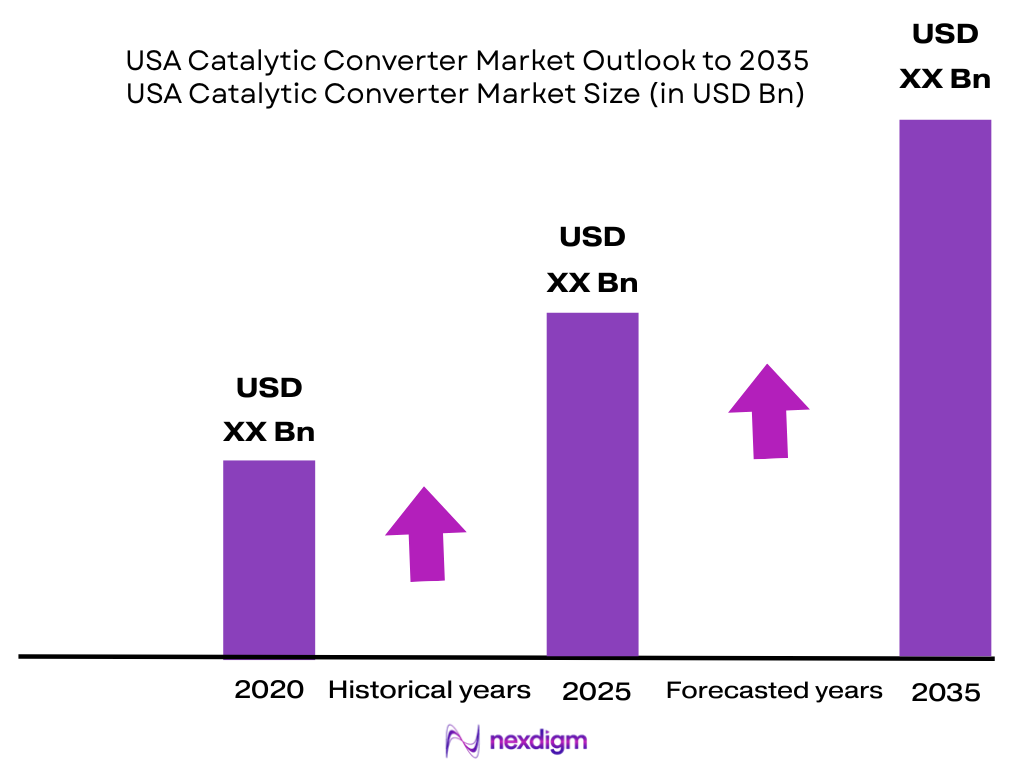
The USA Catalytic Converter Market is valued at USD ~ billion, supported by a very large gasoline, hybrid, diesel, SUV, pickup, and commercial-vehicle population requiring emissions aftertreatment. U.S. vehicle demand remained substantial across the two latest comparable annual periods, while hybrids continued expanding within the registered fleet. EPA’s tightening light- and medium-duty emissions framework further sustains the technological requirement for high-efficiency catalysts on combustion-powered vehicles even as battery-electric penetration increases. California, Texas, Florida, New York, Pennsylvania, Ohio, and major automotive markets across the Midwest and Southeast dominate catalytic-converter demand because of their large vehicle populations, extensive repair networks, high pickup/SUV penetration, and significant aftermarket activity. California is particularly influential because CARB-approved aftermarket converters require vehicle-specific Executive Orders, creating a technically distinct replacement ecosystem, while New York, Colorado, and Maine also maintain CARB-oriented replacement requirements.
Market Segmentation
By Converter Type
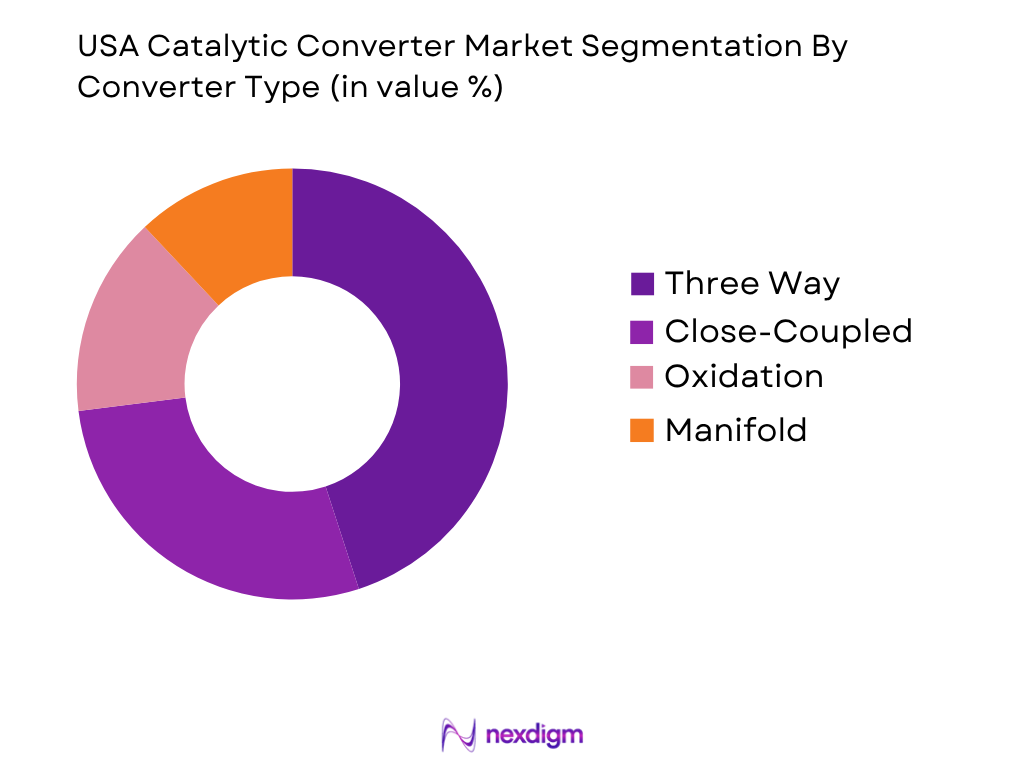
The USA Catalytic Converter Market is segmented into three-way catalytic converters, oxidation catalytic converters, close-coupled converters, manifold converters, underfloor converters, and multi-brick systems. Three-way catalytic converters dominate the market in the report model because gasoline-powered vehicles continue to form the core combustion-engine parc and require simultaneous control of carbon monoxide, hydrocarbons, and nitrogen oxides. Three-way catalysts typically use combinations of palladium, rhodium, and platinum-group-metal chemistry alongside oxygen-storage washcoats. Their relevance extends into gasoline hybrid vehicles, which retain an internal-combustion engine and therefore continue to require catalytic aftertreatment. USGS identifies palladium, platinum, and rhodium as key automotive catalyst materials, while palladium remains especially important for gasoline-engine catalytic converters. EPA’s current vehicle-emission standards also maintain pressure for effective cold-start and lifetime emissions control, supporting sophisticated close-coupled three-way catalyst systems.
By Sales Channel
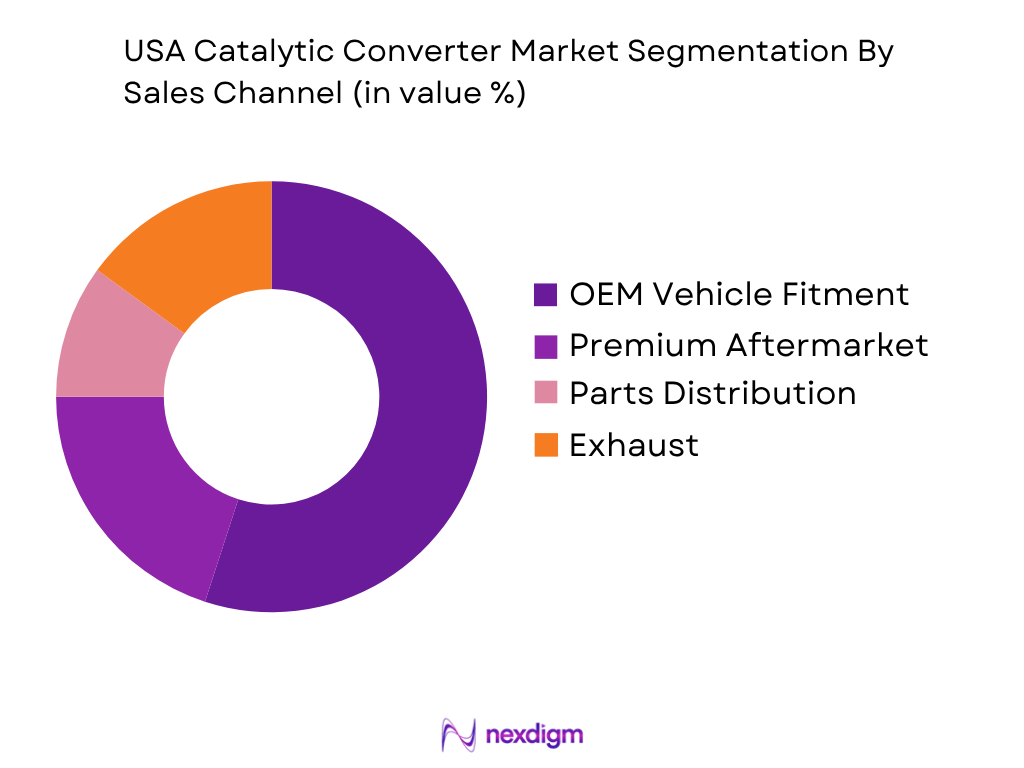
The USA Catalytic Converter Market is segmented into OEM vehicle fitment, OEM dealership replacement, OES aftermarket, independent parts distribution, national auto-parts retail, exhaust specialists, repair shops, and online automotive channels. OEM and original-equipment-linked fitment remains the dominant value segment because converters are emission-certified as part of complete vehicle powertrains and require highly application-specific catalyst chemistry, loading, thermal durability, and OBD calibration. However, the aftermarket represents a critical secondary demand pool because the U.S. operates an ageing vehicle fleet and federal law requires failed converters to be replaced with compliant products rather than simply removed. CARB markets add further complexity by requiring approved converter applications and Executive Order coverage. Direct-fit aftermarket products therefore command strategic importance because they reduce installer fabrication while ensuring application matching and emissions compliance.
Competitive Landscape
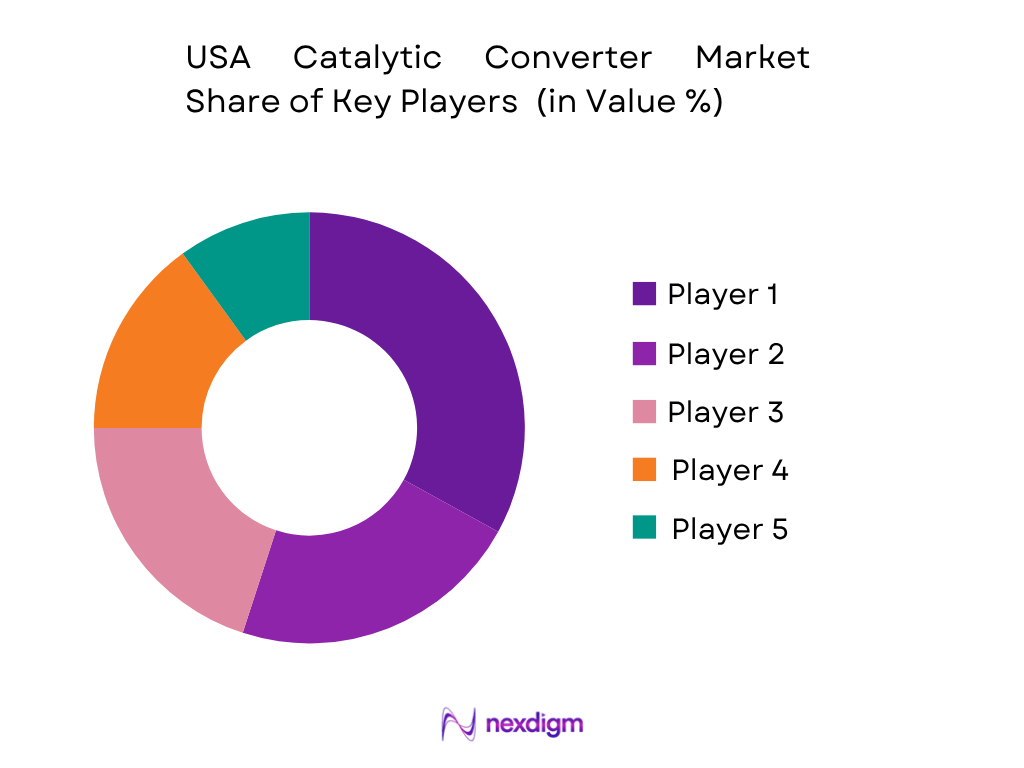
The USA Catalytic Converter Market is concentrated among major exhaust-system suppliers, catalyst-chemistry companies, substrate manufacturers, and aftermarket converter specialists. Walker/Tenneco, MagnaFlow, AP Emissions Technologies, BASF Environmental Catalyst and Metal Solutions, and FORVIA Clean Mobility represent different parts of the value chain, ranging from complete direct-fit replacement assemblies to catalyst formulations and OEM emissions systems. Competitive differentiation increasingly depends on EPA/CARB application coverage, precious-metal optimization, OBD compatibility, substrate engineering, national distribution, and recycling integration. CARB’s requirement for approved application-specific converters creates a particularly high regulatory barrier for aftermarket competitors.
| Major Player | Establishment | Headquarters | Core Converter Offering | EPA/CARB Coverage | Catalyst Technology | Manufacturing Capability | Aftermarket Reach | PGM / Recycling Positioning |
| Tenneco / Walker | 1888 / Walker heritage 1908 | Northville, Michigan | ~ | ~ | ~ | ~ | ~ | ~ |
| MagnaFlow | 1981 | Oceanside, California | ~ | ~ | ~ | ~ | ~ | ~ |
| AP Emissions Technologies | 1927 heritage | Goldsboro, North Carolina | ~ | ~ | ~ | ~ | ~ | ~ |
| BASF Environmental Catalyst and Metal Solutions | BASF origins 1865 | Iselin, New Jersey / global | ~ | ~ | ~ | ~ | ~ | ~ |
| FORVIA Clean Mobility | FORVIA formed 2022 | Nanterre, France | ~ | ~ | ~ | ~ | ~ | ~ |
USA Catalytic Converter Market Analysis
Growth Drivers
Large Gasoline and Hybrid Vehicle Parc Sustaining Converter Fitment and Replacement Demand
The large installed base of gasoline and hybrid light-duty vehicles is a core driver of the USA Catalytic Converter Market because these powertrains continue to require three-way catalytic converters, close-coupled catalysts, oxygen-storage washcoats, and platinum-group-metal formulations for exhaust treatment. U.S. Department of Energy registration data show that California alone had 30,935,500 gasoline vehicles, 2,655,000 hybrid electric vehicles, and 490,900 plug-in hybrids in 2025, while Florida had 15,883,100 gasoline vehicles and 1,037,000 hybrids. These figures illustrate the continuing scale of combustion-based vehicle operation even as electrification advances. Hybridization is particularly relevant because HEVs reduce fuel consumption without eliminating the internal-combustion engine; consequently, they retain catalyst systems and introduce demanding thermal-management conditions as engines cycle between running and stopped states. The catalyst must reach effective conversion temperature quickly after restart and remain capable of controlling hydrocarbons, carbon monoxide, and nitrogen oxides during transient operation. The Department of Energy’s Alternative Fuels Data Center identifies HEVs as the second-largest alternative-fuel vehicle population when flexible-fuel vehicles are excluded, reinforcing their importance as a bridge technology rather than a marginal niche. Vehicle ageing adds another layer of demand because catalytic converters can enter replacement cycles following thermal degradation, contamination, substrate damage, or catalyst-efficiency faults. The U.S. Bureau of Transportation Statistics continues to track a historically old light-vehicle fleet, with its latest dataset covering vehicle-age observations through 2025. Older gasoline vehicles increase exposure to P0420/P0430 catalyst-efficiency events, oil consumption, misfire damage, and exhaust-system corrosion, supporting direct-fit and universal aftermarket converters. Federal law also prevents owners or repairers from simply removing functioning or failed catalysts without approved replacement; EPA reiterated in 2026 that removing a catalytic converter without replacing it with an approved unit constitutes illegal tampering. This regulatory requirement converts a portion of ageing-vehicle repair into mandatory compliant product demand. The broader macroeconomic base supports the scale of vehicle ownership and aftermarket spending. World Bank data place U.S. GDP at USD 30.77 trillion in 2025, GDP per capita at USD 90,026.5, and population at 341,784,857, while inflation stood at 2.9 in 2024. These conditions sustain one of the world’s largest automotive service ecosystems, spanning dealerships, national parts retailers, independent shops, exhaust specialists, fleet maintenance providers, and recyclers. For catalytic-converter suppliers, the growth mechanism is therefore not dependent exclusively on new ICE vehicle production. A large existing gasoline parc, expanding hybrid population, ageing vehicles, and legally enforced emissions-system retention together create ongoing OEM, OES, and aftermarket demand. Suppliers with broad make-model-engine coverage, accurate OBD-compatible application mapping, and strong distribution into high-vehicle-population states are best positioned to convert this installed base into recurring replacement revenue.
Tightening Federal and State Emissions Compliance Driving Higher-Performance Catalyst Systems
Federal and state emissions requirements remain a significant technology and demand driver for catalytic converters because combustion-powered vehicles must meet increasingly rigorous pollutant-control requirements throughout regulated durability periods. EPA announced its Multi-Pollutant Emissions Standards for model-year 2027 and later light- and medium-duty vehicles on March 20, 2024, with the requirements scheduled to phase in across model years 2027 through 2032. The agency states that the rule strengthens standards for harmful air pollutants from light- and medium-duty vehicles and builds on the federal standards applicable through model year 2026. For catalytic-converter manufacturers and catalyst formulators, this raises the importance of low light-off temperature, improved oxygen-storage capability, high thermal durability, optimized washcoat architecture, and efficient platinum-group-metal dispersion. Cold-start emissions are particularly important because the catalyst is least effective immediately after engine start; therefore, OEMs increasingly position catalysts closer to the engine, reduce substrate thermal mass, and calibrate combustion to heat the converter quickly. These requirements can increase technical content per combustion vehicle even if total ICE volumes become more constrained. State regulation adds another important demand layer. California requires aftermarket catalytic converters to be exempted from anti-tampering laws before legal sale or installation, and CARB grants an Executive Order only after a converter demonstrates durability and vehicle-emissions compliance for specified applications. Approved units must therefore be matched to designated vehicle groups rather than treated as generic replacement hardware. Certain Executive Orders also specify a 5-year or 50,000-mile warranty, illustrating the durability threshold imposed on approved aftermarket products. This state-level compliance architecture creates barriers to entry but also supports higher-value replacement products because manufacturers must invest in testing, documentation, precious-metal loading, and application databases. The market significance is amplified by California’s large vehicle parc: DOE data show 30,935,500 gasoline vehicles and 2,655,000 HEVs in the state in 2025, providing an exceptionally large pool of combustion vehicles subject to California emissions rules and replacement requirements. The U.S. economic context further supports investment in advanced emissions technology. The IMF’s 2024 Article IV assessment projected U.S. real GDP growth of 2.6 in 2024, with unemployment averaging 4.2 in the fourth quarter, while World Bank data later recorded GDP of USD 30.77 trillion in 2025. The catalytic-converter market consequently benefits from a combination of regulatory stringency and purchasing scale. OEM suppliers must develop systems capable of meeting progressively demanding certification requirements, while aftermarket companies must maintain EPA-compliant and CARB-approved portfolios across thousands of vehicle applications. This dynamic encourages investment in catalyst chemistry, substrate design, thermal management, and digital vehicle matching. The driver is therefore not simply more converters, but increasingly sophisticated converters with tighter application specificity and compliance documentation.
Market Challenges
Battery-Electric Vehicle Expansion Eliminating Catalytic Converter Content
Battery-electric vehicle adoption represents the most important structural challenge for the USA Catalytic Converter Market because BEVs contain no internal-combustion exhaust system and therefore require no catalytic converter, oxygen-storage washcoat, precious-metal catalyst loading, or exhaust aftertreatment hardware. DOE’s Alternative Fuels Data Center shows that California had 1,843,100 registered electric light-duty vehicles in 2025, while Florida had 450,400, Arizona 141,800, Colorado 162,800, and Georgia 161,200. Every BEV that displaces a gasoline vehicle removes not only the original-equipment catalytic converter but also the future replacement, diagnostic, theft-replacement, and end-of-life converter-recycling opportunities associated with that vehicle. The substitution effect therefore compounds over the vehicle lifecycle. U.S. Geological Survey analysis published in 2025 explicitly identifies EV adoption as a risk to palladium demand because electric vehicles do not use catalytic converters, and palladium is predominantly consumed in automobile and truck catalysts, particularly gasoline applications. This is particularly consequential for catalyst suppliers because the automotive industry has historically been the principal consumer of platinum-group metals; USGS notes that palladium, platinum, and rhodium are widely used in automotive catalytic converters. As a result, electrification affects not only converter manufacturers but also catalyst coaters, PGM refiners, substrate suppliers, recyclers, and automotive exhaust-system producers. The challenge is uneven rather than immediate because the U.S. still operates tens of millions of gasoline vehicles. California, despite leading EV adoption, had more than 30.9 million gasoline vehicles and 2.65 million hybrids in 2025, demonstrating that catalytic converters will remain relevant for a substantial transition period. However, supplier investment decisions must account for the declining lifetime value of new conventional ICE platforms. A converter program launched today can generate replacement demand for many years, whereas an equivalent BEV platform creates no aftertreatment revenue. The macroeconomic environment gives consumers and fleet operators the financial capacity to adopt newer technologies: World Bank data show U.S. GDP of USD 30.77 trillion, GDP per capita of USD 90,026.5, and population of 341,784,857 in 2025. EPA’s 2024 multipollutant standards also accelerate the broader transition toward cleaner powertrains even while maintaining stringent requirements for combustion vehicles that remain in production. For catalytic-converter companies, the structural response requires shifting from a volume-only strategy toward hybrid applications, high-mileage aftermarket replacement, CARB-compliant products, commercial vehicles, and PGM recycling. Capacity investment in conventional gasoline converters must be balanced against the possibility of lower new-vehicle fitment volumes, while SKU portfolios need to prioritize applications with long remaining service lives. Manufacturers with heavy exposure to OEM conventional ICE programs face greater long-term risk than diversified companies participating in hybrids, aftermarket service, catalyst recycling, and broader emissions-control technologies. Electrification therefore does not eliminate near-term catalytic-converter demand, but it places a clear ceiling on long-run new-fitment growth and changes where industry participants must seek value.
Platinum-Group-Metal Supply Exposure and Growing Compliance Complexity
Catalytic-converter manufacturers face a second major challenge from their dependence on platinum, palladium, and rhodium combined with increasingly complex federal and state application requirements. USGS identifies these three platinum-group metals as key catalytic materials used to treat automobile exhaust, with the automotive industry remaining their principal consumer. The problem is strategic because PGM availability is concentrated in a limited number of global mining and refining regions, making catalyst manufacturers exposed to geopolitical disruptions, mine closures, refining constraints, and shifts in demand from other industrial sectors. The United States reinforced the strategic significance of these materials in 2025, when USGS included palladium and platinum on the final critical-minerals list; palladium was specifically identified for use in catalytic converters, electronics, and chemical catalysts. Manufacturers therefore need to manage catalyst formulations carefully, using precious-metal thrifting, substitution between platinum and palladium where technically possible, improved dispersion, and recycled material to reduce dependence on primary supply. Rhodium is particularly difficult to replace in three-way catalysts because of its effectiveness in reducing nitrogen oxides, while palladium remains highly relevant to gasoline catalyst formulations. Regulatory complexity compounds the raw-material challenge. EPA prohibits removal of catalytic converters without approved replacement, while California requires aftermarket converters to obtain an Executive Order before legal sale or installation. CARB approvals are vehicle-specific and depend on durability and emissions performance, requiring manufacturers to maintain detailed engine-family, test-group, and product-application databases. An incorrectly matched converter can cause emissions noncompliance, diagnostic trouble codes, warranty disputes, and reputational damage. The market is particularly demanding because the registered fleet contains an enormous diversity of models, engines, and powertrains. DOE data for 2025 show 30,935,500 gasoline vehicles in California, 15,883,100 in Florida, 8,192,100 in Georgia, and 5,414,000 in Arizona, alongside growing HEV and PHEV fleets. Each engine configuration can require a different converter architecture, precious-metal loading, shell geometry, flange position, oxygen-sensor placement, and OBD-II performance characteristic. Managing this breadth forces aftermarket manufacturers to carry thousands of SKUs or develop highly accurate universal-product strategies. The U.S. macroeconomic base makes the market commercially attractive but does not reduce the technical burden. World Bank data place GDP at USD 30.77 trillion in 2025, while the IMF’s 2024 Article IV projected real growth of 2.6 and a fourth-quarter unemployment rate of 4.2. For smaller converter manufacturers, the capital and technical resources required for catalyst development, durability testing, CARB certification, application mapping, and PGM inventory can therefore become substantial barriers to entry. Larger suppliers with integrated catalyst chemistry, engineering teams, national distribution, and recycling relationships are better positioned to absorb these costs. The result is a market where raw-material security and regulatory competence become as important as manufacturing efficiency.
Market Opportunities
Hybrid Vehicle Expansion Creating a Long-Duration Bridge Market for Advanced Catalysts
Hybrid-electric vehicles create one of the most important future opportunities for the USA Catalytic Converter Market because they provide electrification benefits while retaining an internal-combustion engine and therefore continue to require catalytic aftertreatment. DOE registration data show the size of the current hybrid base: California had 2,655,000 HEVs and 490,900 PHEVs in 2025, Florida had 1,037,000 HEVs and 88,400 PHEVs, Georgia had 382,800 HEVs and 32,900 PHEVs, and Arizona had 312,900 HEVs and 33,900 PHEVs. These existing numbers provide a current, measurable foundation for future catalyst opportunity without relying on speculative future hybrid sales. The technical requirements can be more demanding than conventional gasoline applications because hybrid engines frequently shut down and restart. When the engine stops, exhaust temperature falls and catalyst temperature can decline below its most effective operating window. When combustion resumes, the aftertreatment system must quickly recover conversion efficiency, making low-light-off-temperature catalyst formulations, high oxygen-storage capacity, close-coupled packaging, and thermal-management strategies particularly valuable. Hybrid vehicles can therefore support greater catalyst sophistication even if engine operating hours are reduced. EPA’s multi-pollutant rule announced in March 2024 strengthens emissions requirements for model-year 2027 and later light- and medium-duty vehicles and phases them in through 2032, reinforcing the need for high-performing emissions systems on combustion-containing platforms. For catalyst suppliers, this opens opportunities in optimized three-way catalysts, reduced thermal-mass substrates, improved washcoat chemistry, and precious-metal formulations designed for repeated cold and warm restart conditions. The opportunity is also strategically attractive because hybrid vehicles prolong catalytic-converter relevance during the transition toward fully electric transport. DOE’s national alternative-fuel data identify HEVs as a major registered alternative-powertrain category, while 2025 state registrations demonstrate significant absolute populations across large vehicle markets. These vehicles will eventually enter aftermarket replacement cycles, creating a second revenue stream beyond OEM fitment. Their often complex exhaust systems and strict OBD-II calibration can also favor direct-fit, high-quality replacement products rather than low-specification universal converters. The macroeconomic environment supports continued adoption of advanced vehicles: World Bank data show U.S. GDP of USD 30.77 trillion in 2025, GDP per capita of USD 90,026.5, and population of 341,784,857. For converter manufacturers, the optimal strategy is therefore to treat hybrids as a distinct aftertreatment segment rather than simply grouping them with conventional gasoline cars. Application databases should identify hybrid-specific converter assemblies, thermal performance should be validated for engine-cycling duty, and catalyst formulations should prioritize rapid light-off and durability. Companies that build strong OEM and aftermarket coverage for Toyota, Honda, Ford, Hyundai, Kia, Lexus, and other hybrid-heavy platforms can extend their participation in combustion aftertreatment even as BEVs expand. Hybridization creates a transitional but potentially long-lived demand pool in which converter sophistication can increase even as engine dependence decreases.
High-Mileage Aftermarket, CARB-Compliant Replacement and PGM Recycling Expansion
The combination of an ageing vehicle fleet, strict replacement regulations, and strategic PGM recovery creates a strong future opportunity for the U.S. catalytic-converter aftermarket. The Bureau of Transportation Statistics’ current vehicle-age dataset extends through 2025 and confirms that U.S. light vehicles remain historically old, supporting a large population of cars and trucks entering high-mileage maintenance cycles. As vehicles age, catalytic converters can deteriorate through thermal cycling, engine misfires, oil or coolant contamination, physical substrate damage, or long-term loss of catalyst activity. When the converter no longer meets emissions requirements, EPA rules prevent owners or repairers from simply deleting the component; EPA reiterated in 2026 that removal without an approved replacement is illegal tampering. This provides a regulatory floor for compliant replacement demand. California creates an additional high-value opportunity because aftermarket converters must receive CARB Executive Orders after demonstrating durability and emissions performance for approved vehicles. California’s vehicle base is enormous, including 30,935,500 gasoline vehicles, 2,655,000 HEVs, and 490,900 PHEVs in 2025, meaning even a relatively small annual failure or replacement rate translates into a substantial addressable pool. The opportunity extends beyond California as CARB-oriented replacement requirements influence additional states and encourage aftermarket manufacturers to maintain separate federal and CARB product families. Direct-fit converters are particularly attractive because they reduce shop fabrication, preserve oxygen-sensor location, simplify installation, and improve the probability of correct OBD-II performance. Digital vehicle identification can further improve conversion rates by matching VIN, engine family, emission certification, and converter Executive Order before the repair begins. Recycling is the second major opportunity attached to this aftermarket cycle. USGS identifies palladium, platinum, and rhodium as core catalytic-converter materials and recognizes their strategic importance; palladium and platinum were included on the 2025 U.S. critical-minerals list. Every failed converter therefore represents not only scrap but a potential source of secondary PGM supply. Closed-loop recycling can reduce dependence on mined material, provide catalyst manufacturers with more resilient sourcing, and recover metals from the existing U.S. vehicle parc. This becomes increasingly important as BEV adoption eventually reduces the flow of new catalyst-equipped vehicles: extracting more value from the installed ICE and hybrid fleet can help sustain industry economics during the transition. The reduction in theft also improves the quality of this opportunity. Theft-related demand had distorted the aftermarket, but claims declined sharply during 2024, allowing replacement activity to become more closely linked to genuine vehicle failure and legal service needs rather than criminal loss. The broader economic base remains supportive, with World Bank data showing U.S. GDP at USD 30.77 trillion in 2025 and GDP per capita at USD 90,026.5. For manufacturers, recyclers, distributors, and repair networks, the strongest opportunity is therefore an integrated lifecycle model: sell compliant direct-fit converters, recover spent units through controlled channels, assay and refine the PGM content, and return recycled platinum-group metals into new catalyst production. This strategy combines regulatory replacement demand, an ageing fleet, resource security, and circular-economy economics into a defensible long-term position.
Future Outlook
The USA Catalytic Converter Market is forecast to grow at ~ CAGR during 2026–2035 under the placeholder scenario. Future development will be shaped by opposing forces: tighter combustion-engine emissions requirements and an ageing ICE/hybrid parc support converter technology and replacement demand, while battery-electric vehicles remove catalytic converters entirely from the propulsion system. A major near- and medium-term opportunity lies in hybrid vehicles. Hybrid electric vehicles retain gasoline engines and catalytic converters while operating under frequent start-stop cycles that can make catalyst thermal management more challenging. U.S. Department of Energy registration data show HEVs remain one of the largest alternative-powertrain vehicle populations, creating an increasingly important bridge between conventional gasoline vehicles and full BEVs. Regulation will remain another technology driver. EPA finalized new multi-pollutant standards for light- and medium-duty vehicles in March 2024, covering model years 2027 and later. These standards support greater electrification but also require combustion-powered vehicles remaining in OEM portfolios to deliver stringent lifecycle emissions performance. This favors low-light-off-temperature catalysts, close-coupled architecture, advanced oxygen-storage materials, and optimized PGM loading.
Major Players
- Tenneco / Walker Emissions Control
- MagnaFlow
- AP Emissions Technologies / Eastern Catalytic
- Davico Manufacturing
- Bosal
- Eberspächer
- FORVIA Clean Mobility
- BASF Environmental Catalyst and Metal Solutions
- Umicore
- Johnson Matthey
- Cummins Emission Solutions
- Katcon
- Futaba Industrial
- Corning Incorporated
- DCL International
Key Target Audience
- Catalytic Converter and Exhaust Aftertreatment Manufacturers
- Automotive OEMs and Tier-1 Exhaust-System Suppliers
- Automotive Parts Distributors and National Retail Chains
- Independent Repair Shops and Exhaust Specialists
- Platinum-Group-Metal Refiners and Converter Recyclers
- Investments and Venture Capitalist Firms
- Fleet Operators and Automotive Service Networks
- Government and Regulatory Bodies (U.S. Environmental Protection Agency, California Air Resources Board, National Highway Traffic Safety Administration, State Emissions and Inspection Agencies)
Research Methodology
Step 1: Identification of Key Variables
The initial phase maps automotive OEMs, catalyst producers, converter manufacturers, substrate suppliers, precious-metal companies, distributors, repair shops, recyclers, and regulators. Key variables include vehicle parc, powertrain type, converter count per vehicle, vehicle age, PGM loading, EPA/CARB compliance, replacement incidence, theft replacement, recycling flows, and BEV substitution. Desk research uses EPA and CARB regulatory databases, U.S. Department of Transportation vehicle statistics, USGS PGM information, company product catalogues, and OEM emission-system specifications. Vehicle make-model-engine mapping is used to distinguish converter configurations and compliance categories.
Step 2: Market Analysis and Construction
The top-down model begins with the U.S. ICE and hybrid vehicle parc, annual vehicle production, replacement-eligible vehicles, and average converters per vehicle. Federal and CARB-regulated markets are modeled separately because converter specification, application coverage, and compliance requirements differ materially. The bottom-up model assesses direct-fit and universal converter SKUs, substrate types, catalyst loading, channel volumes, OEM fitment, and replacement activity. Converter values are reconciled with recycling flows to avoid counting recovered spent converters as new product demand.
Step 3: Hypothesis Validation and Expert Consultation
Market assumptions are validated through CATIs and structured interviews with converter manufacturers, catalyst companies, repair shops, exhaust specialists, distributors, recyclers, and vehicle-service professionals. Interviews assess replacement frequency, product choice, CARB application requirements, PGM exposure, diagnostic failure modes, and direct-fit versus universal demand. Specific validation is conducted around P0420/P0430 catalyst-efficiency repairs, hybrid catalyst requirements, converter theft, OBD-II compatibility, and state-specific compliance. Conflicting market signals are triangulated before inclusion.
Step 4: Research Synthesis and Final Output
The final stage reconciles OEM fitment, aftermarket replacement, vehicle-parc analysis, PGM content, and recycling data to construct the USA Catalytic Converter Market model. Demand is segmented by converter type, vehicle type, powertrain, compliance regime, fitment, substrate, catalyst chemistry, sales channel, and geography. Forecast scenarios incorporate ICE vehicle retention, hybrid expansion, BEV penetration, average vehicle age, CARB adoption, PGM substitution, recycling penetration, and aftermarket replacement. Base-case, accelerated-BEV, hybrid-led, and high-age aftermarket scenarios are evaluated.

- Executive Summary
- Research Methodology (Market Definitions and Assumptions, Catalytic Converter Market Boundary, Abbreviations, Vehicle-Parc Mapping, Powertrain Mapping, Converter-per-Vehicle Analysis, Federal/CARB Application Mapping, OEM Production Assessment, Replacement Cycle Analysis, Aftermarket SKU Mapping, PGM Loading Assessment, Market Sizing Approach, Top-Down Analysis, Bottom-Up Analysis, Demand-Side Assessment, Supply-Side Assessment, Manufacturer and Distributor Interviews, Repair-Shop Interviews, Recycling Ecosystem Assessment, Data Triangulation, Forecasting Framework, Scenario Analysis, Limitations and Future Conclusions)

- Definition and Scope
- Evolution of Automotive Catalytic Emission Control in the USA
- Transition from Oxidation Catalysts to Three-Way Catalysts
- Evolution of Close-Coupled and Underfloor Converter Architectures
- Catalytic Converter Role in Gasoline, Diesel and Hybrid Powertrains

- Growth Drivers (Large ICE and Hybrid Vehicle Parc, Vehicle Ageing, EPA Anti-Tampering Enforcement, CARB-Compliant Replacement Demand, OBD-II Catalyst Monitoring, Pickup/SUV Converter Content, Repair-Shop Replacement Demand, Hybrid Vehicle Aftertreatment)
- Market Challenges (Battery-Electric Vehicle Adoption, PGM Supply Volatility, Complex Vehicle-Specific Application Mapping, Converter Theft, Counterfeit and Non-Compliant Products, High Catalyst Technology Requirements, Federal-State Regulatory Fragmentation, Advanced OBD Calibration)
- Market Opportunities (CARB-Compliant Product Expansion, High-Mileage Vehicle Replacement, Hybrid Catalytic Converters, PGM Recycling, Theft-Protection Solutions, Direct-Fit Application Expansion, Low-PGM Catalyst Formulations, Digital VIN/EFN-Based Product Selection)
- Market Trends (PGM Thrifting, Platinum-Palladium Substitution, Close-Coupled Catalysts, Higher Cell-Density Substrates, Application-Specific Direct-Fit Converters, Digital Cataloguing, Recycled PGM Usage, Converter Traceability)
- SWOT Analysis
- Porter’s Five Forces Analysis
- PESTLE Analysis

- By Market Value (2020-2025)
- By Catalytic Converter Unit Volume (2020-2025)
- By OEM-Fitted Converter Volume (2020-2025)

- By Converter Type (In Value %)
Three-Way Catalytic Converters
Oxidation Catalytic Converters
Two-Way Catalytic Converters
Close-Coupled Catalytic Converters
Underfloor Catalytic Converters - By Vehicle Type (In Value %)
Passenger Cars
Sport Utility Vehicles
Crossovers
Light Pickup Trucks
Vans - By Powertrain Type (In Value %)
Conventional Gasoline Vehicles
Gasoline Hybrid Vehicles
Plug-in Hybrid Gasoline Vehicles
Diesel Vehicles
Alternative-Fuel Internal Combustion Vehicles - By Region (In Value %)
Northeast
Midwest
South
West
California-Specific CARB Market

- Market Share of Major Players by Value
- Cross Comparison Parameters (EPA and CARB-Compliant Application Coverage, Direct-Fit and Universal Converter Portfolio Breadth, Platinum-Palladium-Rhodium Catalyst Technology Capability, Substrate and Washcoat Engineering Capability, Vehicle-Specific OBD-II and Engine-Family Compatibility, U.S. Manufacturing and Canning Footprint, National Aftermarket Distribution and Repair-Shop Reach, PGM Recycling and Closed-Loop Material Capability)
- SWOT Analysis of Major Players
- Detailed Profiles of Major Companies
Tenneco / Walker Emissions Control
MagnaFlow
AP Emissions Technologies / Eastern Catalytic
Davico Manufacturing
Bosal
Eberspächer
FORVIA Clean Mobility
BASF Environmental Catalyst and Metal Solutions
Umicore
Johnson Matthey
Cummins Emission Solutions
Katcon
Futaba Industrial
Corning Incorporated
DCL International

- Automotive OEMs & Tier-1 Suppliers
- Independent Repair Shops
- Exhaust Specialists
- Fleet Operators
- Automotive Parts Distributors & Retailers
- Vehicle Owners / Aftermarket Consumers

- By Market Value (2026-2035)
- By Catalytic Converter Unit Volume (2026-2035)
- By OEM-Fitted Converter Volume (2026-2035)


 Request a Sample
 Ask for Customization
 Get a Quote
 Enquire Now