

 Download PDF
Market Overview
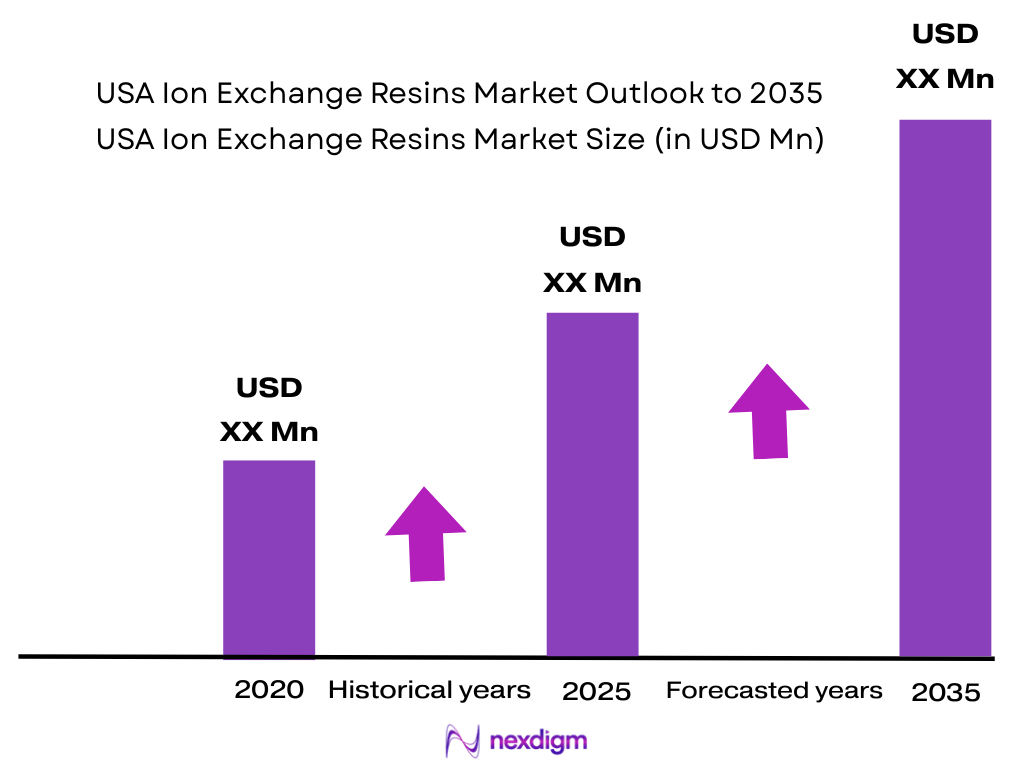
The USA Ion Exchange Resins Market generated USD 309.4 million in 2024, according to published market data, compared with approximately USD 293.5 million in 2023 based on the same historical series. Demand is supported by water treatment, power generation, pharmaceutical purification, chemical processing and semiconductor manufacturing. The market is particularly exposed to water-quality regulation and high-purity processing requirements, while PFAS regulation is creating an additional treatment application for selective ion-exchange media.
The USA Ion Exchange Resins Market is concentrated around California, Texas, Arizona, New York, New Mexico, Ohio, Pennsylvania and the Midwest industrial corridor, where semiconductor fabrication, pharmaceutical production, power generation and large-scale water infrastructure create recurring demand. Arizona is becoming especially important for semiconductor-grade ultrapure-water applications: TSMC committed more than USD 65 billion to three Phoenix fabs, while Intel announced investments exceeding USD 100 billion across Arizona, New Mexico, Ohio and Oregon. These facilities require extensive high-purity water treatment.
Market Segmentation
By Resin Type
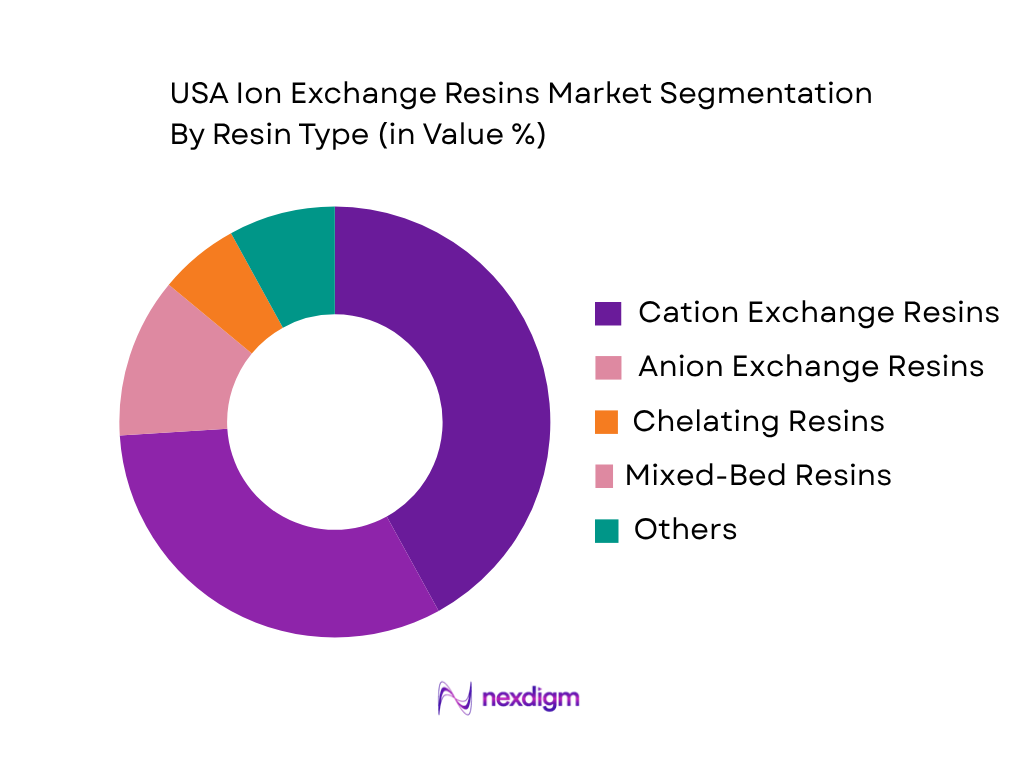
The USA Ion Exchange Resins Market is segmented into cation exchange resins, anion exchange resins, mixed-bed resins, chelating resins, amphoteric resins and specialty ion-exchange resins. Cation exchange resins represent the leading product category because they are extensively used for water softening, demineralization, deionization and industrial water purification. Their broad applicability across municipal and industrial water systems, power-generation facilities and chemical-processing operations provides a larger installed application base than more specialized resin chemistries. Cationic resins are also frequently paired with anionic resins in demineralization and mixed-bed systems, increasing their role across complete treatment trains. Demand is being reinforced by the United States’ large water-infrastructure requirements: EPA estimates USD 629.1 billion of 20-year national drinking-water infrastructure needs, including approximately 9.2 million lead service lines. PFAS regulation also increases demand for advanced treatment media, although PFAS applications favor selective resin formulations rather than conventional softening resins.
By Application
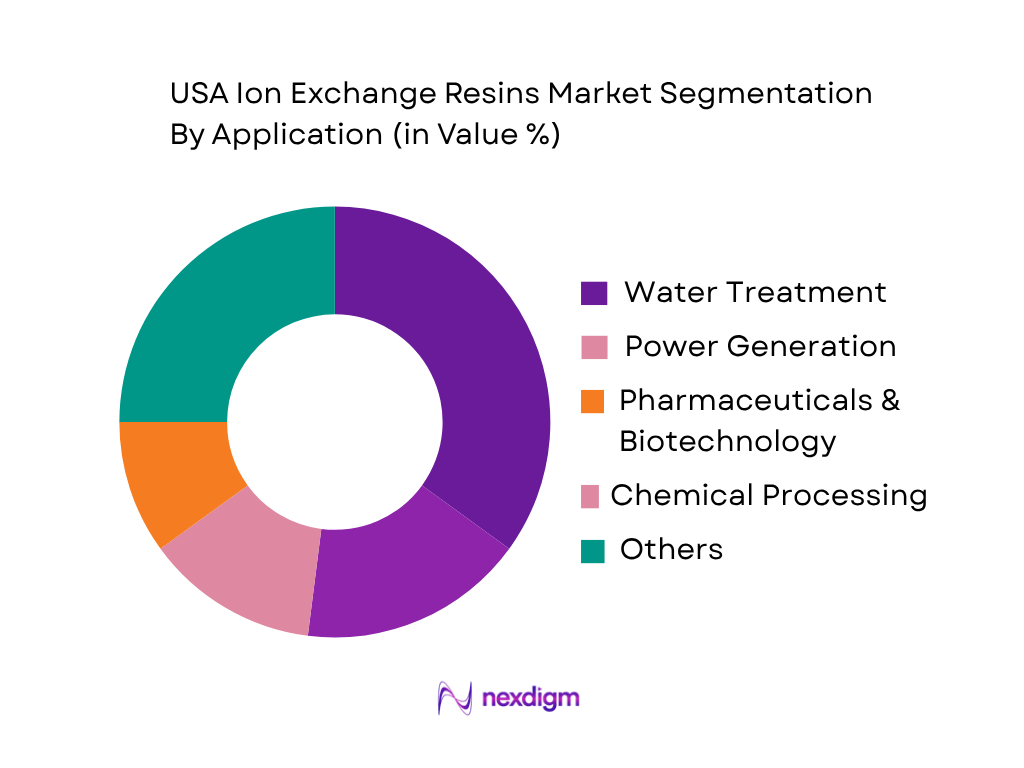
The USA Ion Exchange Resins Market is segmented by application into water treatment, power generation, pharmaceuticals and biotechnology, chemical processing, food and beverage, semiconductor and electronics manufacturing, mining and hydrometallurgy, nuclear power, oil and gas, and industrial wastewater treatment. Water treatment represents the leading application because ion exchange remains an established technology for softening, deionization, demineralization, contaminant removal and ultrapure-water production. Regulatory requirements are strengthening this application. EPA finalized the national PFAS drinking-water regulation in 2024, establishing enforceable limits of 4.0 parts per trillion for PFOA and PFOS and 10 parts per trillion for PFHxS, PFNA and HFPO-DA. EPA’s occurrence assessment identified approximately 1,900 public water systems serving more than 26 million people with at least one PFOA result exceeding the final MCL and approximately 1,600 systems serving nearly 24 million people with at least one PFOS result exceeding the final MCL. This creates a substantial technical-treatment requirement in which selective ion-exchange resins can compete with activated carbon and membrane technologies.
Competitive Landscape
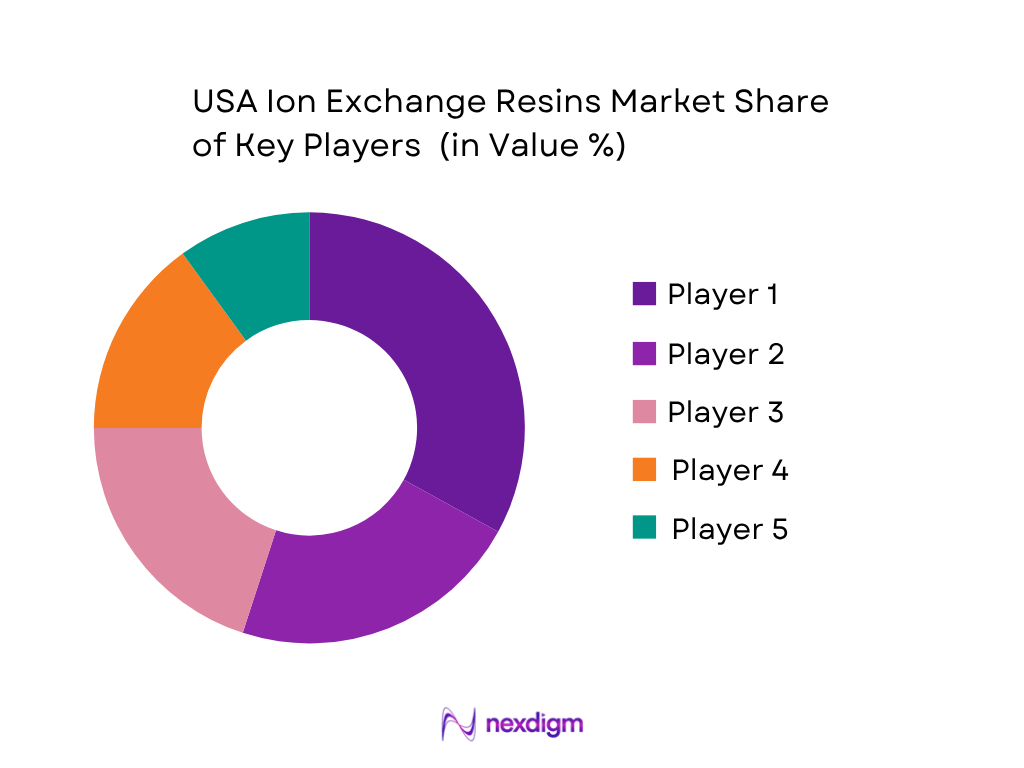
The USA Ion Exchange Resins Market is characterized by global resin manufacturers, specialized U.S. producers and integrated water-treatment companies competing through resin chemistry, exchange capacity, selectivity, manufacturing footprint, technical support and application-specific formulations. Competition is increasingly influenced by PFAS treatment, semiconductor ultrapure-water requirements and pharmaceutical purification. The semiconductor build-out is particularly relevant: the U.S. Department of Commerce announced USD 6.6 billion in CHIPS funding for TSMC Arizona and USD 7.865 billion for Intel, supporting new domestic fabrication capacity that requires highly controlled water-treatment systems.
| Company | Establishment | Headquarters | Resin Portfolio | PFAS Capability | Ultrapure-Water Capability | Regeneration Capability | Key Applications | U.S. Manufacturing / Service Footprint |
| DuPont Water Solutions | 1802 | Wilmington, Delaware | ~ | ~ | ~ | ~ | ~ | ~ |
| Purolite | 1981 | King of Prussia, Pennsylvania | ~ | ~ | ~ | ~ | ~ | ~ |
| LANXESS | 1863 | Cologne, Germany | ~ | ~ | ~ | ~ | ~ | ~ |
| Mitsubishi Chemical Group | 1933 | Tokyo, Japan | ~ | ~ | ~ | ~ | ~ | ~ |
| ResinTech | 1986 | Camden, New Jersey | ~ | ~ | ~ | ~ | ~ | ~ |
USA Ion Exchange Resins Market Analysis
Growth Drivers
Aging Municipal Water Infrastructure and Industrial Water Reuse
The USA Ion Exchange Resins Market is supported by substantial investment requirements across drinking-water and wastewater infrastructure, where ion exchange is used for softening, demineralization, nitrate removal, PFAS treatment and polishing. The U.S. Environmental Protection Agency estimated USD 629.1 billion in eligible drinking-water infrastructure needs over 20 years, including approximately 9.2 million lead service lines, while its clean-water infrastructure assessment identified at least USD 630 billion of wastewater, stormwater and related infrastructure needs over the same period. EPA also reported that more than 3,200 communities, tribes and territories received technical assistance for drinking-water, stormwater and wastewater challenges during fiscal 2024. Industrial water reuse adds another demand channel as manufacturers seek to reduce freshwater withdrawals and improve process-water recovery. Ion exchange is particularly relevant where dissolved ionic contaminants must be selectively removed after conventional filtration or membrane treatment. The technology is also being incorporated into PFAS treatment trains, with EPA identifying ion exchange alongside granular activated carbon and membranes as a best-available treatment technology for PFAS removal. These infrastructure requirements create a large installed base requiring treatment upgrades, replacement media and higher-performance resins. The combination of municipal rehabilitation, industrial water recycling, contaminant-specific treatment and aging treatment assets therefore provides sustained demand for cation, anion, mixed-bed and specialty ion-exchange resins.
Semiconductor Fab Expansion and Increasing Ultrapure-Water Demand
Expansion of domestic semiconductor manufacturing is creating a specialized demand environment for ion-exchange resins used in deionization, polishing and ultrapure-water systems. The U.S. Department of Commerce announced up to USD 6.6 billion in CHIPS funding for TSMC Arizona in 2024, supporting more than USD 65 billion of planned investment in 3 advanced fabs in Phoenix. Intel received up to USD 7.865 billion in CHIPS funding, supporting expected U.S. investment of nearly USD 90 billion and projects across 4 states: Arizona, New Mexico, Ohio and Oregon. Micron separately received up to USD 6.165 billion in direct funding to support its long-term manufacturing program involving approximately USD 100 billion of investment in New York and USD 25 billion in Idaho. Semiconductor fabrication requires extremely high-purity water for wafer cleaning, rinsing and process operations, with ion exchange used alongside membrane and electrodeionization technologies to control ionic contamination. The scale of announced fabrication projects therefore expands the addressable installed base for high-capacity cation and anion resins, mixed-bed polishing systems and specialty media designed for low-leachable, high-purity applications. Demand is particularly relevant in Arizona, New York, Idaho, New Mexico and Ohio, where new semiconductor facilities are being developed. The resulting manufacturing ecosystem also creates recurring requirements for resin replacement, regeneration services and treatment-system maintenance.
Market Challenges
Resin Fouling, Regeneration Chemical Consumption and Resin Replacement Requirements
Resin performance can deteriorate when ion-exchange media encounter organic matter, suspended solids, iron, manganese, oil, silica or other contaminants that occupy exchange sites or obstruct resin pores. This increases regeneration frequency and can shorten useful resin life, creating operational requirements for pretreatment, chemical regeneration and replacement media. The challenge is particularly significant in complex industrial water systems because feedwater composition can change with production cycles and operating conditions. EPA’s drinking-water infrastructure assessment identified USD 629.1 billion of 20-year needs, demonstrating the scale of treatment infrastructure requiring ongoing rehabilitation and modernization rather than one-time installation. EPA also reported 9.2 million lead service lines requiring replacement, illustrating the broader complexity of U.S. water-system assets. Regeneration itself requires chemicals such as hydrochloric acid, sulfuric acid, sodium hydroxide or sodium chloride depending on resin chemistry and treatment objective, while the resulting regenerant stream requires management before discharge. For high-purity applications, even relatively small ionic contamination can compromise treated-water quality, making resin selection, pretreatment and regeneration control critical. Semiconductor manufacturing intensifies these requirements because water systems must maintain extremely low concentrations of ionic contaminants and total dissolved solids. Pharmaceutical and biotechnology facilities similarly require consistent purified-water quality. Consequently, resin manufacturers must compete not only on exchange capacity but also on fouling resistance, osmotic stability, regeneration efficiency, particle uniformity and operating lifetime.
PFAS Treatment Complexity, Spent Resin Disposal and Competition from Membrane Technologies
PFAS remediation creates significant opportunities for ion exchange while simultaneously increasing technical and waste-management complexity. EPA finalized national drinking-water standards for 6 PFAS in April 2024, including enforceable limits of 4.0 ppt for PFOA and PFOS and 10 ppt for PFHxS, PFNA and HFPO-DA. Public water systems have 3 years to complete initial monitoring and 5 years to implement solutions when regulated PFAS exceed applicable limits. EPA expects the rule to prevent PFAS exposure for approximately 100 million people, demonstrating the scale of treatment requirements. Ion exchange competes with granular activated carbon and nanofiltration/reverse osmosis, which EPA also identifies among available PFAS treatment approaches. Selective resins can offer strong PFAS removal, but treatment performance depends on PFAS chain length, competing organic matter, sulfate and other ions in the water matrix. Once exhausted, PFAS-loaded resin requires regeneration, disposal or destruction, creating an additional waste-management consideration. Regeneration can transfer PFAS into a concentrated waste stream rather than eliminate the contaminant, while spent resin disposal must account for contamination levels and applicable state and federal requirements. Consequently, treatment operators increasingly evaluate total lifecycle performance rather than simple removal efficiency. Resin suppliers face pressure to improve selectivity, capacity, regeneration potential and disposal pathways while competing against membrane systems and activated carbon.
Market Opportunities
PFAS-Selective Resins and Advanced Contaminant Removal
The USA Ion Exchange Resins Market has a significant opportunity to develop highly selective media for PFAS and other emerging contaminants because federal drinking-water requirements are creating new treatment obligations. EPA’s final PFAS regulation covers 6 PFAS and establishes enforceable limits of 4.0 ppt for PFOA and PFOS and 10 ppt for PFHxS, PFNA and HFPO-DA. Public water systems have until 2027 to complete initial monitoring and until 2029 to implement solutions where regulated PFAS concentrations exceed the applicable limits. EPA expects the regulation to address exposure affecting approximately 100 million people over time and has made USD 1 billion available through the Infrastructure Investment and Jobs Act to support PFAS testing and treatment. EPA specifically identifies ion exchange, granular activated carbon and membranes as treatment technologies for PFAS removal. This creates an opportunity for manufacturers to differentiate through PFAS-selective functional groups, higher capacity, improved performance against competing ions and longer operating cycles. The opportunity extends beyond municipal drinking water into industrial wastewater, landfill leachate, chemical manufacturing and other contaminated streams. Specialty resins can also target nitrate, arsenic, chromium, uranium and other dissolved contaminants, expanding the application base beyond PFAS. The current regulatory environment therefore favors development of engineered resins rather than reliance solely on conventional softening and demineralization media. Manufacturers capable of demonstrating selective removal, regeneration performance and manageable spent-media treatment can address increasingly stringent water-quality requirements across U.S. treatment systems.
Semiconductor-Grade Ultrapure Water, Pharmaceutical Purification and Critical-Mineral Recovery
Advanced ion-exchange media have an opportunity to capture higher-specification applications where water purity and selective metal-ion separation are critical. The semiconductor expansion provides a strong current demand base: TSMC’s Arizona program involves more than USD 65 billion of investment across 3 fabs, while Intel’s U.S. expansion involves more than USD 100 billion across Arizona, New Mexico, Ohio and Oregon. Micron’s manufacturing program includes approximately USD 100 billion in New York and USD 25 billion in Idaho. These facilities require sophisticated ultrapure-water infrastructure, creating demand for high-capacity cation and anion resins, mixed-bed systems and polishing media. Pharmaceutical and biotechnology manufacturing provides another high-specification application because purified-water systems must consistently control ionic contamination and maintain validated water quality. Ion exchange can also support selective recovery and separation of lithium and other critical metals from aqueous streams, where chelating and specialty resins can be engineered around specific metal-ion affinities. The U.S. government’s focus on domestic critical-mineral supply chains further strengthens the strategic relevance of selective separation technologies. These applications allow resin suppliers to move toward engineered products characterized by high selectivity, controlled particle size, low extractables and application-specific chemical stability. Rather than competing solely in conventional municipal softening, manufacturers can target semiconductor fabs, pharmaceutical plants, battery-material processing and hydrometallurgical operations where specialized resin performance is more important than commodity-volume supply.
Future Outlook
The USA Ion Exchange Resins Market is expected to expand through the convergence of water-quality regulation, industrial water reuse, semiconductor fabrication and high-purity pharmaceutical manufacturing. PFAS treatment is becoming an increasingly important application following EPA’s national drinking-water regulation and associated monitoring requirements. Semiconductor manufacturing is another structural demand driver, with major investments in Arizona, Texas, New Mexico and Ohio requiring advanced ultrapure-water infrastructure. The market is expected to see greater adoption of selective resins, uniform-particle resins, high-capacity media and application-specific formulations.
Major Players
- DuPont Water Solutions
- Purolite
- LANXESS
- Mitsubishi Chemical Group
- ResinTech
- Ecolab
- SUEZ Water Technologies & Solutions
- Veolia Water Technologies
- Thermax
- Kuraray
- Samyang Corporation
- Evoqua Water Technologies
- Ovivo
- Ion Exchange (India)
- Jacobi Carbons
Key Target Audience
- Ion Exchange Resin Manufacturers and Specialty Resin Producers
- Municipal Water Utilities and Industrial Water Treatment Operators
- Semiconductor and Electronics Manufacturing Companies
- Pharmaceutical and Biotechnology Manufacturing Companies
- Power Generation and Nuclear Power Operators
- Chemical, Food & Beverage, Mining and Hydrometallurgical Companies
- Investments and Venture Capitalist Firms
- Government and Regulatory Bodies (U.S. Environmental Protection Agency, state environmental protection agencies, U.S. Department of Energy, U.S. Nuclear Regulatory Commission)
Research Methodology
Step 1: Identification of Key Variables
The initial stage constructs a U.S.-specific ion-exchange-resin ecosystem covering resin manufacturers, water-treatment operators, utilities, industrial users, distributors and regulatory bodies. Key variables include resin chemistry, exchange capacity, regeneration requirements, replacement frequency, application demand, PFAS treatment requirements and ultrapure-water specifications.
Step 2: Market Analysis and Construction
Historical market information is compiled by resin type, application, end-use industry and geographic demand center. The model incorporates government infrastructure and regulatory data, including EPA’s USD 629.1 billion estimate for 20-year drinking-water infrastructure needs and its PFAS treatment requirements.
Step 3: Hypothesis Validation and Expert Consultation
Market hypotheses are validated through structured interviews with resin manufacturers, municipal water operators, power plants, semiconductor fabs, pharmaceutical manufacturers, chemical processors and water-treatment system integrators. Technical discussions focus on exchange capacity, resin selection, regeneration, fouling, replacement cycles and application-specific performance requirements.
Step 4: Research Synthesis and Final Output
The final market model triangulates resin consumption, production, imports, exports, replacement demand and application-level requirements. Regulatory developments, PFAS treatment requirements and semiconductor capacity expansion are incorporated to establish the forward demand framework. The final analysis separates conventional ion exchange from emerging selective-resin applications.

- Executive Summary
- Research Methodology (Market Definition and Scope, Ion Exchange Resin Classification, Functional Group Taxonomy, Resin Chemistry Framework, Market Sizing Methodology, Top-Down Analysis, Bottom-Up Analysis, Capacity and Production Assessment, Demand-Side Assessment, Supply-Side Assessment, Water-Treatment Flow Analysis, Industrial-Application Mapping, Primary Industry Interviews, Trade-Flow Validation, Data Triangulation, Forecasting Framework, Sensitivity Analysis, Assumptions and Limitations)

- Definition and Scope
- Ion Exchange Resin Technology Evolution and Industry Development
- Ion Exchange Resin Value Chain Analysis
- Ion Exchange Resin Manufacturing Process Flow
- Ion Exchange Resin Supply Chain Analysis

- Growth Drivers (Aging Municipal Water Infrastructure, Industrial Water Reuse, Semiconductor Fab Expansion, Pharmaceutical Manufacturing Growth, Power-Generation Water Treatment, PFAS Remediation Requirements, Increasing Ultrapure-Water Demand)
- Market Challenges (Resin Fouling, Regeneration Chemical Consumption, Resin Replacement Requirements, Raw-Material Volatility, PFAS Treatment Complexity, Disposal of Spent Resin, Competition from Membrane Technologies)
- Market Opportunities (PFAS-Selective Resins, Semiconductor-Grade Ultrapure Water, Pharmaceutical-Grade Purification, Industrial Water Reuse, Nuclear Power Water Treatment, Lithium and Critical-Mineral Recovery, Specialty Chelating Resins)
- Market Trends (High-Capacity Resins, PFAS-Selective Ion Exchange, Uniform Particle Size Resins, Advanced Macroporous Resins, Single-Use Ion Exchange Systems, Digital Resin Monitoring, Hybrid Ion Exchange-Membrane Systems, Circular Resin Regeneration)
- Regulatory and Standards Landscape (U.S. EPA Drinking Water Regulations, PFAS Drinking Water Standards, Clean Water Act, Safe Drinking Water Act, NSF/ANSI Standards, FDA Requirements, USP Water Standards, State-Level Water Regulations)
- SWOT Analysis
- Porter’s Five Forces Analysis
- PESTLE Analysis

- By Market Value (2020-2025)
- By Resin Consumption Volume (2020-2025)
- By Domestic Production Volume (2020-2025)
- By Import Volume (2020-2025)
- By Export Volume (2020-2025)
- By Resin Replacement Volume (2020-2025)
- By Regeneration and Reuse Volume (2020-2025)
- By Average Realized Selling Price (2020-2025)

- By Resin Type (In Value %)
Cation Exchange Resins
Anion Exchange Resins
Mixed-Bed Ion Exchange Resins
Chelating Ion Exchange Resins
Amphoteric Ion Exchange Resins
Adsorbent and Specialty Ion Exchange Resins - By Application (In Value %)
Water Treatment
Power Generation
Pharmaceuticals and Biotechnology
Food and Beverage
Chemical Processing
Mining and Hydrometallurgy
Semiconductor and Electronics Manufacturing
Nuclear Power
Oil and Gas
Industrial Wastewater Treatment - By End-Use Industry (In Value %)
Municipal Water Utilities
Industrial Water Treatment
Electric Utilities
Semiconductor Manufacturing
Pharmaceutical Manufacturing
Biotechnology
Food and Beverage Processing - By Physical Form (In Value %)
Gel-Type Resins
Macroporous Resins
Powdered Ion Exchange Resins
Uniform Particle Size Resins
Specialty Porous Resins - By Functional Group (In Value %)
Sulfonic Acid Functional Groups
Carboxylic Acid Functional Groups
Quaternary Ammonium Functional Groups
Tertiary Amine Functional Groups
Chelating Functional Groups
Mixed Functional Groups - By Regeneration Method (In Value %)
Chemical Regeneration
Acid Regeneration
Caustic Regeneration
Salt Regeneration
Electrochemical Regeneration
Single-Use and Non-Regenerable Applications

- Market Share of Major Players (By Revenue, Volume, Resin Type, Application, End-Use Industry, Distribution Channel)
- Cross Comparison Parameters (Ion Exchange Resin Product Portfolio Breadth, Total Ion Exchange Capacity, Resin Selectivity Portfolio, PFAS-Selective Resin Capability, Ultrapure-Water Resin Capability, Manufacturing Capacity, Resin Regeneration Network, Application-Specific Technical Support Capability)
- Pricing and Contract Structure Analysis (Resin Type, Grade, Exchange Capacity, Purchase Volume, Regeneration Requirement, Contract Duration)
- SWOT Analysis of Major Players
- Detailed Profiles of Major Companies
DuPont Water Solutions
Purolite
LANXESS
Mitsubishi Chemical Group
ResinTech
Thermax
Ecolab
Jacobi Carbons
Samyang Corporation
Ion Exchange (India)
SUEZ Water Technologies & Solutions
Veolia Water Technologies
Evoqua Water Technologies
Ovivo
Kuraray

- Buyer Segmentation
- Procurement Behaviour
- Supplier Selection Criteria
- Buyer Pain Points
- Technology Adoption Criteria
- Replacement and Repurchase Behaviour

- By Market Value (2026-2035)
- By Resin Consumption Volume (2026-2035)
- By Domestic Production Volume (2026-2035)
- By Import Volume (2026-2035)
- By Export Volume (2026-2035)
- By Resin Replacement Volume (2026-2035)
- By Regeneration and Reuse Volume (2026-2035)
- By Average Realized Selling Price (2026-2035)


 Request a Sample
 Ask for Customization
 Get a Quote
 Enquire Now