

 Download PDF
Market Overview
The USA Light Gauge Steel Framing Market is valued at USD ~ billion, supported by residential, multifamily, commercial, healthcare, institutional, and industrial construction. U.S. construction put in place increased from USD 2,023.7 billion to USD 2,154.4 billion across the latest two annual observations, while privately owned housing starts moved from approximately 1.42 million units to 1.36 million units. Light gauge steel benefits particularly from commercial partitions, multifamily structures, curtain walls, and prefabricated assemblies. Texas, Florida, California, New York, Georgia, and major metropolitan markets including Dallas–Fort Worth, Houston, Atlanta, Phoenix, and New York constitute important LGS demand centers because of high construction volumes, multifamily development, commercial building activity, and dense contractor networks. Census data identify Dallas–Fort Worth and Houston among the country’s strongest metropolitan population-growth centers, while national construction expenditure increased from USD 2,023.7 billion to USD 2,154.4 billion across the latest two annual observations.
Market Segmentation
By Component Type
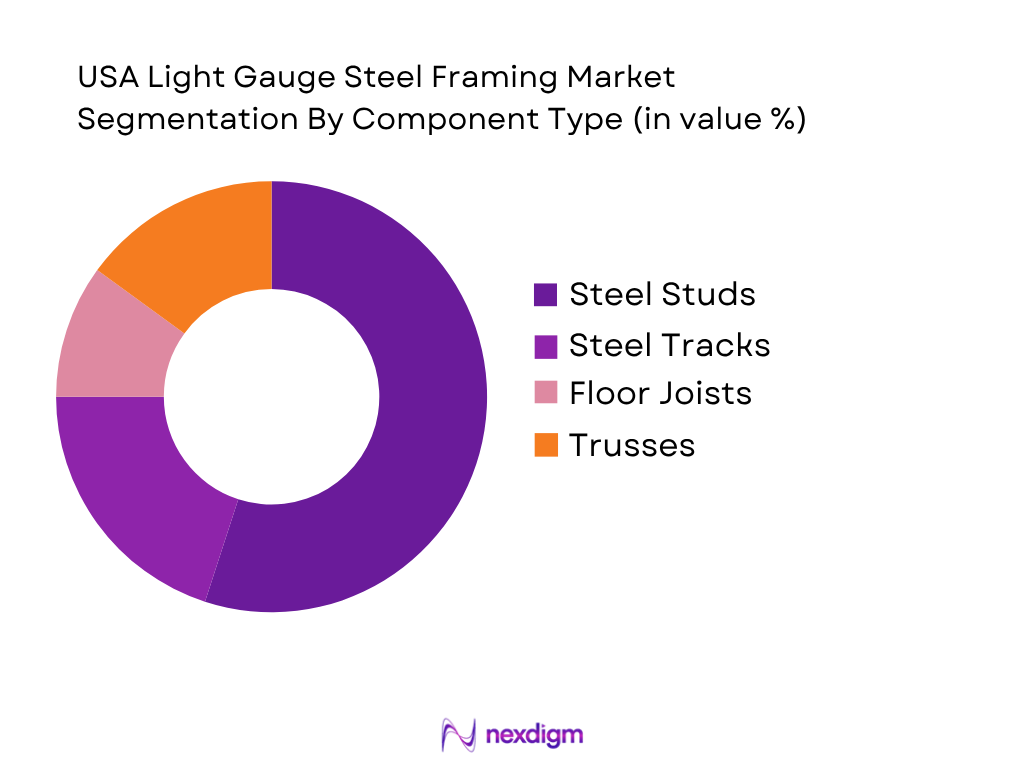
The USA Light Gauge Steel Framing Market is segmented into steel studs, steel tracks, floor joists, roof rafters and trusses, furring and resilient channels, and clips, connectors and ancillary components. Steel studs hold the dominant share in the report model because they are the principal vertical framing members used in non-load-bearing partitions, exterior curtain walls, shaft walls, and structural load-bearing assemblies. Their application extends across office buildings, hotels, hospitals, apartments, schools, retail developments, data centers, and industrial facilities. Studs are produced in numerous depths and thicknesses to accommodate different wall heights, axial loads, wind loads, and deflection requirements. SFIA identifies studs, joists, rafters, trusses, and accessories as the principal cold-formed steel framing elements, while AISI S240 addresses structural walls, floor and roof systems, trusses, and load-carrying applications.
By Application
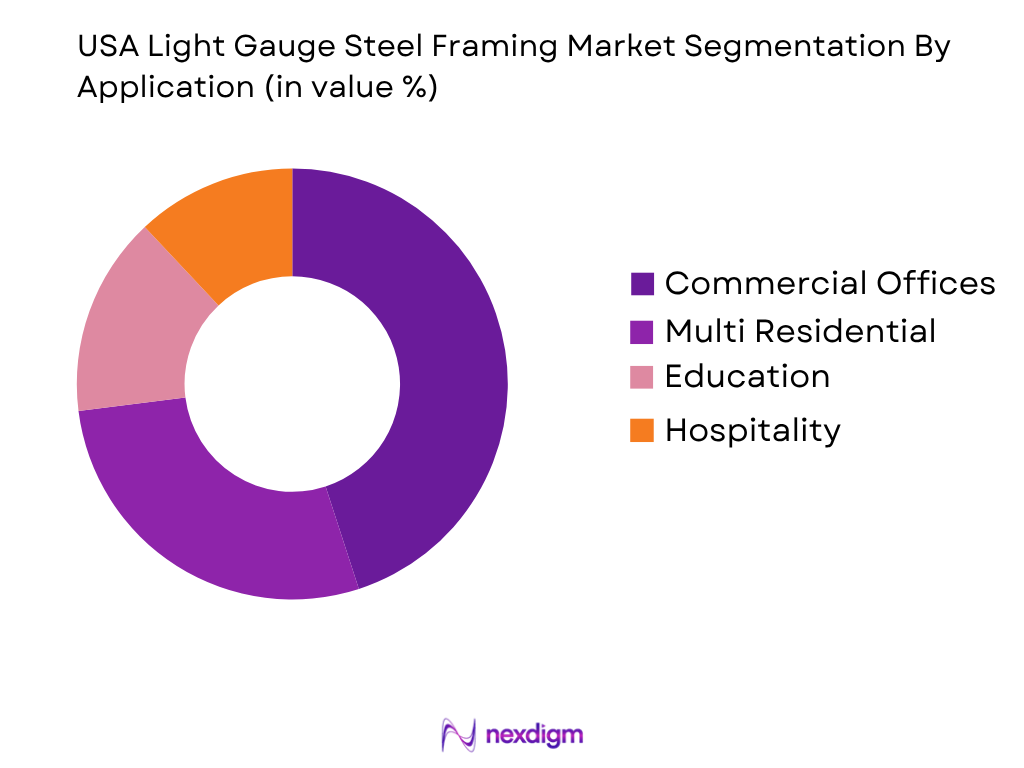
The USA Light Gauge Steel Framing Market is segmented into multifamily residential, commercial offices and mixed-use buildings, healthcare and education, hospitality and retail, industrial and warehousing, data centers, and other institutional buildings. Commercial and mixed-use construction holds a dominant position in the report model because cold-formed steel is extensively specified for interior drywall partitions, shaft-wall assemblies, exterior curtain-wall framing, ceilings, soffits, and tenant-improvement applications. Unlike structural residential framing, where steel competes directly with dimensional lumber, commercial construction has a deeply established metal-stud ecosystem supported by specialty drywall contractors, distributors, architects, and code-compliant manufacturers. The opportunity is reinforced by the scale of U.S. construction: Census Bureau data show total construction expenditure of USD 2,154.4 billion in the latest relevant annual observation. Structural LGS is also expanding in multifamily and prefabricated projects where schedule, dimensional accuracy, and non combustibility are priorities.
Competitive Landscape
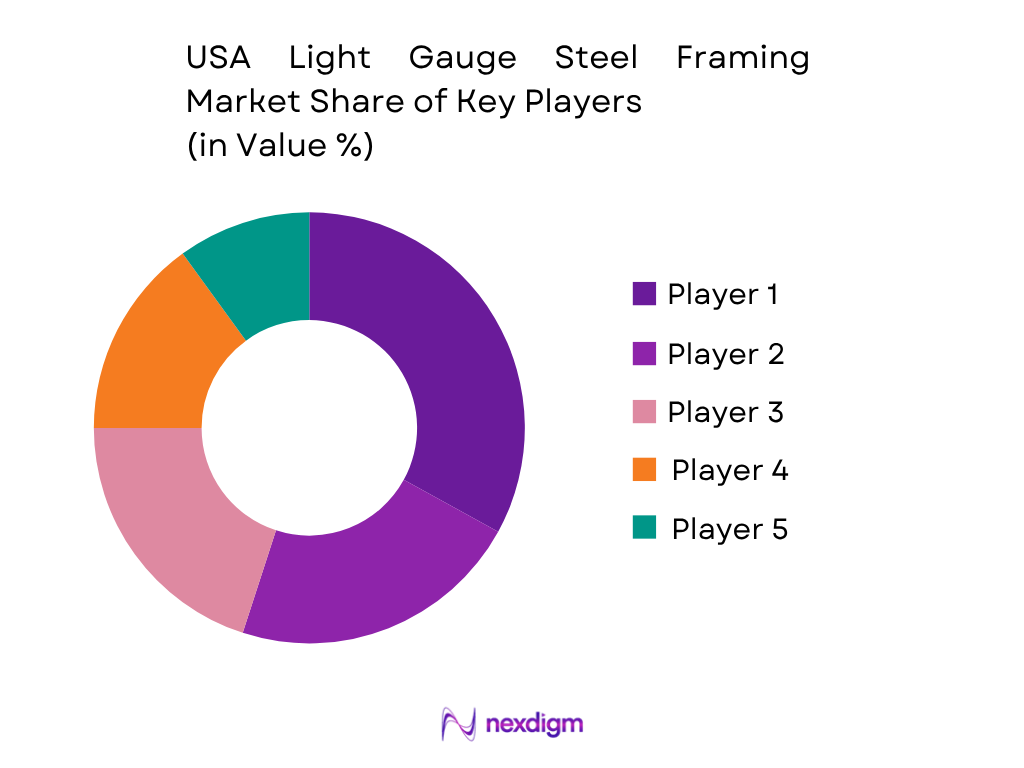
The USA Light Gauge Steel Framing Market is characterized by a combination of nationally distributed manufacturers and strong regional producers, with competition extending beyond commodity studs and tracks into structural engineering, custom roll forming, code compliance, prefabrication support, specialty framing systems, and project-specific technical assistance. ClarkDietrich, CEMCO, Marino\WARE, Telling Industries, and Super Stud represent important competitors with differentiated regional manufacturing footprints and structural/nonstructural offerings. SFIA certification and compliance with ASTM and AISI requirements are increasingly central to supplier qualification.
| Company | Establishment | Headquarters | Product Portfolio | Structural Framing Capability | Manufacturing Footprint | Engineering Support | Specialty / Prefab Capability | Certification / Compliance Position |
| Clark Dietrich Building Systems | 2011 as combined entity | West Chester, Ohio | ~ | ~ | ~ | ~ | ~ | ~ |
| CEMCO | 1974 | City of Industry, California | ~ | ~ | ~ | ~ | ~ | ~ |
| Marino\WARE | 1989 steel-framing manufacturing roots | South Plainfield, New Jersey | ~ | ~ | ~ | ~ | ~ | ~ |
| Telling Industries | 2004 | Willoughby, Ohio | ~ | ~ | ~ | ~ | ~ | ~ |
| Super Stud Building Products | 1973 | Edison, New Jersey | ~ | ~ | ~ | ~ | ~ | ~ |
USA Light Gauge Steel Framing Market Analysis
Growth Drivers
Expanding Nonresidential, Multifamily and Institutional Construction Activity
The expansion of U.S. construction activity provides a substantial demand foundation for the USA Light Gauge Steel Framing Market because cold-formed steel studs, tracks, joists, curtain-wall members and related systems are extensively used in commercial interiors, multifamily housing, healthcare facilities, educational buildings, hotels, mixed-use developments and industrial projects. The U.S. Census Bureau recorded USD 2,154.4 billion of construction put in place in 2024, compared with USD 2,023.7 billion in 2023, demonstrating the scale of the addressable building ecosystem entering the current market cycle. Private residential and nonresidential construction both provide relevant applications for light gauge steel. In May 2024 alone, private construction was running at an annualized USD 1,652.1 billion, including USD 918.2 billion of residential construction and USD 733.9 billion of private nonresidential construction. Public construction added another USD 487.6 billion annualized, including USD 102.1 billion of educational construction, where steel studs are commonly used for partitions, shaft walls, ceilings and specialty wall assemblies. The market remains sizeable into 2026: Census data show total construction spending at a seasonally adjusted annual rate of USD 2,166.5 billion in June 2026, including USD 745.3 billion of private nonresidential construction, USD 877.1 billion of private residential construction and USD 113.1 billion of public educational construction. These activity levels directly support demand for nonstructural steel framing in office partitions, hospitals, schools and tenant improvements while also creating structural LGS opportunities in apartments, student accommodation, senior housing and selected low- and mid-rise buildings. Housing activity adds another important demand layer. U.S. Census data recorded approximately 1.36 million privately owned housing starts in 2024, while June 2026 housing starts were running at an annualized 1.427 million units, including 513,000 units in buildings containing five units or more. Multifamily development is particularly relevant because steel framing can be used for interior partition walls regardless of the primary structural frame, and it can also serve as load-bearing framing, exterior curtain walls, floor joists and prefabricated wall panels in suitable projects. The macroeconomic base reinforces the size and sophistication of this construction environment. World Bank data show the United States remained one of the world’s largest economies, while its 2024 inflation rate was 2.9, and its 2025 GDP reached USD 30.77 trillion, with GDP per capita of USD 90,026.5 and population of 341,784,857. These macroeconomic conditions support extensive commercial real estate, healthcare, infrastructure and residential investment despite cyclical fluctuations. For LGS manufacturers, the important implication is that demand is diversified across multiple construction verticals rather than dependent on a single end market. Commercial partitions provide relatively established and recurring consumption; multifamily buildings create a structural growth opportunity; healthcare and educational facilities require extensive fire-rated and acoustically engineered wall systems; and data-center and industrial developments use metal framing for internal partitions, equipment enclosures and service areas. The continuing scale of construction spending therefore creates a broad underlying demand platform for steel studs, tracks, furring channels, joists, clips and connectors, while the sector’s movement toward more standardized and engineered construction strengthens the relevance of factory-consistent cold-formed steel products.
Increasing Need for Noncombustible, Dimensionally Stable and Code-Compliant Framing Systems
Growing requirements for noncombustible construction, engineered structural performance and predictable building-system quality are strengthening adoption of light gauge steel framing across U.S. commercial and multifamily projects. Cold-formed steel framing differs from conventional dimensional lumber because its structural properties are manufactured to defined steel thicknesses, yield strengths and geometric tolerances, giving designers repeatable engineering characteristics for walls, floors, roofs and curtain-wall systems. The American Iron and Steel Institute’s AISI S240 standard applies to structural members and connections used in cold-formed steel light-frame construction, including floor systems, roof systems, structural walls, shear walls, diaphragms and trusses. This code framework is particularly relevant as U.S. building activity increasingly encompasses complex mid-rise residential, healthcare, institutional and mixed-use developments where fire resistance, wind loading, seismic performance and deflection requirements must be engineered and documented. The scale of such activity is significant. In September 2024, total U.S. construction spending was running at an annualized USD 2,148.8 billion, including USD 913.6 billion in residential construction, USD 740.0 billion in private nonresidential construction and USD 104.2 billion in educational construction. By June 2026, public construction alone reached an annualized USD 544.1 billion, while educational construction stood at USD 113.1 billion and highway construction at USD 150.9 billion, illustrating the continued scale of government-supported built-environment investment. Light gauge steel participates most directly in building construction rather than highway infrastructure, but the larger public investment environment supports schools, universities, hospitals, transit facilities and institutional buildings where code-compliant framing is specified. The demand mechanism is particularly strong in commercial construction because steel studs are already widely integrated into drywall partition systems. Structural LGS extends these advantages into load-bearing applications by combining relatively low member weight with predictable mechanical properties and factory fabrication. Members can be manufactured with pre-punched service holes, customized lengths and engineered profiles, reducing onsite variation. AISI’s framing guidance covers wind-bearing and axial-load-bearing stud walls and joists, highlighting the extent to which LGS is treated as a designed structural system rather than simply a commodity drywall product. Macro conditions further justify demand for efficient construction technologies. World Bank data place the U.S. population at 341,784,857 in 2025, GDP at USD 30.77 trillion and GDP per capita at USD 90,026.5, indicating the scale of residential and commercial space required to serve households and businesses. In 2024, World Bank data also show 13.6 metric tons of CO2-equivalent emissions per capita excluding land-use change, illustrating the broader policy and corporate focus on material efficiency and building lifecycle performance. Steel framing can support material optimization because roll-forming equipment produces standardized sections and manufacturing scrap can be collected for recycling. For contractors and developers, dimensional stability is an additional operating advantage: steel does not undergo the same biological decay, termite attack or moisture-driven dimensional changes as wood, making it relevant to building owners focused on consistent wall geometry and long-term performance. These factors are especially important in regions exposed to hurricanes, termites, wildfire-related noncombustibility concerns or high humidity. The combination of a formal engineering framework, extensive construction activity and increased emphasis on predictable building performance therefore strengthens LGS demand in applications where structural documentation, fire-rated assemblies, precision and reliability outweigh the familiarity of traditional wood framing.
Market Challenges
Cyclical Construction Demand and Exposure to Multifamily and Commercial Project Delays
A major challenge for the USA Light Gauge Steel Framing Market is its exposure to the cyclical nature of construction investment, particularly in multifamily housing, commercial real estate and other projects sensitive to financing conditions. Steel framing demand is derived directly from active construction, meaning that project postponements or cancellations quickly affect shipments of studs, tracks, joists and related framing accessories. U.S. Census Bureau data demonstrate the volatility in the underlying activity base. Privately owned housing starts totaled approximately 1.36 million units in 2024, while 2026 monthly data continued to fluctuate materially; June 2026 housing starts reached an annualized 1.427 million units, but the preceding May estimate was only 1.199 million units. Construction expenditure also shows current softness despite remaining at historically large nominal levels. During the first 6 months of 2026, construction spending totaled USD 1,046.9 billion, compared with USD 1,084.5 billion during the corresponding period of 2025. June 2026 total construction was running at USD 2,166.5 billion annualized, below the USD 2,237.7 billion level recorded in June 2025. Private residential construction stood at USD 877.1 billion annualized in June 2026, while private nonresidential construction was USD 745.3 billion. These are still large addressable markets, but reductions in project flow can create immediate pressure on roll-forming utilization, distributor inventories and framing-contractor backlogs. The challenge is particularly significant for structural LGS manufacturers because structural systems often depend on early project specification. If a multifamily project is delayed before construction begins, the loss affects engineered stud packages, floor joists, wall panels, trusses and associated connectors simultaneously. Nonstructural framing is somewhat more diversified because renovation and tenant-improvement projects can partly offset weakness in new construction, but commercial office and retail activity remain sensitive to property-market conditions. The macroeconomic backdrop further illustrates the uncertainty. World Bank data show U.S. economic growth at 2.2 in 2025, with GDP at USD 30.77 trillion, GDP per capita at USD 90,026.5, unemployment at 4.2, and a population of 341,784,857. Although these figures indicate a large and resilient economy, building projects frequently depend on long-duration financing, developer confidence and expected occupancy. Consequently, fluctuations in borrowing conditions can disproportionately affect new apartments, hotels and office developments, all of which are meaningful LGS end markets. The challenge also creates operational consequences along the supply chain. Roll-forming plants must balance steel-coil inventories against uncertain order volumes; distributors must decide how much structural and nonstructural product to stock across multiple stud depths and material thicknesses; and contractors must maintain crews despite irregular project starts. Large manufacturers can partially manage volatility by serving multiple regions and applications, whereas smaller regional producers may be more exposed to a single metropolitan construction cycle. Census data for May 2026 show construction spending at USD 2,210.2 billion annualized, compared with USD 2,244.4 billion in May 2025, reinforcing that demand can weaken even while the nominal construction base remains substantial. For the LGS market, cyclical volatility therefore affects far more than aggregate volume: it influences plant utilization, distributor working capital, steel procurement timing, contractor labor planning and competitive pricing behavior. Companies with diversified exposure to healthcare, education, data centers, multifamily, renovation and institutional construction are better positioned to absorb this volatility than suppliers relying heavily on a narrow set of new-build categories.
Skilled Labor, Engineering Complexity and Installation Capability Constraints
The USA Light Gauge Steel Framing Market also faces a significant skills and execution challenge because structural and complex nonstructural steel framing requires trained installers, accurate shop drawings, compliant fastening practices and coordination among contractors, engineers and manufacturers. The issue is increasingly important in a construction industry already experiencing high labor requirements. The U.S. Bureau of Labor Statistics reported that construction added 39,000 jobs in March 2024, including 16,000 jobs among nonresidential specialty trade contractors, demonstrating the ongoing need for field labor as construction activity expanded. BLS subsequently projected approximately 149,400 openings for construction laborers and helpers each year across the 2024–2034 period, largely because workers leave occupations or exit the labor force. These figures are not specific to steel framers, but they illustrate the scale of workforce replenishment required across the construction sector in which LGS contractors compete for skilled labor. Light gauge steel installation requires competencies that differ from conventional carpentry. Workers must understand stud and track identification, steel thickness, screw selection, fastener spacing, web stiffening, bridging, deflection-track installation, structural openings, joist connections and manufacturer-specific details. Structural projects add further requirements around load paths, shear walls, hold-downs, connectors and inspection. AISI S240 specifically governs the design and installation of structural members and connections used in cold-formed steel light-frame construction, including floor systems, roof systems, structural walls, shear walls, diaphragms and trusses, confirming that the system involves engineered assembly rather than simple substitution of steel studs for lumber. The challenge becomes more pronounced as project complexity increases. Tall curtain-wall studs must meet deflection requirements; exterior framing must accommodate wind loads; floor joists require engineered span and bearing conditions; and mid-rise load-bearing LGS needs coordinated structural design. Errors can lead to rework, inspection delays or noncompliant assemblies. At the same time, the broader construction industry remains extremely large. Census data recorded USD 2,154.4 billion in construction put in place during 2024, while June 2026 construction was running at USD 2,166.5 billion annualized. This volume creates substantial competition for qualified drywall installers, structural framers, construction managers and project engineers. BLS projects construction-manager employment to increase over the 2024–2034 period and identifies approximately 46,800 openings per year for that occupation, further highlighting ongoing demand for technical project leadership. The economic environment intensifies the importance of productivity. World Bank data show U.S. GDP of USD 30.77 trillion in 2025, GDP per capita of USD 90,026.5, and a population exceeding 341 million, which underpin a massive built-environment economy requiring continual construction and renovation. For LGS manufacturers, labor constraints can slow adoption when contractors perceive wood framing as easier to source crews for in residential markets. They also increase the importance of technical support, installation training, BIM coordination, pre-punched members and preassembled panels. Manufacturers that merely sell commodity studs may have limited ability to resolve the labor bottleneck, whereas companies providing engineered shop drawings, panelization and onsite technical assistance can reduce installation risk. Labor limitations therefore represent both a direct constraint on field-framed LGS and an incentive for the market to shift toward prefabrication. Until automated and panelized approaches become more widespread, however, the availability of competent designers, estimators and installers remains a meaningful barrier to accelerating steel-framing penetration in applications traditionally dominated by wood.
Market Opportunities
Expansion of Panelized, Modular and Factory-Fabricated Light Gauge Steel Systems
Off-site construction and factory fabrication represent one of the strongest future opportunities for the USA Light Gauge Steel Framing Market because the technology can directly address construction labor constraints, material waste, dimensional variability and schedule risk while leveraging the repeatability of cold-formed steel profiles. The opportunity is supported by the scale of current U.S. building activity rather than relying on speculative future construction volumes. Census Bureau data show USD 2,154.4 billion of total construction spending in 2024, including substantial residential, commercial and institutional activity. Housing starts were approximately 1.36 million units, creating a large base of potential residential projects, while June 2026 data show annualized multifamily starts in buildings with five units or more at 513,000 units. Multifamily housing is particularly well suited to panelized LGS because apartment projects involve repeated wall geometries, floor plans, openings and unit configurations. Steel studs and tracks can be modeled digitally, cut to exact length, punched for services and assembled into wall panels in a factory before being transported to the site. This approach shifts labor from variable outdoor environments into controlled manufacturing conditions and can allow electrical or mechanical openings to be incorporated before installation. The opportunity is reinforced by workforce pressure. BLS projects approximately 149,400 annual openings for construction laborers and helpers across the 2024–2034 period, while demand for construction managers remains significant. Factory-produced LGS panels can reduce the amount of repetitive measuring, cutting and individual stud installation performed on site, allowing smaller field crews to install larger assemblies. Current construction expenditure in relevant institutional categories also supports expansion beyond housing. Public educational construction reached USD 113.1 billion annualized in June 2026, while private nonresidential construction totaled USD 745.3 billion. Schools, hospitals, dormitories, hotels and standardized commercial buildings can all use prefabricated wall or floor assemblies where repetitive design creates manufacturing efficiency. The formal structural framework provided by AISI S240 further supports factory fabrication because load-bearing walls, floor systems, roof systems, diaphragms and trusses can be engineered to codified requirements before production. The macroeconomic base also makes industrialized construction relevant at national scale. The World Bank reports a U.S. population of 341,784,857 in 2025, GDP of USD 30.77 trillion and GDP per capita of USD 90,026.5, sustaining long-term requirements for housing and institutional infrastructure. The future-growth opportunity for LGS suppliers therefore extends beyond higher volumes of individual studs and tracks. Manufacturers can move upstream into engineering, digital detailing, automated roll forming, panel assembly and logistics. Roll-forming machines can receive dimensional data directly from design software, helping reduce manual transcription and cutting errors. Prefabricators can deliver numbered wall panels aligned with erection sequencing, while integrated truss and floor systems allow larger portions of the building shell to be manufactured off site. This evolution also creates opportunities for software providers, equipment manufacturers, panelizers and specialist structural engineers. For conventional steel-framing manufacturers, partnerships with modular and panelized builders can provide higher-value channels than commodity distribution. The current scale of U.S. construction, combined with persistent workforce needs, establishes a strong present-day foundation for this opportunity without requiring aggressive assumptions about future building volumes.
Growing Demand from Data Centers, Healthcare, Education and Resilient Building Applications
A second major opportunity for the USA Light Gauge Steel Framing Market lies in specialized nonresidential construction where requirements for noncombustibility, dimensional consistency, high wall heights, service integration and rapid buildout favor engineered metal framing. Healthcare, education, data centers, advanced manufacturing and institutional facilities provide attractive applications because these projects typically contain extensive interior partition networks, mechanical spaces, equipment rooms, shaft walls, ceilings and fire-rated assemblies. Current Census data demonstrate the size of the underlying nonresidential opportunity. Private nonresidential construction was running at USD 745.3 billion annualized in June 2026, while public construction reached USD 544.1 billion, including USD 113.1 billion in educational construction. During May 2024, private nonresidential construction had already reached an annualized USD 733.9 billion, while public educational construction was USD 102.1 billion, showing that these are persistent, high-volume construction categories rather than temporary spikes. Steel studs are well aligned with these facilities because hospitals and schools often require multiple fire-resistance and acoustic wall assemblies, while data centers demand large quantities of internal partitions and service-zone framing around technically intensive equipment. Structural LGS can also be used for equipment platforms, infill walls, exterior curtain walls and secondary framing where lightweight systems reduce dead load. The opportunity extends to regions exposed to hurricanes, termites and moisture because galvanized cold-formed steel can provide a durable framing option when correctly designed and protected. AISI S240 establishes requirements covering structural walls, floors, roofs, shear walls, diaphragms and trusses, allowing engineers to design LGS systems for lateral and gravity demands across multiple building types. U.S. construction activity remains sufficiently large to support continued supplier specialization: Census reported total construction of USD 2,154.4 billion in 2024, while June 2026 activity remained above USD 2.16 trillion annualized. The macroeconomic environment provides additional context. World Bank figures show the United States had GDP of USD 30.77 trillion in 2025, GDP per capita of USD 90,026.5, and population of 341,784,857, supporting continued demand for healthcare capacity, education infrastructure, technology facilities and commercial space. The opportunity is especially relevant for manufacturers capable of moving beyond standard 3⅝-inch drywall studs into deeper and thicker structural sections, shaft-wall products, deflection tracks, high-load jambs, bridging systems and engineered connectors. Tall walls in warehouses, industrial plants and data centers can require stronger members and more sophisticated lateral bracing than standard office partitions. Healthcare projects can require precise coordination of wall-mounted equipment, mechanical penetrations and acoustic assemblies. Schools and public buildings place emphasis on code documentation and repeatable system performance. Manufacturers that provide engineering calculations, BIM files, load tables and tested fire-rated assembly data can therefore compete on technical value rather than purely steel tonnage. This creates a pathway for higher-value product mixes and stronger specification relationships with architects, structural engineers and specialty contractors. Growth in these specialized applications can also offset cyclical weakness in conventional office or single-family construction because institutional, digital infrastructure and public projects follow different investment cycles. The combination of large current nonresidential spending, formal cold-formed steel design standards and increasing complexity of modern buildings provides a credible foundation for future LGS expansion in technically demanding construction segments.
Future Outlook
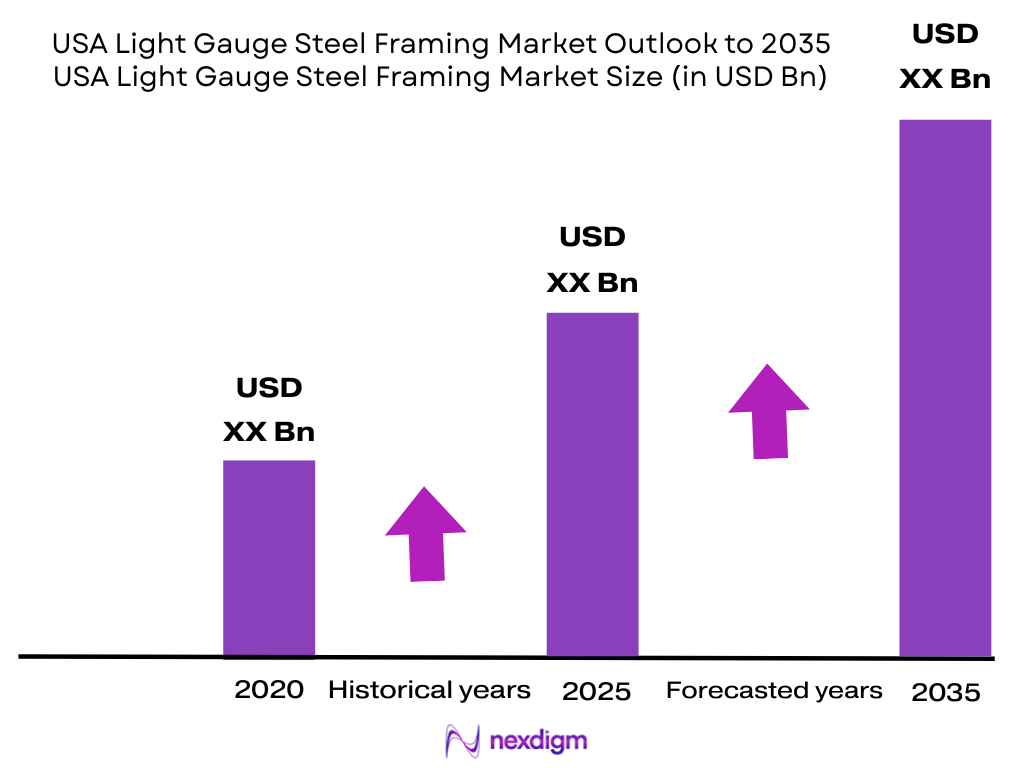
The USA Light Gauge Steel Framing Market is forecast to expand at ~ CAGR during 2026–2035 under the placeholder forecast framework. Future development will increasingly be shaped by multifamily construction, commercial interiors, healthcare and data-center projects, off-site fabrication, labor availability, building resilience, and adoption of digital design-to-manufacturing systems. Growth will not be uniform, however, because structural LGS remains exposed to steel costs, interest-rate-sensitive construction activity, and competition from dimensional lumber and alternative structural systems. Panelized and prefabricated steel framing should become increasingly important where developers require schedule predictability and repeatable assemblies. Factory production allows studs and tracks to be cut, punched, assembled, and quality-controlled before arriving on site. This can reduce field cutting, material waste, and dependence on highly variable jobsite conditions while allowing framing models to integrate directly with BIM and fabrication software. Multifamily construction provides a particularly important structural opportunity. Census Bureau data recorded 1,364,100 privately owned housing units started in 2024, creating a substantial underlying residential construction base. Although wood remains deeply entrenched in U.S. residential framing, LGS can gain relevance in mid-rise apartments, student housing, senior housing, affordable housing, and mixed-use structures where non combustibility, dimensional stability, prefabrication, and resistance to termites or moisture are valued. Commercial construction should continue providing the most stable demand for nonstructural steel framing. Interior metal studs are established across office, healthcare, education, hospitality, retail, government, and data-center projects. Renovation and tenant-improvement activity also provides recurring demand independent of entirely new building starts. Code compliance will remain a major competitive differentiator. AISI S240 addresses structural members and connections used in cold-formed steel light-frame construction, including floors, roofs, structural walls, shear walls, diaphragms, and trusses. SFIA’s certification program requires participating framing manufacturers to comply with its independent code-compliance requirements, creating a structured basis for contractor and specifier confidence.
Major Player
- ClarkDietrich Building Systems
- CEMCO
- Marino\WARE
- Telling Industries
- MBA Building Supplies
- SCAFCO Steel Stud Company
- Super Stud Building Products
- The Steel Network
- Studco Building Systems USA
- Phillips Manufacturing
- Olmar Supply
- FrameTech Systems
- FRAMECAD
- Howick Ltd.
- Hadley Group
Key Target Audience
- Light Gauge Steel Framing Manufacturers
- Steel Stud, Track and Cold-Formed Component Fabricators
- General Contractors and Specialty Framing Contractors
- Multifamily, Commercial and Institutional Real Estate Developers
- Modular Construction and Off-Site Fabrication Companies
- Steel Coil Producers, Service Centers and Building-Material Distributors
- Investments and Venture Capitalist Firms
- Government and Regulatory Bodies (U.S. Department of Housing and Urban Development, U.S. Department of Commerce, International Code Council, State and Local Building Departments)
Research Methodology
Step 1: Identification of Key Variables
The initial phase involves constructing an ecosystem map covering steel mills, galvanized-coil processors, roll-forming manufacturers, distributors, panelizers, contractors, developers, architects, and structural engineers. Critical variables include construction spending, housing starts, framing tonnage, structural versus nonstructural usage, stud thickness, coating specifications, project type, regional construction activity, and off-site fabrication penetration. U.S. Census construction and housing databases are combined with AISI and SFIA technical frameworks and manufacturer product information. This establishes the addressable construction base and ensures that structural and nonstructural cold-formed steel products are classified consistently.
Step 2: Market Analysis and Construction
The top-down market model begins with residential and nonresidential construction activity and allocates addressable floor area according to building type and framing applicability. Steel intensity, installed wall area, average member spacing, and structural/nonstructural framing penetration are then used to calculate theoretical material demand.
The bottom-up model assesses manufacturer shipments, roll-forming capacity, distributor volumes, project bills of materials, and contractor consumption. Tonnage and linear-foot demand are reconciled with average realization to derive the market structure without double-counting steel moving through multiple distribution layers.
Step 3: Hypothesis Validation and Expert Consultation
Market hypotheses are validated through CATIs and structured interviews with framing manufacturers, steel distributors, specialty drywall contractors, structural framers, general contractors, modular builders, and developers. Consultations focus on steel consumption, preferred gauges, stud spacing, supplier selection, lead times, installed productivity, and substitution against wood framing.
Experts are also consulted regarding panelization, engineering requirements, code compliance, regional construction practices, and labor constraints. Supplier-reported production information is compared with project-level consumption to identify inconsistencies before final market estimates are constructed.
Step 4: Research Synthesis and Final Output
The final stage triangulates Census construction activity, manufacturer data, channel interviews, framing specifications, and project-level material requirements. Market demand is segmented by component, application, framing type, construction method, steel thickness, distribution channel, and geography.
Forecast scenarios incorporate construction cycles, multifamily activity, commercial development, steel availability, labor constraints, panelization, modular construction, and wood-to-steel substitution. Base-case, accelerated off-site adoption, and construction-downside scenarios are developed to assess long-term market resilience.

- Executive Summary
- Research Methodology (Market Definitions and Assumptions, Abbreviations, Light Gauge Steel Framing System Boundary, Cold-Formed Steel Product Mapping, Steel Tonnage Conversion, Construction Floor-Area Mapping, Building Permit Mapping, Market Sizing Approach, Top-Down Analysis, Bottom-Up Analysis, Demand-Side Assessment, Supply-Side Assessment, Manufacturer Shipment Assessment, Distributor Channel Mapping, Contractor and Fabricator Interviews, Project Bill-of-Materials Analysis, Data Triangulation, Forecasting Framework, Scenario Analysis, Limitations and Future Conclusions)

- Definition and Scope
- Evolution of Cold-Formed Steel Framing in the USA
- Transition from Conventional Wood and Masonry Framing to Cold-Formed Steel Systems
- Structural versus Non structural Steel Framing Ecosystem
- Light Gauge Steel Framing Manufacturing Process

- Growth Drivers (Multifamily Construction Demand, Commercial Interior Partition Usage, Fire-Resistant Framing Requirements, Termite and Moisture Resistance, Dimensional Stability, Off-Site Construction Adoption, Construction Labor Constraints, Recyclable Steel Content)
- Market Challenges (Steel Price Volatility, Competition from Wood Framing, Thermal Bridging, Skilled Framing Labor Requirements, Engineering Complexity, Material Lead Times, Interest-Rate-Sensitive Construction Activity, Regional Code Variation)
- Market Opportunities (Panelized Multifamily Construction, Modular Housing, Data Centers, Healthcare Construction, Resilient Building Systems, Automated Roll Forming, Low-Waste Construction, High-Recycled-Content Steel)
- Market Trends (Digital Fabrication, BIM-to-Machine Integration, Factory Panelization, Increased Structural Stud Usage, Taller LGS Walls, Prefabricated MEP-Compatible Framing, Lightweight Construction, Sustainability Documentation)
- Technology Substitution Analysis (Wood Stud Framing, Structural Steel, Concrete, CMU, Cross-Laminated Timber, Insulated Concrete Forms, Structural Insulated Panels)
- SWOT Analysis
- Porter’s Five Forces Analysis
- PESTLE Analysis

- By Market Value (2020-2025)
- By Steel Tonnage (2020-2025)
- By Linear Feet of Framing Members (2020-2025)

- By Component Type (In Value %)
Steel Studs
Steel Tracks
Floor Joists
Roof Rafters and Trusses
Furring Channels - By Framing Type (In Value %)
Structural/Load-Bearing Framing
Non structural Interior Framing
Exterior Curtain-Wall Framing
Shaft-Wall Framing
Floor and Ceiling Framing - By Application (In Value %)
Multifamily Residential Buildings
Single-Family Residential Buildings
Commercial Offices
Retail and Mixed-Use Buildings
Hospitality Buildings - By Region (In Value %)
Northeast
Midwest
South
West

- Market Share of Major Players by Value
- Cross Comparison Parameters (Structural and Non-structural Product Portfolio Breadth, Steel Thickness and Member-Depth Range, Galvanized Coating Capability, Manufacturing Plant and Roll-Forming Footprint, Code Compliance and Certification Coverage, Engineering and BIM Support Capability, Distributor and Contractor Network Reach, Panelization and Off-Site Construction Capability)
- SWOT Analysis of Major Players
- Detailed Profiles of Major Companies
ClarkDietrich Building Systems
CEMCO
Marino\WARE
Telling Industries
MBA Building Supplies
SCAFCO Steel Stud Company
Super Stud Building Products
The Steel Network
Studco Building Systems US
Phillips Manufacturing
Olmar Supply
FrameTech Systems
FRAMECAD
Howick Ltd.
Hadley Group

- Multifamily Developer Demand
- Commercial Developer Demand
- General Contractor Procurement Behaviour
- Specialty Framing Contractor Procurement
- Drywall Contractor Procurement

- By Market Value (2026-2035)
- By Steel Tonnage (2026-2035)
- By Linear Feet of Framing Members (2026-2035)


 Request a Sample
 Ask for Customization
 Get a Quote
 Enquire Now