

 Download PDF
Market Overview
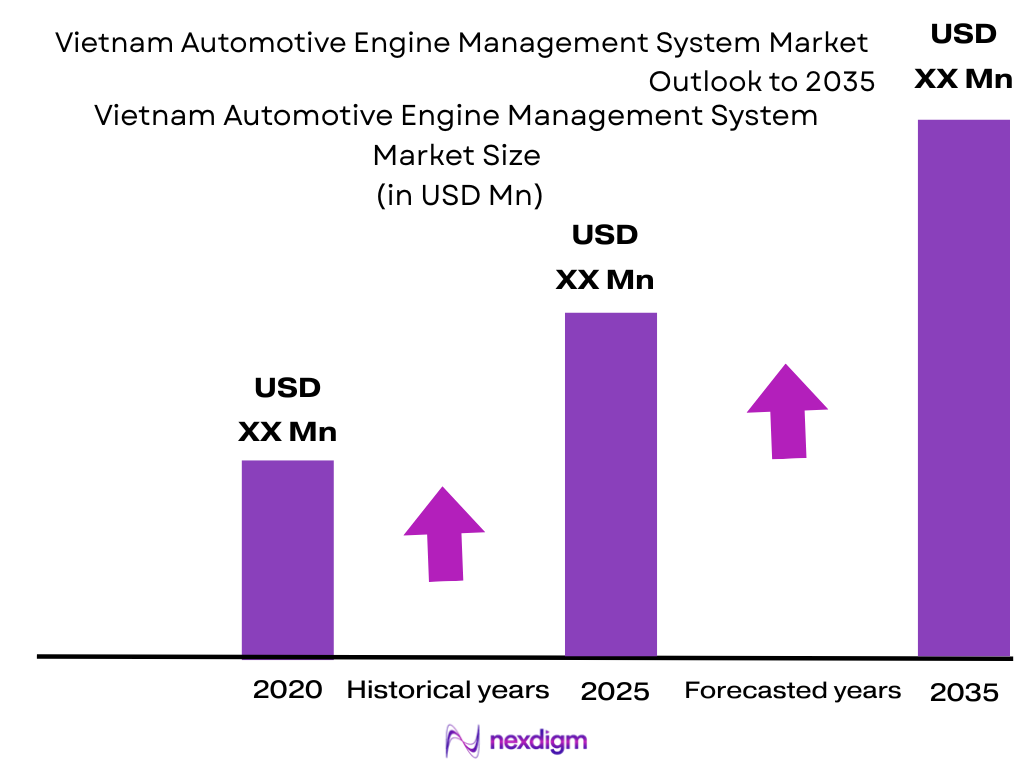
The Vietnam Automotive Engine Management System Market is valued at USD ~ million, based on the requested placeholder framework. Underlying automotive demand strengthened as VAMA-member vehicle sales increased from 301,989 units to 340,142 units, led by passenger cars and commercial vehicles. Rising electronic fuel injection, turbocharged gasoline engines, diesel common-rail systems, oxygen-sensor integration, emissions diagnostics and emerging hybrid powertrains are increasing ECU, sensor, injector and actuator requirements per applicable vehicle. Hanoi, Hai Phong, Ho Chi Minh City, Binh Duong and Dong Nai form the principal demand and supply clusters because they combine vehicle assembly, component manufacturing, automotive software, distribution and large service networks. Locally assembled VAMA-member vehicle sales moved from 181,380 units to 172,730 units, while imported vehicle sales increased from 120,609 to 167,412 units, creating simultaneous OEM and replacement demand for multiple Japanese, Korean, European and regional engine-management architectures.
Market Segmentation
By Component Type
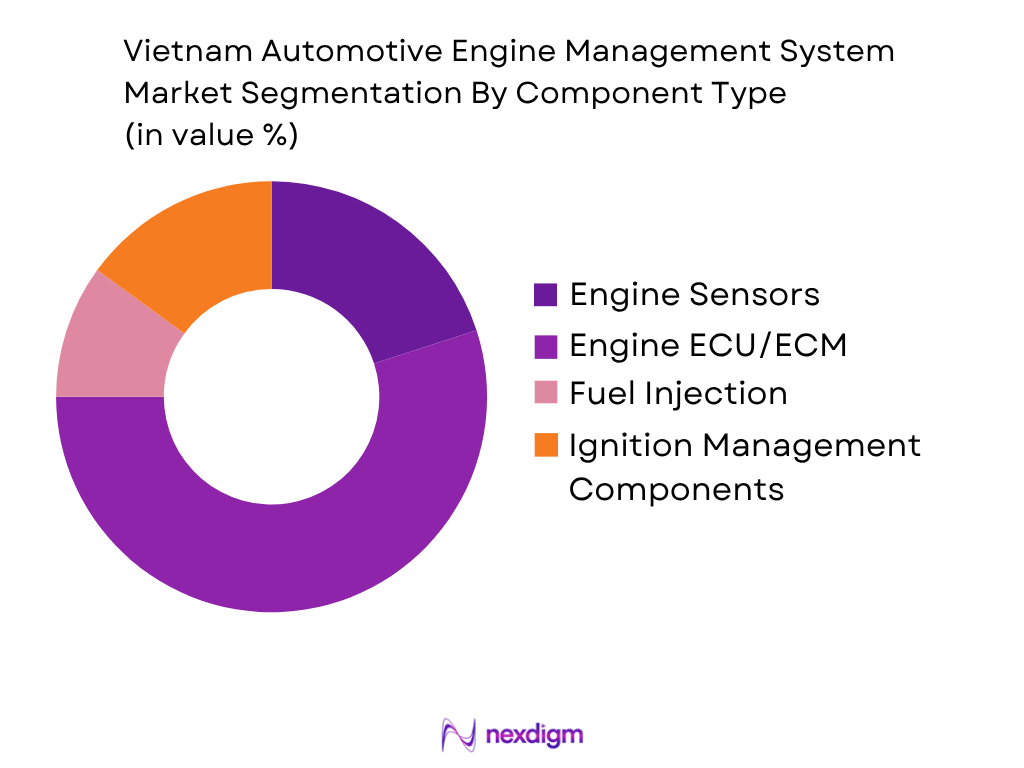
The Vietnam Automotive Engine Management System Market is segmented into engine control units and powertrain controllers, engine and exhaust sensors, fuel-injection components, ignition-management components, electronic throttle and air-management components, and other engine electronics. Engine control units and powertrain controllers hold the dominant value position because the ECU acts as the computational center connecting fuel delivery, ignition, airflow, emissions control and diagnostic functions. Increasing turbocharging, electronically controlled transmissions and hybridization further raise controller sophistication. Sensors form another substantial category because closed-loop engine management depends on oxygen, crankshaft, camshaft, pressure, temperature, knock and airflow inputs. Vietnam also possesses localized sensor-manufacturing capability: DENSO Manufacturing Vietnam produces engine-related products, while DENSO’s Vietnam portfolio includes oxygen sensors used for fuel regulation and exhaust-emission control.
By Powertrain Type
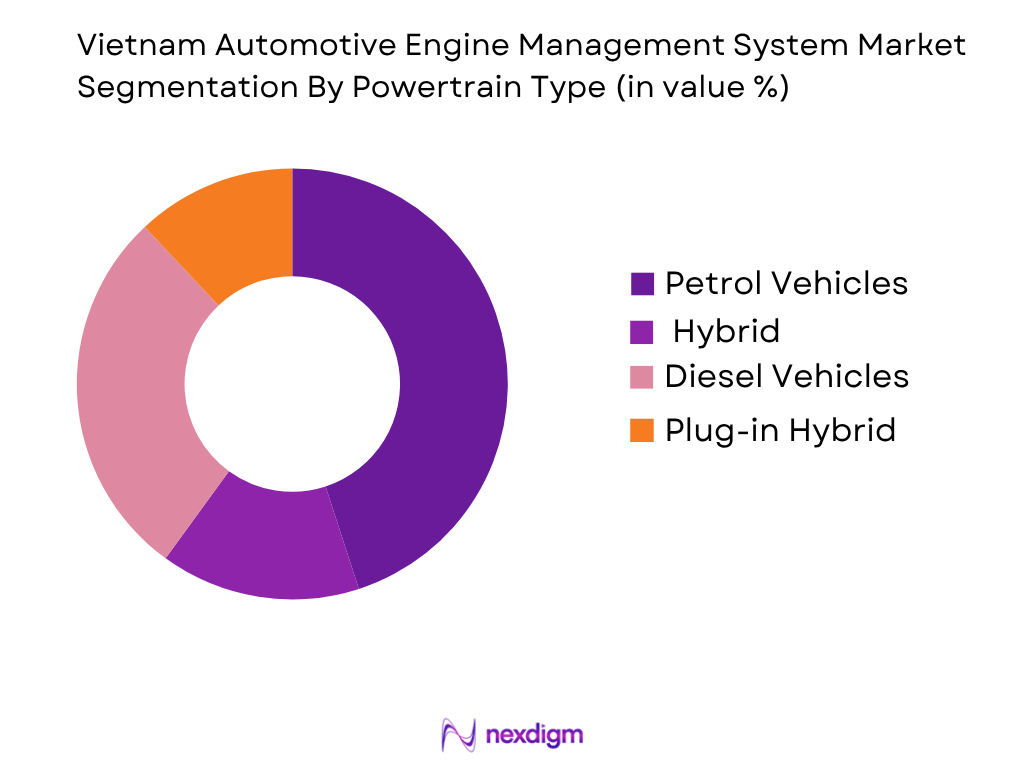
The Vietnam Automotive Engine Management System Market is segmented into conventional petrol, conventional diesel, hybrid electric, plug-in hybrid and other alternative-fuel internal-combustion powertrains. Petrol vehicles dominate current EMS demand because passenger cars, crossovers, MPVs and motorcycles rely extensively on spark-ignition architectures requiring fuel injection, ignition timing, oxygen sensing, throttle management and catalyst control. Turbocharged gasoline engines increase electronic content further through boost-pressure sensing and more precise fuel and knock management. Diesel remains important in pickups, commercial vehicles and trucks, where common-rail injection, EGR, turbocharger control and aftertreatment require higher-value electronics. Hybrid powertrains remain smaller but are strategically significant because they retain combustion-engine management while introducing supervisory controllers for engine restart, torque coordination, battery interaction and thermal optimization.
Competitive Landscape
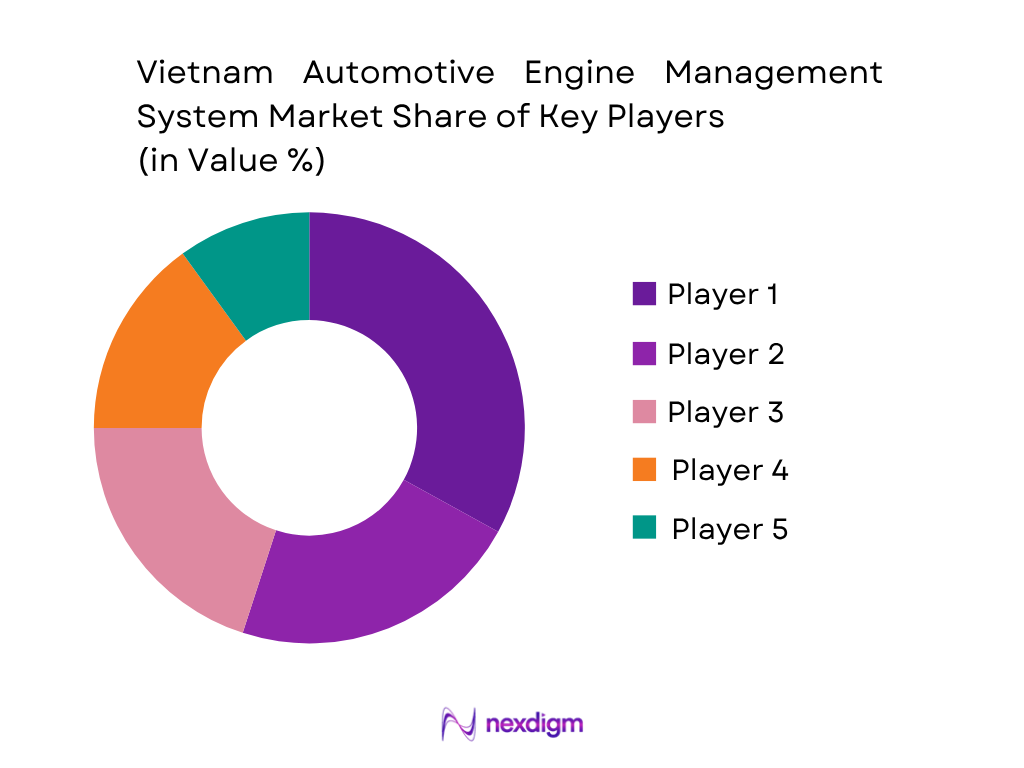
The Vietnam Automotive Engine Management System Market is led primarily by international Tier-1 automotive electronics and powertrain suppliers serving Japanese, Korean, European and locally assembled vehicle platforms. Bosch and DENSO have particularly relevant local footprints: Bosch operates automotive software and engineering capabilities in Vietnam, while DENSO Manufacturing Vietnam has produced engine-related products locally since 2001. Competition increasingly centers on ECU architecture, sensing, injection capability, embedded software, local engineering support, emissions calibration and compatibility with hybrid and software-defined powertrains.
| Player | Establishment | Headquarters | ECU/Powertrain Control | Engine Sensors | Fuel-System Capability | Motorcycle Coverage | Hybrid/SDV Capability | Vietnam/Regional Footprint |
| Bosch | 1886 | Germany | ~ | ~ | ~ | ~ | ~ | ~ |
| DENSO | 1949 | Kariya, Japan | ~ | ~ | ~ | ~ | ~ | ~ |
| Astemo | 2021 integrated entity | Tokyo, Japan | ~ | ~ | ~ | ~ | ~ | ~ |
| AUMOVIO | 2025 independent entity | Frankfurt, Germany | ~ | ~ | ~ | ~ | ~ | ~ |
| BorgWarner | 1928 | Auburn Hills, USA | ~ | ~ | ~ | ~ | ~ | ~ |
Vietnam Automotive Engine Management System Market Analysis
Growth Drivers
Expanding Vehicle Manufacturing, Urban Mobility and Electronic Fuel-Injection Base
Vietnam’s expanding automotive and motorcycle ecosystem is increasing the addressable installed base for engine control units, fuel-injection electronics, ignition modules, oxygen sensors, MAP sensors, crankshaft and camshaft sensors, electronic throttle systems and diesel common-rail controls. The World Bank reports Vietnam’s economy at USD 476.39 billion in 2024, with GDP per capita of USD 4,717.3 and an urban population representing 38.83 units per 100 residents; by 2025, population reached approximately 102 million and GDP per capita rose to USD 5,065.99. This expanding economic and urban base supports greater demand for motorcycles, passenger vehicles, urban delivery vehicles and commercial fleets, all of which require increasingly electronic combustion control where ICE or hybrid propulsion is used. Vietnam Automobile Manufacturers Association data reported through official trade channels show 301,989 automobiles sold in the earlier comparison period, including 181,380 locally assembled vehicles and roughly 120,600 completely built-up imports, highlighting a substantial platform base for both OEM and replacement engine-management demand. The importance of the motorcycle channel is even greater. Vietnam has more than 70 million motorcycles and mopeds subject to the country’s new exhaust-emissions inspection framework, meaning the existing parc alone creates long-tail demand for electronically controlled fueling, oxygen sensing, throttle-position sensing, crankshaft sensing, ignition components and diagnostic support. High urban motorcycle density further magnifies this effect: government-linked transport research identifies motorcycles as approximately 95 vehicles out of every 100 road vehicles in Hanoi and Ho Chi Minh City. For the engine-management market, this combination of expanding household purchasing capacity and an unusually large two-wheeler installed base is strategically important because motorcycle ECUs are compact and lower-content than passenger-car controllers, but their addressable unit volumes are far greater. Passenger vehicles contribute higher value per system through turbocharged gasoline engines, multipoint or direct injection, variable valve timing, knock control and increasingly sophisticated OBD functions. Commercial vehicles add diesel common-rail injection, exhaust-gas recirculation, turbocharger control and exhaust aftertreatment. Vietnam therefore presents a multi-layered EMS demand structure spanning low-cost motorcycle EFI systems, passenger-car gasoline ECUs and high-content diesel commercial-vehicle controllers rather than a market dependent on a single automotive category.
Tightening Emissions Regulation and Greater Electronic Control of the Existing Vehicle Parc
Vietnam’s shift toward tighter emissions monitoring is creating a direct technical requirement for more accurate and durable engine-management systems. The Ministry of Construction reported in 2026 that more than 70 million motorcycles and mopeds nationwide fall under a new exhaust-emissions standards regime. Motorcycles manufactured from 2017 through mid-2026 are assigned Level 3 requirements, while motorcycles manufactured from July 2026 onward are subject to Level 4 requirements. For EMS suppliers, such regulation is commercially relevant because emission compliance increasingly depends on closed-loop electronic fuel injection, oxygen sensing, accurate ignition timing, intake-pressure measurement, catalyst management and reliable onboard diagnostics rather than purely mechanical engine tuning. A malfunctioning oxygen sensor, MAP sensor, fuel injector, throttle-position sensor or ECU calibration can directly alter air-fuel ratio and exhaust output. The opportunity extends beyond new vehicles because the regulatory framework increasingly addresses the enormous existing motorcycle fleet. Ho Chi Minh City alone reported more than 11 million motorcycles and scooters subject to emissions inspection following administrative restructuring, demonstrating the scale of potential diagnostic, sensor-replacement and repair activity attached to tighter emissions oversight. The city’s transport authorities have also identified approximately 1 million cars and 7.3 million motorcycles in the pre-restructuring urban fleet, with road transport responsible for significant local nitrogen-oxide pollution, reinforcing the policy rationale for tighter engine and exhaust controls. Vietnam’s macroeconomic environment allows such regulatory modernization to occur alongside continued industrial expansion. The IMF reported that the economy grew strongly in 2024 and continued with 6.9 units of year-on-year real expansion in the first quarter of 2025, while its current country profile lists a population of 103.077 million in 2026. From an engine-management perspective, regulation raises both hardware content and software complexity. Motorcycle manufacturers require accurate electronic fuel injection and diagnostic logic; gasoline passenger cars require increasingly precise lambda, ignition and catalyst controls; diesel vehicles require common-rail control, EGR monitoring, turbocharger actuation and aftertreatment coordination. These technologies also create a replacement market because emissions testing exposes failed sensors and poorly functioning fuel-control components that might otherwise remain in operation. The shift therefore does more than push OEMs toward cleaner engines: it creates an ecosystem of ECU calibration, diagnostic equipment, sensor replacement, injector servicing and emissions-related aftermarket repair.
Market Challenges
High Dependence on Imported High-Value Engine Electronics and Automotive Components
Vietnam’s engine-management industry remains constrained by dependence on imported high-value components, which limits domestic capture of ECU, semiconductor, injection-system and advanced sensor value despite growing vehicle assembly activity. Ministry of Industry and Trade data reported through Vietnam’s official trade information channels indicate that the domestic automotive industry imports as much as 80 components out of every 100 units of production-component requirement in some areas. Vietnam’s supporting automotive ecosystem includes roughly 300 specialized enterprises, comprising around 40 vehicle manufacturing and assembly companies, 45 chassis and body manufacturers and 214 automotive component and spare-parts companies. These figures reveal a structural issue for the engine-management market: assembling vehicles domestically does not automatically translate into domestic production of microcontrollers, ECU printed-circuit assemblies, automotive memory, injector drivers, oxygen sensors, high-pressure fuel-system electronics or advanced embedded software. A modern engine ECU depends on automotive-grade semiconductor devices with stringent temperature, vibration, electromagnetic-compatibility and functional-reliability requirements. Replacing an imported microcontroller or sensor is also not straightforward because ECU hardware, software and emissions calibration are validated as an integrated vehicle system. Vietnam’s economic scale makes reducing this dependency increasingly important. World Bank data show GDP of USD 476.39 billion in 2024 and GDP per capita of USD 4,717.3, while population reached approximately 102 million in 2025. The IMF further reports a population of 103.077 million for 2026, demonstrating the domestic market scale against which local automotive electronics investment could potentially be amortized. However, localization remains technically demanding. Engine-management suppliers need electronics manufacturing capability, automotive-grade quality systems, software validation laboratories, environmental testing, calibration expertise and long-term OEM nomination cycles. The challenge is particularly acute because Vietnam’s market incorporates Japanese, Korean, European, American and increasingly Chinese vehicle architectures, each using distinct engine controllers, communication protocols and diagnostic ecosystems. A fragmented platform base makes it harder for domestic suppliers to achieve the volumes required for specialized ECU or sensor manufacturing. Imported engines and CBU vehicles further reduce opportunities for local EMS fitment at the factory level. Thus, while vehicle assembly expands, Vietnam can remain exposed to foreign Tier-1 and semiconductor supply chains unless the country moves from low- and medium-complexity mechanical components into electronic controls, smart sensors and automotive software. For EMS manufacturers, this means supply-chain resilience, local technical partnerships and selective localization are as important as vehicle demand itself.
Battery-Electric Vehicle and Electric-Motorcycle Substitution of Conventional Engine Management
Electrification represents the most important long-term technological challenge for Vietnam’s automotive engine-management system market because every full battery-electric vehicle removes the conventional combustion engine and consequently eliminates most traditional EMS content. A battery-electric motorcycle does not require a gasoline engine ECU, injector, ignition coil, spark timing control, oxygen sensor, intake-pressure sensor or catalyst-management logic. A battery-electric passenger vehicle similarly substitutes fuel-system and engine-management electronics with battery-management systems, traction inverters, motor controllers and high-voltage thermal-control electronics. This substitution risk is particularly significant in Vietnam because motorcycles dominate urban mobility and policy is increasingly directed toward electrifying the two-wheeler fleet. Hanoi stated in 2026 that it was preparing a low-emission-zone pilot inside Ring Road 1 from July 1, 2026, against the backdrop of approximately 8 million road vehicles in the capital. Hanoi subsequently considered restricting gasoline-powered motorcycles on specific central streets covering 0.5 square kilometers and approximately 20,000 residents as part of that low-emission transition. Ho Chi Minh City has likewise announced low-emission-zone measures beginning from 2026 and has an enormous motorcycle fleet that provides a natural target for electrification policies. The challenge for engine-management suppliers is therefore not merely declining demand for one component. Electrification can remove an entire bundle of products simultaneously: engine ECUs, fuel injectors, fuel-pressure sensors, spark-related components, oxygen sensors, throttle-management devices and exhaust-system diagnostic sensors. At the same time, Vietnam’s economy continues expanding. World Bank figures show GDP at USD 476.39 billion in 2024, while IMF reporting indicates that real economic activity continued strongly into 2025 and the country’s population reached 103.077 million in 2026. This means EMS suppliers face a transition within a growing mobility market rather than straightforward automotive contraction. They must continue supporting millions of petrol motorcycles, gasoline passenger cars and diesel commercial vehicles while shifting engineering investment toward hybrids, powertrain domain controllers and broader vehicle electronics. Suppliers focused exclusively on conventional injection or ignition hardware face greater substitution exposure. Companies possessing embedded software, sensing, thermal-management and semiconductor-integration capabilities have a more defensible transition path because those competencies can migrate into hybrid and electric propulsion. The strategic challenge is therefore timing: exiting conventional engine-management investment too quickly would sacrifice a huge installed ICE fleet, while moving too slowly toward electrified electronics risks technological obsolescence.
Market Opportunities
Hybrid, E10-Compatible and Multi-Fuel Engine-Management Architectures
Vietnam’s transition toward lower-emission mobility does not imply that all future growth opportunities will come from battery-electric vehicles. Hybrid powertrains, biofuel-compatible engines and advanced gasoline systems can expand the technical scope of engine management because they preserve the combustion engine while adding more sophisticated electronic control. The Ministry of Industry and Trade reported in 2026 that most gasoline vehicles currently operating in Vietnam can safely use E5 and E10 gasoline, demonstrating an established technical foundation for broader ethanol-blended fuel adoption. E10 compatibility matters to EMS suppliers because changes in fuel oxygen content and combustion behavior require accurate electronic injection, lambda feedback, ignition adaptation and cold-start calibration. Controllers with adaptive fueling capability can therefore become more strategically valuable than fixed, low-function engine-management platforms. Vietnam’s automotive industrial strategy also increasingly includes hybrid vehicles, biofuels and other green-fuel architectures within supporting-industry development priorities. Government-linked industry information notes that the country has around 30,000 mechanical enterprises, while automotive-sector policy is seeking greater local capability in drivetrains, engines and components. The domestic economic environment provides a large base for deployment: World Bank figures place GDP at USD 476.39 billion in 2024 with GDP per capita of USD 4,717.3, while the IMF records the country’s population at 103.077 million in 2026. Hybridization is especially attractive for the EMS market because a hybrid retains injectors, crankshaft and camshaft sensors, oxygen sensors, ignition control, throttle management and catalyst functions while adding supervisory coordination between the engine, motor, battery and transmission. This increases electronic control complexity per applicable vehicle. Engine restart strategy, torque arbitration, battery state interaction, thermal optimization and catalyst-temperature control become software functions layered on top of conventional combustion control. For suppliers, this creates opportunities in integrated powertrain control modules rather than standalone ECUs. E10 and future biofuel strategies create a second avenue. Flexible calibration architectures can allow common ECU hardware to support multiple fuel blends, reducing platform-development costs for OEMs while creating additional embedded-software value. These solutions also fit Vietnam’s gradual transition model: they lower emissions and petroleum dependence without requiring immediate replacement of the entire ICE fleet. Companies capable of combining fuel-injection hardware, oxygen sensing, embedded control, hybrid supervision and calibration engineering are therefore positioned to capture a larger portion of future powertrain electronics demand.
Localization of ECUs, Smart Sensors, Calibration Software and Automotive Electronics
Vietnam’s limited domestic automotive electronics depth creates a substantial opportunity for localization of engine ECUs, sensor modules, embedded software, electronic fuel-injection controls and diagnostic technologies. Ministry of Industry and Trade information indicates that the automotive sector still imports as much as 80 units of production components for every 100 units required in relevant categories and has around 214 domestic auto-component and spare-parts enterprises within its specialized supporting-industry structure. Rather than viewing this import dependence only as a constraint, it represents clear white space for companies capable of localizing higher-value electronics. Vietnam already has a broader component-export base from which the industry can move upward technologically. Customs-linked government trade information reported exports of means of transport and spare parts exceeding USD 11 billion during the first nine months of 2024, including approximately USD 2.4 billion shipped to the United States, USD 2.18 billion to Japan and USD 1.14 billion to Korea. These trade flows demonstrate that Vietnam already participates materially in global vehicle-component supply chains, even if engine-management electronics remain more technology-intensive than many currently localized parts. The economic platform is also strengthening: World Bank data show USD 476.39 billion of GDP in 2024, GDP per capita of USD 4,717.3, and approximately 102 million residents in 2025, while the IMF reports 103.077 million residents in 2026. Engine-management localization could proceed in stages. Sensors and control-module assembly represent relatively accessible entry points, followed by PCB assembly, ECU validation, software calibration, diagnostic algorithms and eventually deeper semiconductor integration. Smart oxygen, pressure, temperature and position sensors are particularly attractive because they combine electronic content with manufacturing processes that can leverage Vietnam’s existing electronics ecosystem. Software creates another route requiring less heavy industrial investment. Local teams can develop calibration maps, diagnostic functions, AUTOSAR software layers, communication protocols and validation tools for engines assembled or sold domestically. This opportunity expands as motorcycles, turbocharged passenger vehicles, diesel commercial fleets and hybrids require greater computational content. Localization would also reduce lead-time exposure and improve application engineering between OEMs and suppliers. Vietnam’s growing automotive export capability provides a further strategic upside: locally developed EMS components could ultimately supply ASEAN and other emerging automotive markets rather than serving only domestic production. For business professionals, the strongest opportunity therefore lies not in replicating commodity mechanical components but in moving into high-value controllers, sensors, software and diagnostics where Vietnam’s current import dependence leaves meaningful whitespace.
Future Outlook
The Vietnam Automotive Engine Management System Market is projected to expand at ~ CAGR during 2026–2035 under the requested placeholder framework. Growth will increasingly depend on electronic content per combustion or hybrid vehicle rather than solely on conventional ICE vehicle volumes. Turbocharged gasoline engines, hybridization, increasingly sophisticated emissions monitoring, locally developed automotive software and greater sensor content are expected to support higher-value EMS architectures. Vietnam’s macroeconomic environment provides a favorable automotive demand base. World Bank data place GDP at USD 476.39 billion and GDP per capita at USD 4,717.3, while the population exceeded 100 million. The economy subsequently reached about USD 514.7 billion, with GDP per capita above USD 5,000, expanding the household and industrial base capable of supporting vehicle ownership and automotive manufacturing. Local automotive electronics capability should also deepen. DENSO Manufacturing Vietnam operates from the Hanoi-area industrial ecosystem and manufactures engine-related products; related DENSO operations in Vietnam produce sensing and solenoid technologies. Bosch’s Ho Chi Minh City operation adds software development, validation and automotive engineering capabilities. These activities create a foundation for Vietnam to capture more EMS value beyond final vehicle assembly.
Major Players
- Robert Bosch GmbH / Bosch Vietnam
- DENSO Corporation / DENSO Manufacturing Vietnam
- AUMOVIO
- Astemo Ltd.
- Marelli
- BorgWarner Inc.
- Valeo
- PHINIA Inc. / Delphi
- FORVIA HELLA
- Schaeffler Group
- Mitsubishi Electric Automotive
- AISIN Corporation
- Hyundai Mobis
- Niterra Co., Ltd.
- Standard Motor Products / Intermotor
Key Target Audience
- Automotive OEMs and Vehicle Assemblers
- Motorcycle and Scooter Manufacturers
- Engine ECU, Sensor and Fuel-Injection Component Manufacturers
- Automotive Tier-1 and Tier-2 Component Suppliers
- Automotive Semiconductor and Embedded Software Companies
- Automotive Parts Distributors and Fleet Maintenance Networks
- Investments and Venture Capitalist Firms
- Government and Regulatory Bodies (Ministry of Construction, Vietnam Register, Ministry of Industry and Trade, Ministry of Science and Technology)
Research Methodology
Step 1: Identification of Key Variables
The initial phase constructs a complete Vietnam Automotive Engine Management System Market ecosystem covering vehicle assemblers, motorcycle manufacturers, global Tier-1 suppliers, engine-component manufacturers, electronics companies, distributors and workshops. Critical variables include vehicle sales, local assembly, imported vehicles, fuel type, injection architecture, ECU content, sensor count, emissions technology, hybridization and aftermarket replacement behavior.
Step 2: Market Analysis and Construction
The top-down model begins with VAMA vehicle volumes and complementary OEM data, separating passenger cars, commercial vehicles, locally assembled vehicles and imports. These volumes are mapped against petrol, diesel and hybrid architectures. The bottom-up calculation aggregates engine ECUs, sensors, injectors, ignition components, throttle-control systems and emissions electronics across representative vehicle platforms and separates OEM from replacement demand.
Step 3: Hypothesis Validation and Expert Consultation
Market hypotheses are validated through CATIs with vehicle OEMs, motorcycle manufacturers, Tier-1 powertrain suppliers, electronics companies, distributors and independent workshops. Interviews test assumptions concerning ECU content, sensor replacement, gasoline direct injection, diesel common rail, localization, imported semiconductor dependence, hybrid-control requirements, diagnostic practices and the effect of battery-electric substitution.
Step 4: Research Synthesis and Final Output
The final phase triangulates VAMA information, company-level supply data, macroeconomic indicators and primary industry feedback. Forecast models incorporate vehicle demand, local assembly, hybrid adoption, electronic content per vehicle, motorcycle EMS modernization, increasingly stringent emissions control, software localization, aftermarket replacement and EV substitution to produce market and segment-level scenarios.

- Executive Summary
- Research Methodology (Market Definitions and Assumptions, Abbreviations, Engine Management System Market Boundary, Vehicle Production and Registration Mapping, Powertrain Mapping, ECU Content-per-Vehicle Assessment, Sensor Content Assessment, Passenger Vehicle EMS Assessment, Motorcycle EMS Assessment, Commercial Vehicle EMS Assessment, OEM Fitment Analysis, Replacement Cycle Assessment, Top-Down Analysis, Bottom-Up Analysis, Demand-Side Assessment, Supply-Side Assessment, OEM-Tier-1-Distributor-Workshop Interviews, Data Triangulation, Electrification Substitution Scenarios, Forecasting Framework, Limitations and Future Conclusions)

- Definition and Scope
- Evolution of Electronic Engine Management in Vietnam
- Transition from Carburetion to Electronic Fuel Injection
- Evolution of Passenger Vehicle Engine Control Systems
- Evolution of Motorcycle Electronic Fuel Injection

- Growth Drivers (Expansion of Locally Assembled Vehicles, High Motorcycle Installed Base, Electronic Fuel Injection Adoption, Turbocharged Petrol Engines, Diesel Common-Rail Control, Emission Compliance, Increasing Sensor Content, Hybrid Vehicle Introduction)
- Market Challenges (Battery-Electric Vehicle Substitution, Imported ECU and Semiconductor Dependence, Limited Local Engine Electronics Value Addition, Diagnostic Skill Requirements, Fragmented Independent Aftermarket, Controller Software Complexity)
- Market Opportunities (Hybrid Engine Management, Motorcycle Smart ECUs, GDI Control, Smart Sensors, ECU Software Development, Sensor Localization, Diesel Aftertreatment Electronics, ECU Remanufacturing and Diagnostics)
- Market Trends (EFI Motorcycles, Turbo-Petrol Engines, Hybridization, Smart Sensor Integration, Multicore Controllers, Connected Diagnostics, Software-Defined Powertrain Architecture)
- SWOT Analysis
- Porter’s Five Forces Analysis
- PESTLE Analysis

- By Market Value (2020-2025)
- By Engine Management System Unit Volume (2020-2025)
- By Engine ECU/ECM Unit Volume (2020-2025)

- By Component Type (In Value %)
Engine Control Unit / Engine Control Module
Powertrain Control Module
Motorcycle Engine Control Unit
Fuel Injectors
High-Pressure Fuel Pumps - By Vehicle Type (In Value %)
Passenger Cars
SUVs and Crossovers
MPVs
Pickup Trucks
Light Commercial Vehicles - By Powertrain Type (In Value %)
Conventional Petrol Vehicles
Conventional Diesel Vehicles
Mild Hybrid Vehicles
Full Hybrid Electric Vehicles
Plug-in Hybrid Electric Vehicles
Alternative-Fuel Internal Combustion Vehicles - By Application (In Value %)
Fuel Injection Management
Ignition Timing Management
Electronic Throttle Control
Air-Fuel Ratio Management
Turbocharger Boost Control - By Region (In Value %)
Northern Vietnam
Southern Vietnam
Central Vietnam
Hanoi Automotive Demand Cluster
Hai Phong-Quang Ninh Manufacturing Corridor

- Market Share of Major Players by Value
- Cross Comparison Parameters (Engine ECU and Powertrain Controller Portfolio Breadth, Passenger Vehicle-Motorcycle-Commercial Vehicle Coverage, Petrol-Diesel-Hybrid Engine Management Capability, Fuel Injection and Engine Sensor Portfolio Depth, Emission Calibration and OBD Software Capability, Vietnam Manufacturing-R&D-Localization Footprint, OEM and Aftermarket Distribution Reach, Software-Defined Powertrain and Semiconductor Integration Capability)
- SWOT Analysis of Major Players
- Detailed Profiles of Major Companies
Robert Bosch GmbH / Bosch Vietnam
DENSO Corporation / DENSO Manufacturing Vietnam
AUMOVIO
Astemo Ltd.
Marelli
BorgWarner Inc.
Valeo
PHINIA Inc. / Delphi
FORVIA HELLA
Schaeffler Group
Mitsubishi Electric Automotive
AISIN Corporation
Hyundai Mobis
Niterra Co., Ltd.
Standard Motor Products / Intermotor

- Private Passenger Vehicle EMS Demand
- Luxury Vehicle Owner Demand
- SUV and Off-Road User Demand
- Delivery Fleet Demand
- Commercial Logistics Fleet Demand

- By Market Value (2026-2035)
- By Engine Management System Unit Volume (2026-2035)
- By Engine ECU/ECM Volume (2026-2035)


 Request a Sample
 Ask for Customization
 Get a Quote
 Enquire Now