

 Download PDF
Market Overview
Market Size and Growth Drivers: The Vietnam Biocides Market is valued at ~USD 100 million in 2024, with the market supported by accelerating industrial activity, water and wastewater treatment requirements, food processing, coatings production, and aquaculture. Vietnam’s industrial production index increased 8.4% in 2024, compared with 1.3% in 2023, while manufacturing and processing increased 9.6%, creating a broader industrial base requiring microbial-control solutions. The water supply, waste management and wastewater treatment sector increased 10.7%, strengthening demand for biocidal treatment technologies.
Dominant Cities and Industrial Clusters: The Vietnam Biocides Market is concentrated around Ho Chi Minh City, Hanoi, Hai Phong, Binh Duong, Dong Nai and Bac Ninh, reflecting the country’s concentration of manufacturing, water treatment, food processing, textiles, electronics, chemicals and coatings production. Industrial production expanded across 60 of 63 provinces and centrally governed cities in 2024, while major industrial locations such as Bac Giang, Hai Phong, Hai Duong, Dong Nai, Ho Chi Minh City and Binh Duong recorded notable industrial-production growth. This concentration creates recurring demand for industrial preservatives, disinfectants, cooling-water biocides and process-water microbial control.
Market Segmentation
By Product Type
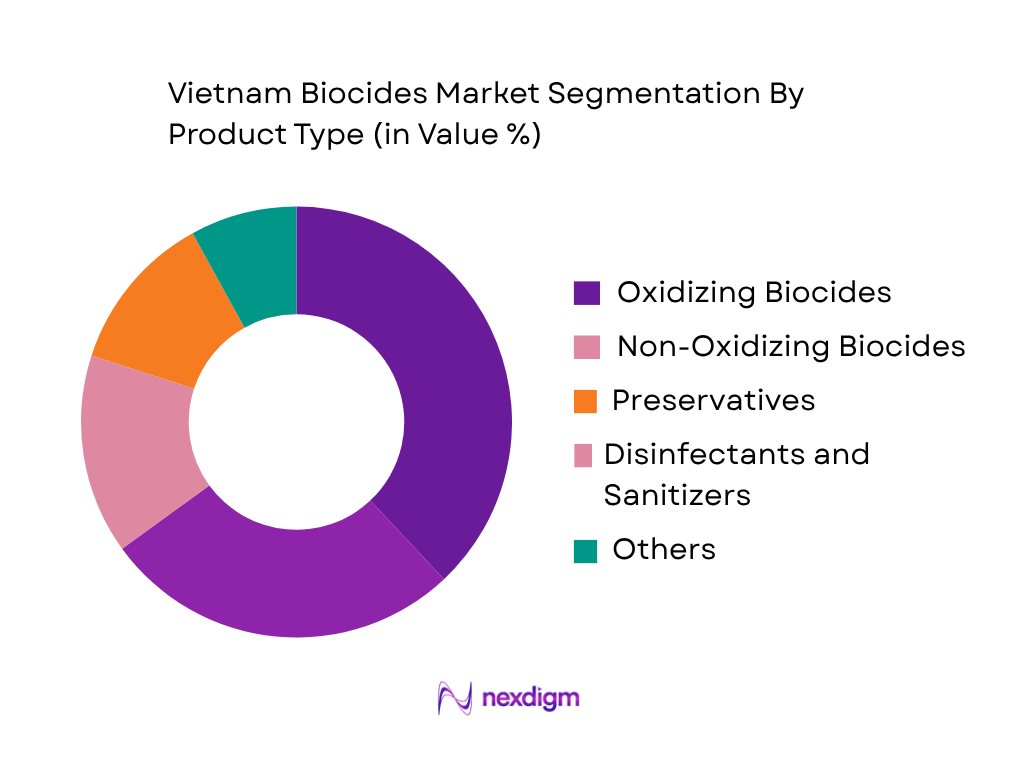
The Vietnam Biocides Market is segmented by product type into oxidizing biocides, non-oxidizing biocides, preservatives, disinfectants and sanitizers, antimicrobial additives, and microbial-control agents. Oxidizing biocides are positioned as the leading sub-segment because of their suitability for rapid microbial control across industrial water treatment, wastewater systems, cooling-water circuits and sanitation applications. Chlorine-, bromine- and peroxide-based technologies can provide broad-spectrum microbial control and are compatible with high-throughput industrial treatment environments. Vietnam’s water supply, waste management and wastewater treatment sector expanded 10.7% in 2024, compared with 5.5% in 2023, increasing the operating base for microbial-control applications. Industrial manufacturing also expanded strongly, with the manufacturing and processing sector increasing 9.6% in 2024. These conditions support recurring use of biocides where bacterial, fungal and algal growth can affect process efficiency, equipment reliability and product quality.
By Application
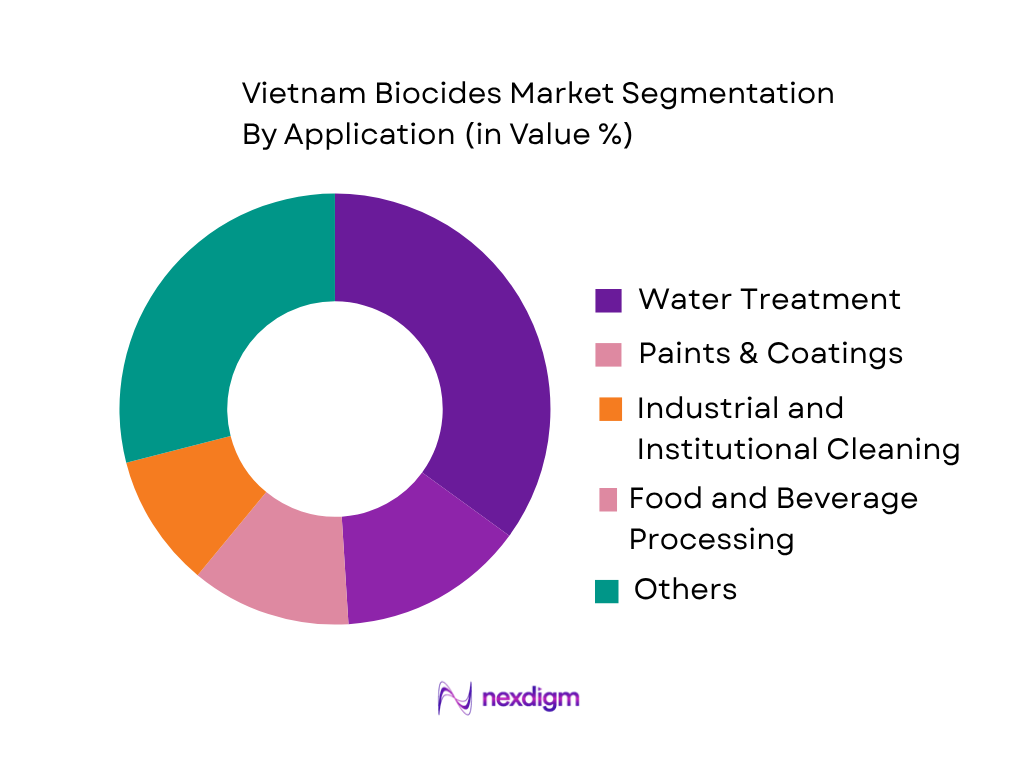
The Vietnam Biocides Market is segmented by application into water treatment, paints and coatings, industrial and institutional cleaning, food and beverage processing, personal care and cosmetics, pulp and paper, oil and gas, textiles, wood preservation, and aquaculture. Water treatment is expected to remain the dominant application because microbial control is integral to cooling-water systems, industrial process water, wastewater treatment, membrane systems and other water-intensive operations. Vietnam recorded 9.6% growth in manufacturing and processing in 2024, while industrial consumption increased 11.3%, expanding the base of industrial facilities requiring process-water management. Total fishery production also reached 9.547 million tonnes, including 5.722 million tonnes of aquaculture production, creating additional microbial-control requirements for aquaculture water management.
Competitive Landscape
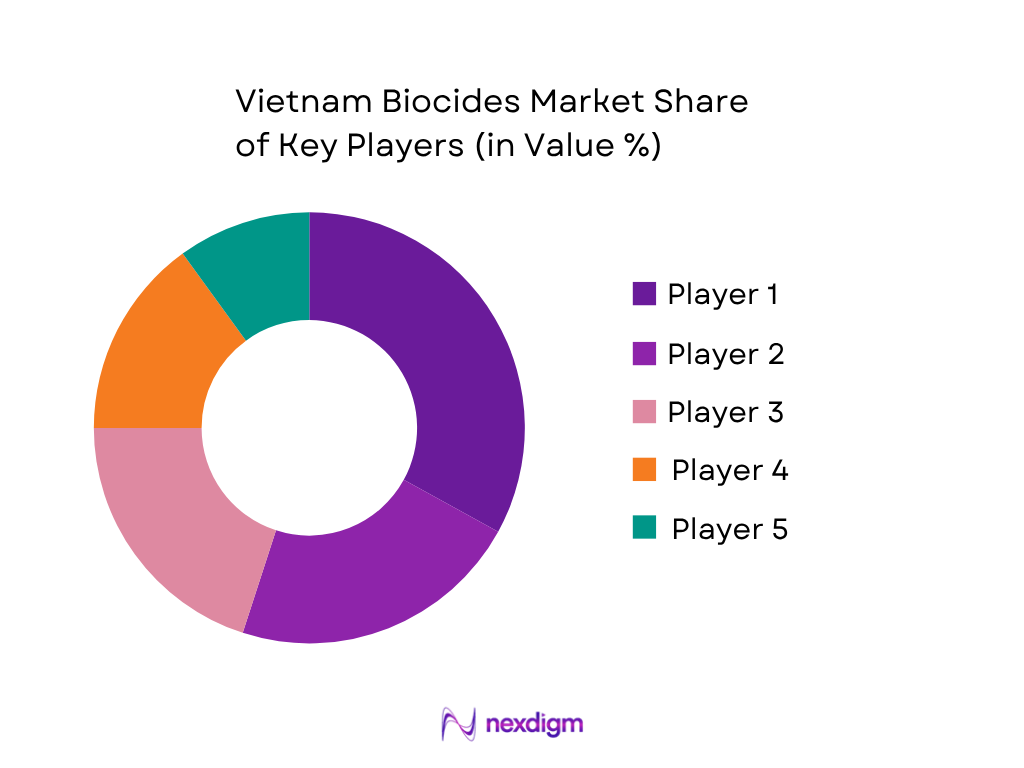
The Vietnam Biocides Market includes multinational specialty-chemical manufacturers with portfolios covering preservatives, antimicrobial additives, water-treatment chemicals, disinfectants and material-protection technologies. Competitive differentiation is increasingly based on active-ingredient breadth, regulatory support, formulation expertise, technical service, application-specific efficacy and the ability to supply customers across industrial water treatment, coatings, consumer products and manufacturing. BASF, for example, has operated in Vietnam since 1994 and maintains a sales office in Ho Chi Minh City, while Arxada and LANXESS maintain broad antimicrobial and material-protection portfolios covering industrial, coatings, hygiene and preservation applications.
| Company | Establishment Year | Headquarters | Active Ingredient Portfolio | Major Application Areas | Vietnam Presence | Technical Service | Regulatory Capability | Distribution Strength |
| BASF | 1865 | Ludwigshafen, Germany | ~ | ~ | ~ | ~ | ~ | ~ |
| LANXESS | 1863 | Cologne, Germany | ~ | ~ | ~ | ~ | ~ | ~ |
| Arxada | 2021 | Basel, Switzerland | ~ | ~ | ~ | ~ | ~ | ~ |
| Ecolab | 1923 | St. Paul, United States | ~ | ~ | ~ | ~ | ~ | ~ |
| Nouryon | 2018 | Amsterdam, Netherlands | ~ | ~ | ~ | ~ | ~ | ~ |
Vietnam Biocides Market Analysis
Market Growth Drivers
Expansion of Industrial Manufacturing and Process-Water Treatment
Vietnam’s expanding manufacturing base is a direct demand driver for biocides because microbial control is required across cooling-water systems, process water, wastewater, paints and coatings, textiles, food processing, pulp and paper, and chemical manufacturing. The National Statistics Office of Vietnam reported that the country’s Industrial Production Index increased 8.2 points in 2024, while manufacturing and processing increased 9.6 points. The water supply, waste management and wastewater-treatment sector increased 10.7 points, indicating stronger activity in a downstream area directly associated with industrial microbial-control requirements. Chemical and chemical-product manufacturing increased 11.9 points, further strengthening the addressable industrial base for preservatives and antimicrobial formulations. The World Bank recorded Vietnam’s GDP at USD 476.39 billion in 2024, compared with USD 433.86 billion in 2023, while real GDP growth reached 7.1 points in 2024. The country’s population reached 100,987,686 people, creating a large domestic industrial and consumer base. Vietnam’s industrial expansion is also strongly linked to international manufacturing supply chains: merchandise exports reached USD 405.53 billion, while imports reached USD 380.76 billion. These figures support continued requirements for microbial preservation, industrial sanitation, water-treatment biocides and material-protection solutions across manufacturing-intensive applications.
Growth of Water-Intensive Industrial and Aquaculture Activities
Increasing water-intensive production is strengthening demand for biocides used to control bacteria, algae, fungi and biofilm in industrial and aquaculture environments. Vietnam’s National Statistics Office recorded 9.547 million tonnes of total fisheries production in 2024, including 5.722 million tonnes of aquaculture production. This creates a substantial operating base for water-quality management, pond sanitation, microbial-control programs and aquaculture biosecurity products. Industrial water demand is also supported by manufacturing expansion: the manufacturing and processing sector increased 9.6 points in 2024, while water supply, waste management and wastewater treatment increased 10.7 points. The World Bank reported that Vietnam had 100,987,686 people in 2024, while its GDP reached USD 476.39 billion, demonstrating the scale of the economy and domestic demand base supporting industrial and municipal infrastructure. The World Bank also recorded 45 points for the population using safely managed sanitation services in 2024, highlighting continuing infrastructure requirements around sanitation and wastewater management. In January 2024, the World Bank approved the Binh Duong Water Environment Improvement Project, designed to improve water quality and wastewater treatment for more than 500,000 people. Such investment in water infrastructure creates opportunities for microbial-control chemicals across treatment systems, industrial facilities and related water-management applications.
Market Challenges
Regulatory and Environmental Requirements for Biocidal Chemistry
Regulatory scrutiny represents a significant challenge for the Vietnam Biocides Market because suppliers must manage active-ingredient selection, product registration, hazard classification, labeling, safe handling and environmental requirements across different applications. Vietnam’s expanding industrial base increases the volume of chemicals entering manufacturing and water-treatment systems, making environmental management increasingly important. The World Bank recorded 100,987,686 people in Vietnam in 2024 and reported that safely managed sanitation services reached 45 points, demonstrating the continuing importance of water-quality and sanitation infrastructure. The World Bank also estimated that untreated wastewater and inadequate drainage could reduce Vietnam’s GDP by 3.5 points annually by 2035, underlining the economic significance of wastewater management. The regulatory challenge is particularly relevant for suppliers of oxidizing and non-oxidizing biocides because efficacy must be balanced with aquatic toxicity, residual concentrations and discharge requirements. Vietnam imported USD 380.76 billion of goods in 2024, of which USD 356.43 billion consisted of production materials, machinery and equipment, demonstrating the country’s extensive dependence on imported industrial inputs. For specialty biocides, this international supply-chain exposure can increase documentation, compliance and product-registration requirements. Suppliers therefore need strong regulatory capabilities alongside technical formulation expertise to maintain market access.
Dependence on Imported Specialty Chemicals and International Supply Chains
Import dependence presents a structural challenge for Vietnam’s Biocides Market because many advanced antimicrobial active ingredients, preservatives, specialty formulations and associated chemical inputs are supplied through international manufacturers. Vietnam’s National Statistics Office reported merchandise imports of USD 380.76 billion in 2024, with USD 356.43 billion classified as production materials, machinery and equipment. The country’s total merchandise trade reached USD 786.29 billion, while the foreign-invested sector accounted for USD 240.65 billion of imports. China was Vietnam’s largest import market, supplying USD 144.3 billion of goods in 2024. This extensive cross-border industrial structure means specialty chemical availability can be influenced by international logistics, regulatory changes, upstream manufacturing disruptions and regional supply conditions. The challenge is particularly relevant to biocides because certain active ingredients require specialized production technologies and cannot always be substituted quickly without reformulation or customer qualification. Vietnam’s manufacturing and processing sector increased 9.6 points in 2024, creating additional demand for specialty chemical inputs while simultaneously increasing the importance of reliable supply. For biocide suppliers, maintaining inventory, qualifying alternative sources and developing locally adaptable formulations can therefore become important competitive requirements.
Market Opportunities
Expansion of Industrial Wastewater and Advanced Water-Treatment Applications
Vietnam’s continuing investment in wastewater and water-quality infrastructure creates a significant opportunity for advanced biocides designed for cooling-water circuits, industrial process water, wastewater treatment, membrane systems and biofilm control. The country’s water supply, waste management and wastewater-treatment sector increased 10.7 points in 2024, while the broader industrial sector expanded 8.2 points. Manufacturing and processing increased 9.6 points, creating additional water-treatment requirements across factories and industrial parks. The World Bank approved the Binh Duong Water Environment Improvement Project in January 2024, with the project expected to improve water quality and wastewater treatment for more than 500,000 people. The World Bank also reported that safely managed sanitation services covered 45 points of Vietnam’s population in 2024, indicating substantial room for infrastructure improvement. Vietnam’s GDP reached USD 476.39 billion, while population reached 100,987,686, providing a large economic and demographic base for infrastructure investment. The combination of industrial expansion and wastewater-treatment development creates opportunities for biocide suppliers offering specialized microbial-control programs rather than commodity chemicals alone. Products focused on biofilm prevention, membrane protection, cooling-water microbial control and treatment optimization can address increasingly sophisticated industrial water-management requirements.
Sustainable Biocides for Aquaculture, Food Processing and Export-Oriented Manufacturing
Demand for more application-specific and environmentally responsible biocides is creating opportunities across Vietnam’s aquaculture, food-processing and export-oriented manufacturing industries. Vietnam produced 9.547 million tonnes of fisheries output in 2024, including 5.722 million tonnes from aquaculture, providing a substantial base for water sanitation, microbial-growth management and aquaculture biosecurity. The country’s merchandise exports reached USD 405.53 billion, with processing-industry products accounting for USD 356.74 billion, demonstrating the scale of manufacturing and export activity requiring consistent product quality and microbial control. The manufacturing and processing sector increased 9.6 points in 2024, while Vietnam’s GDP increased to USD 476.39 billion. These conditions support opportunities for preservatives and antimicrobial technologies that can improve product stability, control microbial contamination and support manufacturing hygiene without creating unnecessary environmental burdens. Suppliers with expertise in low-residual formulations, controlled microbial treatment, biofilm management and application-specific dosing can address increasingly sophisticated requirements across aquaculture and export manufacturing. The opportunity extends beyond commodity disinfectants toward integrated microbial-control solutions combining chemistry, monitoring, formulation support and technical service.
Future Outlook
Over the forecast period, the Vietnam Biocides Market is expected to expand as industrial production, water treatment, food processing, coatings, aquaculture and manufacturing capacity continue to create requirements for microbial-control technologies. Demand is expected to shift toward application-specific formulations offering improved efficacy, regulatory compliance and environmental performance. The increasing sophistication of industrial water-management systems should support demand for both oxidizing and non-oxidizing biocides. Regulatory changes are also expected to influence active-ingredient selection, formulation design, product registration and supplier qualification. Vietnam’s industrial production index increased 8.4% in 2024, while chemical and chemical-product manufacturing increased 11.9%, establishing a stronger industrial base for specialty chemical consumption. Industrial manufacturing consumption increased 11.3%, indicating stronger downstream utilization of manufactured inputs. A particularly important development for the market is regulatory tightening. Vietnam’s Ministry of Health issued Circular 05/2026/TT-BYT, effective 15 May 2026, establishing a list of chemicals prohibited in household and medical insecticidal/disinfectant preparations and a disclosure list containing 87 hazardous chemicals. This creates opportunities for suppliers offering compliant formulations and alternatives to restricted chemistries.
Major Players
- BASF
- LANXESS
- Arxada
- Ecolab
- Nouryon
- Dow
- Clariant
- Solenis
- Kemira
- Evonik Industries
- Albemarle
- Troy Corporation
- Lubrizol
- Veolia
- Thor Group
Key Target Audience
- Biocides and specialty-chemical manufacturers
- Water treatment companies and industrial water-management operators
- Paints, coatings and construction-chemical manufacturers
- Food and beverage processing companies
- Personal care, cosmetics and household-product manufacturers
- Investments and venture capitalist firms
- Government and regulatory bodies (Ministry of Health, Ministry of Industry and Trade, Ministry of Agriculture and Environment, Vietnam Chemicals Agency)
- Industrial manufacturers and chemical distributors
Research Methodology
Step 1: Identification of Key Variables
The initial phase involves mapping the Vietnam Biocides Market ecosystem across active-ingredient producers, importers, formulators, distributors, water-treatment companies and consuming industries. Secondary research covers Vietnam’s chemical regulations, industrial-production statistics, trade flows, water-treatment activity and downstream manufacturing indicators. Key variables include active-ingredient demand, formulation type, application, end-use industry and regulatory status.
Step 2: Market Analysis and Construction
Historical market data are constructed using a bottom-up assessment of biocidal active ingredients and formulated products consumed across water treatment, coatings, cleaning, food processing, personal care, aquaculture and other industrial applications. Industrial-production indicators are used to validate downstream demand conditions, while import and distribution analysis helps establish supply availability and the role of imported specialty chemicals.
Step 3: Hypothesis Validation and Expert Consultation
Market hypotheses are validated through interviews with biocide manufacturers, chemical distributors, water-treatment providers, coatings producers, industrial users and regulatory stakeholders. Discussions focus on active-ingredient preferences, formulation requirements, application-specific dosage practices, purchasing criteria, regulatory constraints and substitution trends. Expert feedback is used to challenge assumptions and reconcile top-down and bottom-up market calculations.
Step 4: Research Synthesis and Final Output
The final stage integrates primary research, government statistics, regulatory documents, company information, trade data and industry-specific indicators. Market estimates are cross-checked by application and end-use industry to prevent double counting. Competitive analysis then evaluates active-ingredient portfolios, application coverage, technical support, regulatory capabilities and distribution strength to produce the final Vietnam Biocides Market assessment.

- Executive Summary
- Research Methodology (Market Definition and Scope, Biocidal Active Ingredients Included, Formulated Biocidal Products Included, Application Boundary Conditions, Market Sizing Units, Revenue and Volume Measurement Framework, Top-Down Market Sizing, Bottom-Up Market Sizing, Demand-Side Assessment, Supply-Side Assessment, Import-Export Trade Flow Analysis, Active Ingredient Mapping, Formulator and Distributor Mapping, Primary Industry Interviews, Regulatory Document Review, Data Triangulation, Market Forecasting Framework, Scenario Analysis, Assumptions and Limitations)

- Definition and Scope
- Biocides Industry Structure and Product Classification
- Biocidal Active Ingredient-to-Formulation Value Chain
- Domestic Manufacturing, Formulation and Distribution Landscape

- Market Growth Drivers (Expansion of Industrial and Municipal Water Treatment, Rising Manufacturing Activity, Increasing Hygiene and Infection-Control Requirements, Growth of Food and Beverage Processing, Expansion of Aquaculture, Increasing Demand for Microbial Control in Paints and Coatings)
- Market Challenges (Regulatory Restrictions on Hazardous Active Ingredients, Import Dependence for Specialty Actives, Environmental and Toxicological Compliance Requirements, Active Ingredient Substitution Requirements, Technical Formulation Complexity, Wastewater and Residual Biocide Management)
- Market Opportunities (Advanced Water Treatment Biocides, Low-Toxicity and Environmentally Preferable Formulations, Marine and Aquaculture Biofouling Control, Preservatives for Water-Based Paints and Coatings, Industrial Cooling-Water Microbial Control, Sustainable Disinfection Solutions, Local Formulation and Blending Capacity)
- Market Trends (Shift Toward Low-Formaldehyde Preservatives, Non-Oxidizing Biocide Adoption, Chlorine-Alternatives, On-Site Biocide Generation, Multifunctional Antimicrobial Formulations, Biofilm-Specific Treatment, Digital Water Monitoring, Sustainable Microbial Control)
- Regulatory and Compliance Landscape (Vietnam Chemical Law, Chemical Product Registration Requirements, Household and Medical Insecticide and Disinfectant Regulations, Ministry of Health Product Requirements, Plant Protection Chemical Lists, Hazardous Chemical Disclosure Requirements, Product Labeling and Safety Data Sheet Requirements, Environmental Protection Requirements)
- SWOT Analysis
- Porter’s Five Forces Analysis
- PESTLE Analysis

- By Market Value (2020-2025)
- By Biocidal Active Ingredient Consumption Volume (2020-2025)
- By Formulated Product Consumption Volume (2020-2025)
- By Average Active Ingredient Concentration (2020-2025)
- By Domestic Production and Imported Product Supply (2020-2025)
- By End-Use Industry Consumption (2020-2025)

- By Product Type (In Value %)
Oxidizing Biocides
Non-Oxidizing Biocides
Preservatives
Disinfectants and Sanitizers
Antimicrobial Additives
Microbial Control Agents - By Active Ingredient Type (In Value %)
Quaternary Ammonium Compounds
Isothiazolinones
Glutaraldehyde
Chlorine-Based Biocides
Bromine-Based Biocides
DBNPA
Bronopol
Phenolic Biocides
Organic Acids and Their Salts
Metal-Based Biocides - By Formulation Type (In Value %)
Liquid Biocides
Powder Biocides
Granular Biocides
Emulsion and Dispersion Formulations
Concentrated Biocidal Formulations
Ready-to-Use Disinfectant Formulations - By Application (In Value %)
Water Treatment
Paints and Coatings
Industrial and Institutional Cleaning
Personal Care and Cosmetics
Pulp and Paper
Wood Preservation
Oil and Gas
Food and Beverage Processing
Textiles
Construction Materials
Aquaculture and Animal Hygiene - By End-Use Industry (In Value %)
Municipal and Industrial Water Treatment
Manufacturing and Process Industries
Food and Beverage Manufacturing
Healthcare and Institutional Facilities
Construction and Building Materials
Textile and Leather Manufacturing
Pulp and Paper Manufacturing
Oil, Gas and Petrochemical Operations
Agriculture, Aquaculture and Animal Production
Consumer and Household Products - By Distribution Channel (In Value %)
Direct Manufacturer Sales
Chemical Distributors
Specialty Chemical Distributors
Industrial Formulators
Water Treatment Solution Providers
Local Chemical Trading Companies

- Market Share of Major Players (By Value, Active Ingredient, Product Type, Application, End-Use Industry, Distribution Channel)
- Cross Comparison Parameters (Active Ingredient Portfolio Breadth, Biocidal Formulation Portfolio, Application-Specific Solutions, Local Manufacturing and Formulation Presence, Regulatory Registration Capability, Technical Service and Microbiology Support, Distribution Network Coverage, Product Innovation and Sustainable Biocide Development)
- SWOT Analysis of Major Players
- Detailed Profiles of Major Companies
LANXESS
Arxada
BASF
Ecolab
Nouryon
Dow
Veolia
Clariant
Kemira
Solenis
Thor Group
Troy Corporation
Lubrizol
Albemarle
Evonik Industries

- Industrial Biocide Consumption Assessment
- Water Treatment Operator Analysis
- Paint and Coatings Manufacturer Analysis
- Food and Beverage Processor Analysis
- Healthcare and Institutional Facility Analysis
- Aquaculture Operator Analysis

- By Market Value (2026-2035)
- By Biocidal Active Ingredient Consumption Volume (2026-2035)
- By Formulated Product Consumption Volume (2026-2035)
- By Average Active Ingredient Concentration (2026-2035)
- By Domestic Production and Imported Product Supply (2026-2035)
- By End-Use Industry Consumption (2026-2035)


 Request a Sample
 Ask for Customization
 Get a Quote
 Enquire Now