

 Download PDF
Market Overview
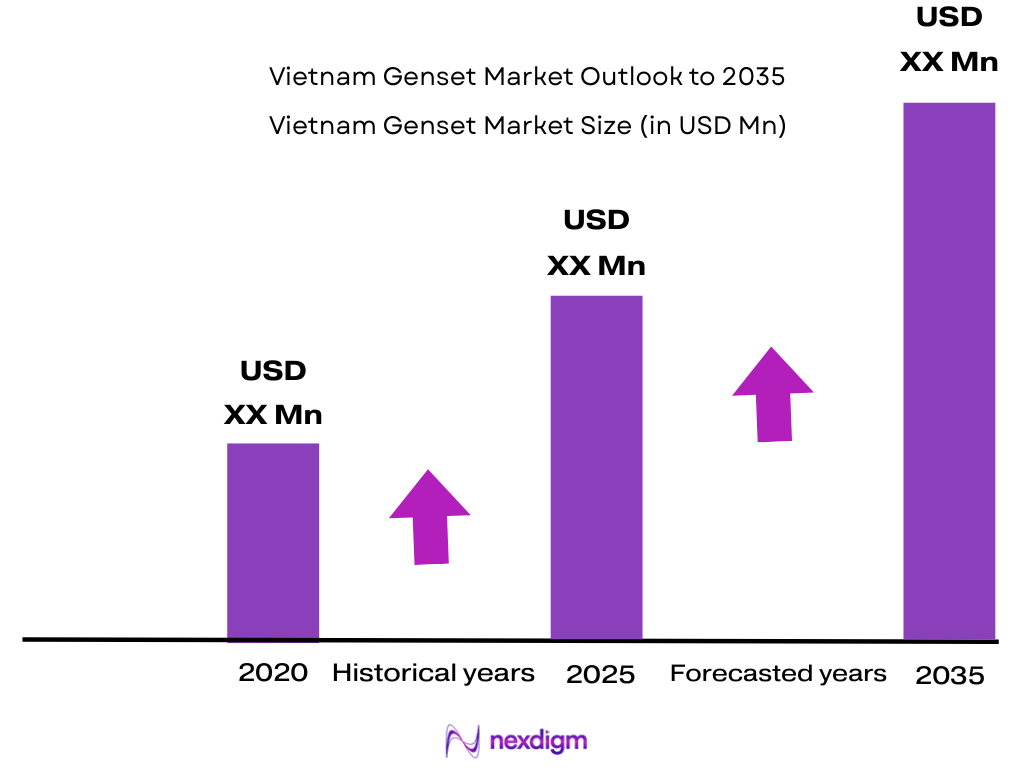
The Vietnam Genset Market is valued at approximately ~ million, supported by automobile sales increasing from 301,989 units to 340,142 units and national daily electricity consumption rising from a previous peak of about 940 million kWh to more than 1 billion kWh. Automotive workshops, dealerships, roadside service facilities, vehicle assembly plants and mobile maintenance operations require portable and standby electricity for diagnostic tools, compressors, lighting, welding equipment and emergency operations. Ho Chi Minh City, Hanoi, Hai Phong, Bac Ninh, Bac Giang, Hai Duong and the southern industrial corridor dominate automotive genset demand because they combine vehicle servicing activity, assembly operations, industrial parks and dense commercial infrastructure. Vietnam’s economy reached VND 11,511.9 trillion, equivalent to USD 476.3 billion, while automobile sales reached 340,142 units, strengthening demand for dependable auxiliary electricity across automotive production, distribution and aftermarket facilities.
Market Segmentation
By Power Rating
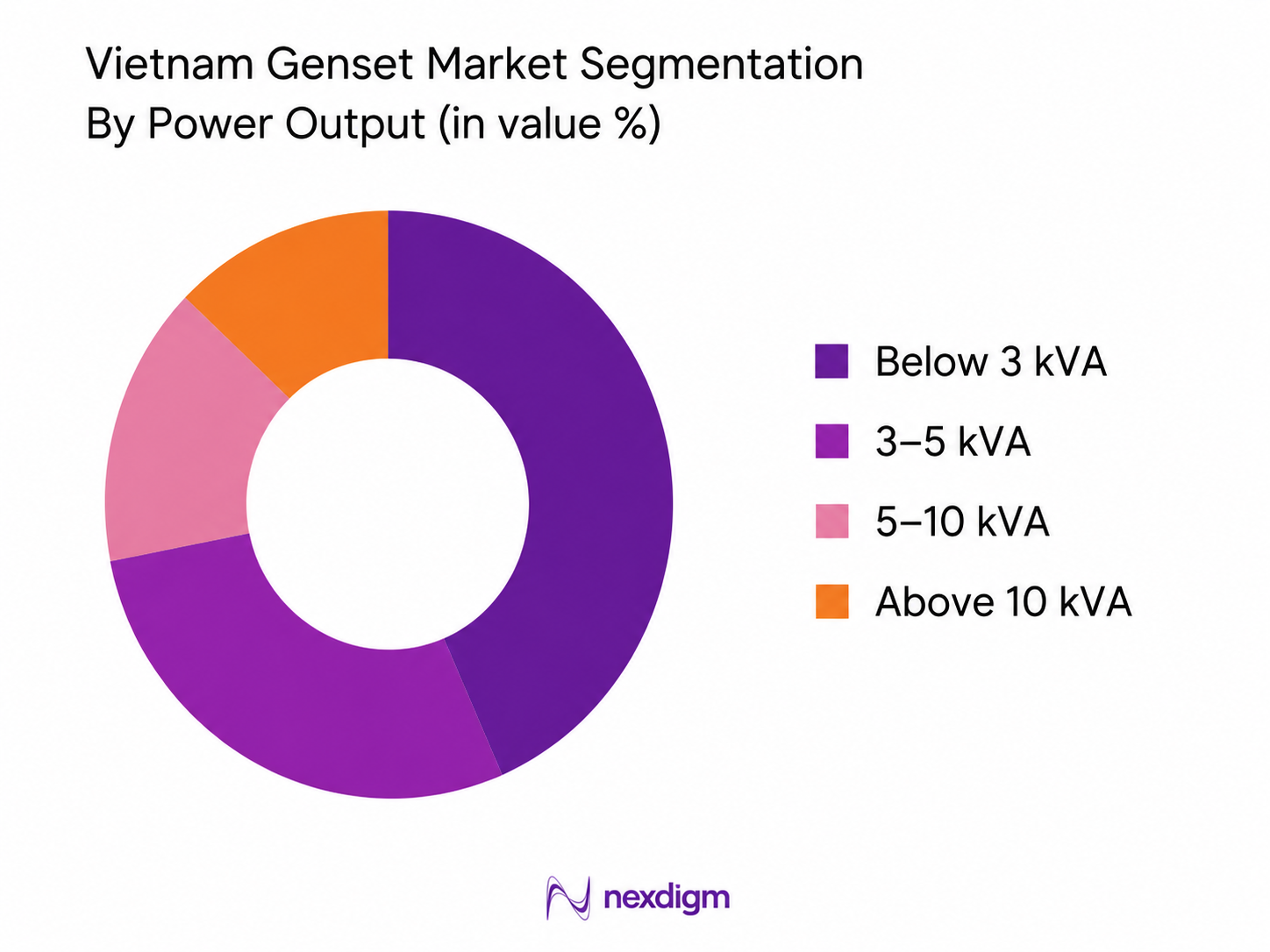
The Vietnam Genset Market is segmented into below 3 kVA, 3–5 kVA, 5–10 kVA and above 10 kVA automotive gensets. The 3–5 kVA segment holds the dominant market position because it provides sufficient output for the equipment commonly operated in independent garages, tyre shops, roadside repair units, detailing centres and small dealerships while remaining portable enough for mobile deployment. Typical loads include air compressors, battery chargers, diagnostic equipment, power tools, portable lighting and small welding equipment. Vietnam’s large two-wheeler and growing passenger-vehicle servicing ecosystem favours compact petrol-powered units because they can be transported between bays or roadside locations without the installation requirements associated with larger stationary systems. Honda’s portable inverter portfolio illustrates the technical characteristics favoured in this segment, while Yamaha’s EF2000iS demonstrates the importance of lightweight inverter architecture, low-noise operation and extended runtime. Huu Toan, a Vietnamese generator manufacturer, also supplies gasoline generators through a nationwide service network, strengthening local availability.
By Application
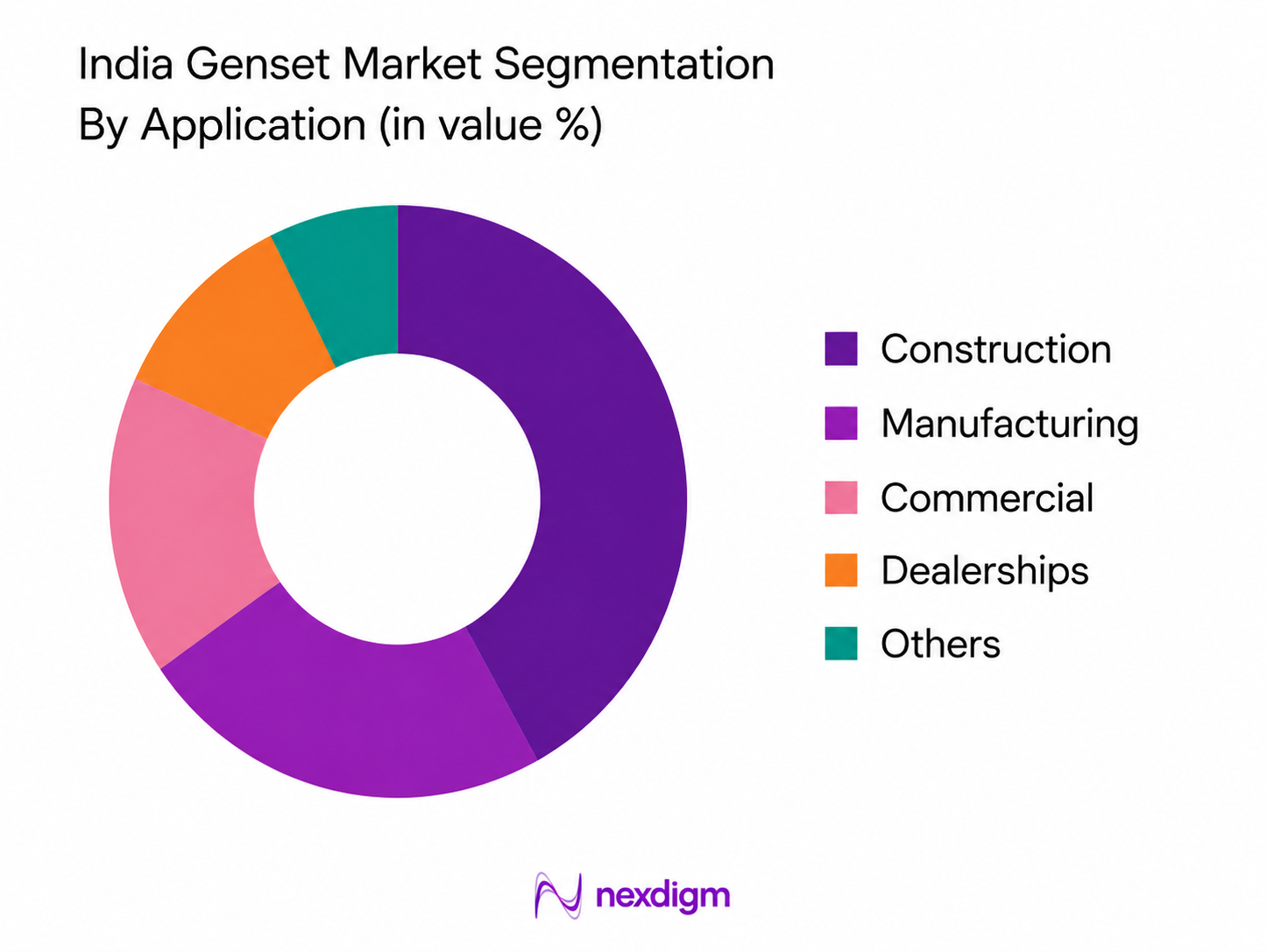
The Vietnam Genset Market is segmented into automotive workshops and repair centres, dealerships and service centres, vehicle manufacturing and assembly facilities, roadside/mobile maintenance, tyre and battery centres and automotive logistics facilities. Automotive workshops and repair centres account for the dominant market position because Vietnam’s expanding vehicle parc creates recurring demand for diagnostics, mechanical repairs, tyre servicing, lubrication, electrical repairs and bodywork. VAMA members recorded 340,142 vehicle sales, including 257,900 passenger vehicles, 79,332 commercial vehicles and 2,910 special-purpose vehicles, continually enlarging the serviceable fleet. Independent workshops frequently require backup power for lifts, compressors, scan tools, battery systems and lighting, particularly where maintaining operating continuity is commercially important. The application also favours petrol gensets because workshops often need relatively low-capacity portable units rather than large diesel installations. Increasing electronics content in new vehicles further raises the importance of stable electricity for computerized diagnostics and battery-support equipment.
Competitive Landscape
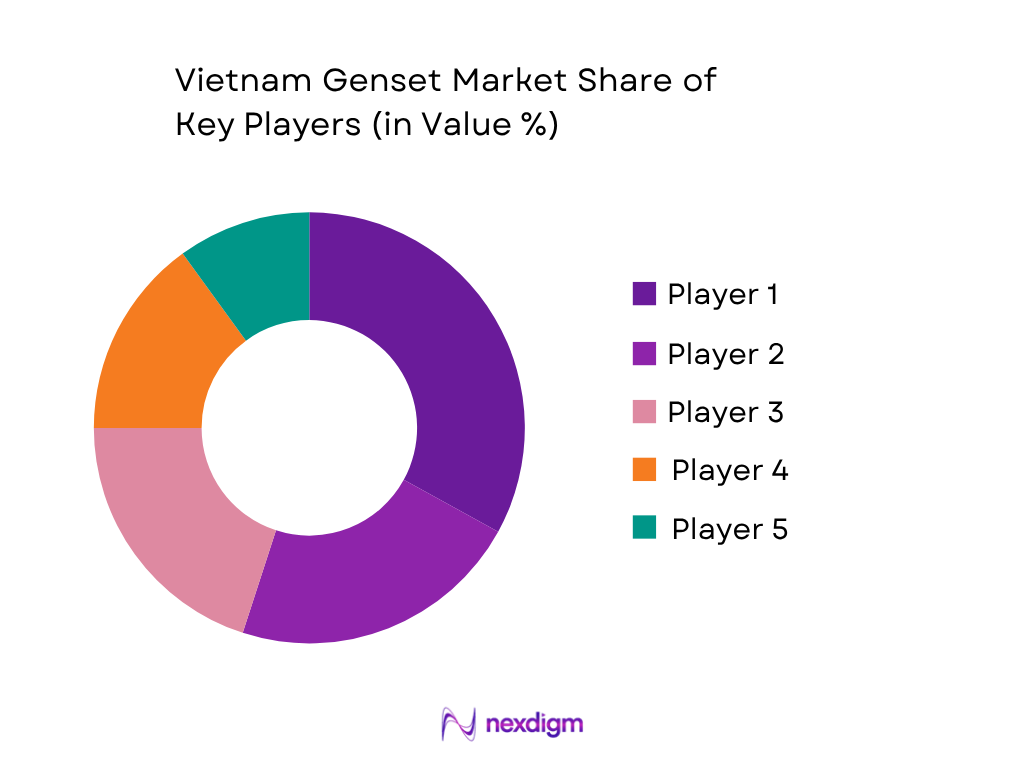
The Vietnam Genset Market combines established Japanese power-equipment brands, Vietnamese generator manufacturers, international portable-power companies and imported Asian equipment suppliers. Honda and Yamaha compete strongly through compact gasoline and inverter generators suited to workshops, roadside maintenance and portable automotive applications. Huu Toan has an important domestic position because it manufactures gasoline and diesel generators locally and maintains nationwide warranty support. Atlas Copco targets higher-duty portable-power applications, while Hyundai-branded generating equipment strengthens competition across imported power solutions. Product differentiation increasingly centres on fuel efficiency, inverter output quality, noise levels, portability, runtime and service availability.
| Major Player | Establishment Year | Headquarters | Automotive-Relevant Power Range | Petrol / Gasoline Capability | Inverter Technology | Portability | Runtime / Fuel Efficiency Focus | Vietnam Service / Distribution Presence |
| Honda Motor Co. | 1948 | Tokyo, Japan | ~ | ~ | ~ | ~ | ~ | ~ |
| Yamaha Motor Co. | 1955 | Iwata, Japan | ~ | ~ | ~ | ~ | ~ | ~ |
| Huu Toan Group | 1982 | Vietnam | ~ | ~ | ~ | ~ | ~ | ~ |
| Atlas Copco | 1873 | Stockholm, Sweden | ~ | ~ | ~ | ~ | ~ | ~ |
| Hyundai Power Equipment | 1947* | South Korea | ~ | ~ | ~ | ~ | ~ | ~ |
Vietnam Genset Market Analysis
Growth Drivers
Rapid Industrial Expansion and Manufacturing-Linked Backup Power Requirements
Vietnam’s accelerating manufacturing and industrial activity is a primary growth driver for automotive and mobile gensets because factories, workshops, warehouses, industrial parks, construction operations and vehicle-service facilities increasingly require dependable supplementary power for tools, lighting, compressors, diagnostic equipment and temporary operations. Vietnam’s General Statistics Office reported that the Index of Industrial Production reached 8.4 points of annual expansion in 2024, with manufacturing and processing remaining the principal contributor to industrial output. During the first quarter of 2025, industrial production continued expanding, with the national IIP registering 7.8 points of growth, indicating continued utilisation of production infrastructure and electrically powered industrial assets. This industrial development matters directly for mobile gensets because factories and industrial contractors cannot always tolerate electrical interruptions, especially during commissioning, maintenance, outdoor work, factory expansion or emergency conditions. The supporting macroeconomic environment is substantial: World Bank data places Vietnam’s GDP at USD 476.39 billion in 2024 and approximately USD 514.7 billion in 2025, while GDP per capita reached USD 5,066 in 2025. The IMF separately recorded a strong economic rebound in 2024, supported by exports and foreign direct investment, with the momentum continuing into 2025. Manufacturing-oriented foreign investment reinforces the need for increasingly reliable industrial power because multinational production operations require controlled voltage, continuity and contingency planning. Petrol-powered automotive gensets occupy an important niche within this ecosystem where portability and rapid deployment matter more than continuous baseload generation. Small workshops can use compact units for power tools and maintenance operations; construction contractors can deploy mobile sets before permanent electricity connections are completed; roadside automotive-service businesses can support equipment during outages; and industrial maintenance teams can move compact generators between sites. Vietnam’s infrastructure expansion also strengthens this relationship. Construction activity grew by 7.99 points during the first quarter of 2025, compared with 7.57 points in the corresponding period of the preceding year, according to the General Statistics Office. New factories, logistics facilities, highways, industrial parks and urban infrastructure create temporary electricity requirements during development phases when permanent grid infrastructure may not yet be fully operational. Portable gensets therefore function as complementary infrastructure rather than merely emergency household equipment. The opportunity is particularly relevant for petrol units in lower power bands because they are lighter, easier to relocate and suitable for intermittent loads such as construction tools, mobile service equipment, lighting and small compressors. Vietnam’s export-oriented economic model also raises the operational consequences of downtime. Manufacturing facilities supporting electronics, machinery, garments, automotive components and other export industries require strict production scheduling; temporary power systems can help support maintenance and contingency operations where even short interruptions can disrupt workflows. The combination of a USD 476.39 billion economy, expanding industrial production, continuing construction growth and substantial export-linked manufacturing activity therefore provides a broad, data-supported demand foundation for compact and mobile genset applications. Principal supporting sources include the General Statistics Office of Vietnam, World Bank and International Monetary Fund.
Rising Electricity Load and Requirement for Supplementary Power Resilience
Rapid increases in Vietnam’s electricity demand are strengthening the strategic role of supplementary gensets for businesses, construction contractors, workshops and mobile operations even as the national grid continues expanding. The Ministry of Industry and Trade reported that national peak electricity demand reached a record 54,370 MW on 4 August 2025, while the northern power system alone reached 28,167 MW. These record load levels illustrate the increasing stress placed on generation and transmission infrastructure by industrialisation, commercial activity, cooling loads and household consumption. The market relevance is not based on the assumption that Vietnam experiences continuous shortages; rather, it arises because businesses exposed to operational interruption increasingly require contingency equipment even when nationwide supply is broadly stable. The Ministry of Industry and Trade had already highlighted supply-security concerns in 2024, noting that electricity consumption had reached 141.8 billion kWh by 18 June while authorities worked to avoid a recurrence of the shortages recorded during the preceding summer. The requirement for resilience has strengthened further. In 2026, the government instructed the Ministry of Industry and Trade to secure at least 3,000 MW of peak-load reduction capability during the summer period and pursue substantial conservation measures when system imbalances could occur. For automotive and portable genset suppliers, these conditions create demand among users who require independent electricity for short-duration interruptions, remote operations or temporary sites. Vehicle workshops require lifts, diagnostic computers, lighting, compressors and battery-service equipment; small manufacturers need temporary energy to protect critical processes; contractors require portable electricity for tools and welding equipment; telecom maintenance teams need power at remote sites; and mobile service fleets benefit from generator sets mounted on vehicles or transported between jobs. Vietnam’s macroeconomic scale magnifies this electricity requirement. World Bank data indicates that national output increased from USD 476.39 billion in 2024 to USD 514.7 billion in 2025, while the country’s population reached approximately 101.6 million people in 2025. The IMF describes the economy as having maintained strong momentum through early 2025 following its 2024 rebound, reinforcing continued commercial electricity consumption. Importantly, electricity access itself is no longer the central issue: World Bank statistics indicate essentially universal electricity access. Consequently, genset demand is shifting from first-time electrification toward reliability, mobility and contingency applications. This distinction benefits compact petrol gensets because they can be deployed quickly without the installation complexity associated with large stationary generation. In construction, automotive repair, events, roadside services and light commercial applications, portability can be more important than continuous operating efficiency. The record 54,370 MW peak demonstrates the scale at which Vietnam’s electricity system must now operate, while the government’s 2026 requirement for 3,000 MW of peak reduction underscores the importance of demand management and resilience. Petrol gensets will not replace grid expansion, renewable generation or large diesel standby systems, but they remain valuable for distributed loads requiring independent, short-duration power. Principal supporting sources include the Ministry of Industry and Trade, World Bank and International Monetary Fund.
Market Challenges
Grid Reliability Improvements Reducing Dependence on Routine Backup Generation
One of the principal challenges for Vietnam’s Genset Market is the continuing improvement of national electricity availability and grid-management capability. Portable generators retain an important role in emergencies and remote applications, but they compete against a power system that has achieved effectively universal electricity access and is receiving substantial investment in generation, transmission and system planning. World Bank data records electricity access at essentially 100 out of every 100 residents in 2024, meaning the market no longer benefits materially from large unelectrified population clusters requiring primary generator-based electricity. Instead, genset demand increasingly depends on temporary power, operational resilience and specialised mobile applications. The Ministry of Industry and Trade reported that electricity supply during the first eight months of 2025 essentially met actual consumption requirements despite national peak demand reaching a record 54,370 MW and northern peak demand reaching 28,167 MW. This is important commercially because improved supply reliability reduces the number of businesses that need to operate petrol generators routinely during grid outages. The government is simultaneously accelerating power-development projects under the adjusted Power Development Plan VIII, with provincial authorities instructed to resolve investor-selection, planning and project-approval bottlenecks. Vietnam has also continued commissioning substantial centralized generation infrastructure, expanding the electricity resources available to industrial and urban users. The long-term competitive challenge is therefore structural: genset manufacturers cannot depend only on inadequate grid supply as their value proposition. As transmission systems, renewable generation, battery storage, demand-response programmes and large power projects expand, routine generator operation should become less necessary in well-connected industrial and urban locations. Government electricity-management policies reinforce this shift. During 2026, authorities targeted 3,000 MW of peak-load reduction capability and introduced broader energy-saving measures designed to manage high-demand periods without relying solely on emergency generation. For petrol genset suppliers, this pushes demand toward applications where mobility provides clear value—construction projects, roadside repair, mobile workshops, disaster response, events and remote temporary work—rather than permanent stationary backup at large factories. Economic development can simultaneously intensify this challenge because newer buildings and factories may incorporate modern uninterruptible power supplies, battery energy-storage systems, rooftop solar and sophisticated electrical management. Vietnam’s economy expanded to approximately USD 514.7 billion in 2025, providing customers with greater capacity to invest in alternatives to small combustion-based generation. Hybrid solar-plus-storage solutions are particularly competitive for users concerned about noise, emissions and repeated fuel handling. Petrol gensets therefore need to compete through low upfront complexity, portability, fast refuelling, compact dimensions and high power-to-weight characteristics. Manufacturers that fail to move beyond a basic “power outage” proposition could face declining relevance as grid infrastructure improves. Successful suppliers will increasingly target differentiated cases where grid-connected alternatives cannot provide equivalent mobility or instantaneous deployability. Principal supporting sources include the World Bank and Vietnam Ministry of Industry and Trade.
Fuel Supply Exposure, Emissions Pressure and Energy-Transition Requirements
Petrol-powered gensets face a second structural challenge from Vietnam’s exposure to petroleum supply conditions and its broader transition toward cleaner energy. Small gasoline generators provide rapid and convenient power, but their operating model depends on continued availability of refined fuel, making them vulnerable to supply-chain disruptions and evolving environmental policies. Vietnam’s Ministry of Industry and Trade warned in 2024 that domestic fuel-supply management remained challenging because international conflicts, disruptions in Red Sea shipping, production decisions by oil-exporting countries and changes in global petroleum inventories could affect fuel flows. These risks matter to genset operators because fuel must be transported and stored wherever generators are deployed, particularly on construction sites, roadside operations or rural work locations. Petrol also requires careful storage because of volatility, degradation and fire-safety considerations. The challenge becomes more pronounced as Vietnam increases its energy-import dependence. The Ministry of Industry and Trade reported in 2026 that Vietnam had been a net energy importer for years and that imported energy represented 43.9 parts of every 100 units of national energy supply in 2025. Although the user requirement excludes percentages as a preferred presentation, this government indicator is relevant because it demonstrates a rising dependence on external energy flows that can affect combustion-based backup systems. More fundamentally, Vietnam has committed to reaching net-zero carbon emissions by 2050, and the World Bank notes continued national emphasis on green growth, climate resilience and cleaner energy investment. Small petrol engines emit carbon dioxide, carbon monoxide, nitrogen oxides and other pollutants during operation, which creates increasing competitive pressure from battery power stations, hybrid solar-storage systems and cleaner generator technologies. Noise is another limitation for petrol gensets deployed around residential buildings, hotels, hospitals or dense urban commercial districts. Regulatory tightening can therefore increase engineering requirements for mufflers, catalytic systems, fuel management and engine controls. The broader electricity transition accelerates the challenge. Commercial electricity consumption reached approximately 288 billion kWh in 2025, according to Ministry of Industry and Trade information, creating a large incentive to expand cleaner centralized generation and renewable capacity rather than distributed fossil-fuel generation. Vietnam’s strong macroeconomic performance increases pressure to reconcile growth with energy security. World Bank data places the economy at USD 514.7 billion in 2025, while the IMF identifies infrastructure development and structural reforms as important parts of the country’s medium-term strategy. Petrol genset suppliers must therefore improve fuel economy and emissions performance while demonstrating that their products serve short-duration, mobile or emergency applications rather than competing directly against cleaner long-duration energy systems. Multi-fuel technology, electronic fuel injection, variable-speed engines and hybrid generator-battery configurations can reduce some exposure, but they increase product complexity. The central challenge for Vietnam’s Automotive Genset Market is consequently balancing the practical advantages of portable petrol generation against an economy increasingly focused on energy security, efficient electricity consumption and lower-emission power systems. Principal supporting sources include the Ministry of Industry and Trade, World Bank and International Monetary Fund.
Market Opportunities
Inverter Gensets, Smart Controls and Hybrid Generator-Battery Systems
Technological upgrading represents one of the strongest future opportunities for Vietnam’s Genset Market because the country’s expanding industrial and digital economy increasingly requires cleaner, quieter and more precisely regulated mobile electricity. The opportunity can be justified from current power and economic indicators rather than speculative future market statistics. National peak electricity demand reached 54,370 MW in August 2025, while the northern system recorded 28,167 MW, demonstrating the growing scale and complexity of Vietnam’s electricity requirements. At the same time, World Bank data records approximately 84 internet users for every 100 residents in 2024, indicating extensive use of digital equipment and electronically sensitive devices across households and businesses. Conventional fixed-speed generators are less suitable for some sensitive electronics because fluctuations in voltage and frequency can affect equipment performance. Inverter petrol gensets address this requirement by converting generated current electronically, enabling cleaner output for computers, diagnostic equipment, telecommunications hardware, electronic tools and mobile service systems. Variable engine speed can additionally reduce unnecessary fuel consumption and noise when electrical loads are below rated output. These characteristics are relevant to automotive workshops, mobile mechanics, construction crews, telecom maintenance teams and event operators. Smart monitoring adds another layer of opportunity. Bluetooth, Wi-Fi or cellular-connected generator controls can provide runtime information, maintenance alerts, fuel status and fault diagnostics, allowing fleet owners to manage multiple mobile gensets more systematically. Vietnam’s large internet-connected population and rapidly digitising manufacturing sector create a favourable environment for such connected equipment. Industrial production continued expanding during 2025, while construction activity recorded 7.99 points of expansion in the first quarter, providing a broad installed customer base for portable power equipment. Hybrid generator-battery systems provide an even larger technical opportunity. Instead of operating a combustion engine continuously under variable load, the petrol generator can charge a battery when required and shut down when stored energy is sufficient. This configuration reduces engine runtime, noise and fuel consumption while retaining the fast refuelling and emergency availability of liquid fuel. It can be particularly useful on construction sites, mobile service vans, temporary roadside facilities and telecom maintenance locations. Vietnam’s energy-transition direction strengthens the commercial logic for such systems. The World Bank highlights the country’s net-zero commitment and increasing investment in climate resilience and green growth. Hybrid systems allow existing genset manufacturers to participate in this transition rather than competing exclusively against battery suppliers. The broader macroeconomic foundation is strong: Vietnam produced approximately USD 476.39 billion of GDP in 2024 and USD 514.7 billion in 2025, while industrial activity and infrastructure investment continued expanding. These conditions support customer migration from basic open-frame generators toward enclosed inverter sets, remote-start systems, electronically controlled engines and hybrid power packages. Suppliers capable of combining engine engineering, alternator technology, power electronics and battery-management systems can therefore create substantially more differentiated products than traditional commodity generators. Principal supporting sources include the World Bank, General Statistics Office and Ministry of Industry and Trade.
Infrastructure Construction, Remote Worksites and Mobile Service Applications
Vietnam’s continuing infrastructure and construction expansion creates a significant opportunity for portable and automotive gensets because many work locations require electricity before permanent grid connections are established or at points where grid power cannot conveniently follow moving crews. The General Statistics Office reported construction activity expanding by 7.99 points in the first quarter of 2025, compared with 7.57 points during the corresponding period in 2024. This activity encompasses roads, industrial facilities, commercial buildings, logistics infrastructure and public-investment projects, all of which generate temporary requirements for lighting, electric tools, pumps, compressors, testing equipment and mobile workshops. The opportunity is strengthened by Vietnam’s wider infrastructure programme. The IMF has specifically identified accelerated public investment and implementation of planned infrastructure projects as important elements supporting economic activity and medium-term productive capacity. Petrol gensets fit selected construction and service applications because compact units can be carried in pickup trucks, vans or trailers and deployed without fixed installations. Units in lower and medium output bands are particularly suitable for construction contractors, mobile vehicle-service technicians, road-maintenance crews, agricultural mechanics, telecom field teams and emergency-response operations. Vietnam’s geography strengthens the case for mobility. Although World Bank data indicates effectively universal household electricity access, access does not mean that electrical supply is available exactly where temporary work is conducted. Road-building crews, temporary depots, roadside repair operations, bridge projects and outdoor maintenance activities may operate far from convenient connection points. Portable generators solve a location problem rather than an electrification problem. The continuing expansion of Vietnam’s economy also increases the absolute scale of commercial and infrastructure activity. GDP reached approximately USD 476.39 billion in 2024 and USD 514.7 billion in 2025, while the population approached 101.6 million people in 2025. These fundamentals support continued requirements for transportation, residential construction, commercial facilities and logistics infrastructure. Electricity-system pressures provide an additional rationale for mobile contingency equipment. National peak load reached 54,370 MW in 2025, and the government subsequently instructed authorities to secure 3,000 MW of peak-load reduction capability during high-demand summer periods in 2026. Contractors and mobile service businesses that cannot postpone work during localized supply disruptions can therefore maintain portable generators as resilience assets even when grid reliability is generally high. Manufacturers can capture this opportunity by developing rugged products specifically for field operations: reinforced frames, wheel kits, weather-resistant enclosures, electric start, multiple protected outlets, low-oil shutdown, digital hour meters and simplified maintenance access. Rental companies represent another route to market because construction firms may require equipment only for particular projects rather than permanent ownership. Service networks and spare-parts availability will be central competitive factors, especially outside Hanoi and Ho Chi Minh City where field equipment may operate far from major distributors. The opportunity is therefore based on current infrastructure momentum rather than speculative demand projections: construction is already expanding, economic output exceeds USD 500 billion, and electricity loads are reaching new records. Automotive gensets that combine portability, reliability and contractor-oriented engineering can address a clear operational requirement within Vietnam’s infrastructure development cycle. Principal supporting sources include the General Statistics Office, World Bank, International Monetary Fund and Ministry of Industry and Trade.
Future Outlook
The Vietnam Genset Market is expected to expand at approximately ~ CAGR during 2026–2035, supported by continuing vehicle parc expansion, growing automotive manufacturing activity and increasing demand for reliable electricity in service environments. Future demand will increasingly favour compact inverter generators capable of supplying stable electricity to sensitive diagnostic equipment, ECU programming systems, battery chargers and electronically controlled workshop equipment. Low-noise designs will become more important as service centres expand within dense urban areas. At the same time, rapid improvements in Vietnam’s national grid will limit purely outage-driven generator demand in major urban centres. However, automotive facilities requiring continuity, mobile repair teams and workshops in secondary cities will continue to use generators for redundancy and temporary power. Vietnam’s record electricity consumption demonstrates the importance of resilience. Electricity consumption exceeded 1 billion kWh in a single day, while first-half commercial electricity supplied by EVN reached 135.64 billion kWh. Rising industrial and commercial loads are therefore likely to maintain interest in localized backup systems even as national generating capacity expands.
Major Players
- Honda Power Equipment
- Yamaha Motor Power Products
- Huu Toan Group
- Hyundai Power Equipment
- Atlas Copco
- Elemax / Sawafuji Electric
- Denyo
- Generac
- Briggs & Stratton
- Kohler Energy
- FIRMAN Power Equipment
- Total Tools
- INGCO
- Lutian Machinery
- Kipor Power Equipment
Key Target Audience
- Genset manufacturers
- Portable power-equipment distributors and dealers
- Automobile OEMs and vehicle assembly companies
- Automotive dealerships and authorized service networks
- Independent automotive workshops and mobile service operators
- Automotive component and industrial-equipment suppliers
- Investments and venture capitalist firms
- Government and regulatory bodies (Ministry of Industry and Trade, Ministry of Construction, Vietnam Register, Electricity Regulatory Authority of Vietnam)
Research Methodology
Step 1: Identification of Key Variables
The initial phase constructs an ecosystem map for the Vietnam Genset Market covering generator manufacturers, importers, automotive OEMs, dealers, workshops, mobile service operators and industrial users. Key variables include generator power rating, fuel type, operating hours, automotive load requirements, inverter capability, noise levels, portability, fuel-tank capacity, distribution coverage and service infrastructure.
Step 2: Market Analysis and Construction
Historical market demand is developed using a combination of automotive fleet activity, new vehicle sales, workshop density, automotive manufacturing activity and portable-power requirements. VAMA vehicle sales, industrial activity and national electricity-demand indicators are assessed alongside generator product specifications and distribution structures. The analysis separates workshop backup demand from mobile service, dealership and automotive manufacturing applications.
Step 3: Hypothesis Validation and Expert Consultation
Market hypotheses are validated through structured interviews and CATIs with generator distributors, automotive workshops, equipment dealers, OEM service centres and fleet-maintenance operators. Interviews evaluate preferred kVA ratings, average generator utilisation, conventional versus inverter preference, portability requirements, noise sensitivity, maintenance frequency, purchasing criteria and brand-selection behaviour.
Step 4: Research Synthesis and Final Output
The final phase triangulates demand-side workshop and automotive activity with supply-side generator availability, product ranges and dealer coverage. Technical benchmarks from manufacturers including Honda, Yamaha, Huu Toan and Atlas Copco are used to classify products by portable power capability, runtime and intended operating environment. The model is then validated against Vietnam’s automotive sales, industrial activity and electricity-demand conditions.

- Executive Summary
- Research Methodology (Market Definition and Scope, Automotive Genset Classification, Top-Down Market Sizing, Bottom-Up Unit Assessment, Import and Local Assembly Analysis, kVA-Wise Demand Modelling, End-User Installation Mapping, Distributor and Dealer Interviews, EPC and Rental Company Interviews, Data Triangulation, Forecasting Framework, Research Limitations)

- Definition and Scope
- Industry Evolution and Genset Adoption Cycle
- Vietnam Power Backup Ecosystem
- Automotive and Engine-Driven Genset Industry Genesis
- Installed Genset Base and Replacement Cycle

- Growth Drivers (Industrial Park Expansion, Manufacturing FDI, Construction Activity, Digital Infrastructure, Critical Power Reliability)
- Market Challenges (Fuel Consumption, Emissions, Noise, Import Dependence, Maintenance Complexity)
- Market Opportunities (Hybrid Gensets, Local Assembly, Rental Power, Digital Monitoring, High-Efficiency Engines)
- Market Trends (Digital Controllers, IoT Monitoring, ATS Integration, Low-Noise Enclosures, Fuel Optimization)
- Government Regulations and Standards (Engine Emissions, Noise Limits, Electrical Safety, Fire Protection, Import Compliance, Environmental Requirements)
- SWOT Analysis
- Porter’s Five Forces Analysis
- PESTLE Analysis

- By Market Value (2020-2025)
- By Unit Sales (2020-2025)
- By Installed Capacity in kVA (2020-2025)

- By Power Rating (In Value %)
Below 10 kVA
10–30 kVA
31–75 kVA
76–125 kVA
126–250 kVA - By Genset Configuration (In Value %)
Open-Type Gensets
Silent/Acoustic-Enclosed Gensets
Containerized Gensets
Portable Gensets
Mobile/Towable Gensets
Customized Packaged Gensets - By Application (In Value %)
Emergency Backup Power
Continuous Industrial Power
Construction Site Power
Temporary and Rental Power
Remote-Site Power
Telecom Backup Power - By Region (In Value %)
Ho Chi Minh City and Southeast Vietnam
Hanoi and Red River Delta
Northern Industrial Corridor
Central Vietnam
Mekong Delta
Northern Midlands and Mountainous Areas

- Market Share of Major Players
- Cross Comparison Parameters (Power Range in kVA, Engine Platform, Fuel Consumption Efficiency, Acoustic Performance, Controller and Remote Monitoring Capability, Dealer and Service Network Coverage, Local Assembly and Customization Capability, Warranty and Spare-Parts Support)
- SWOT Analysis of Major Players
- Detailed Profiles of Major Companies
Cummins
Caterpillar
Mitsubishi Heavy Industries Engine & Turbocharger
Denyo
Kohler Energy / Rehlko
FG Wilson
Perkins-Powered Generator Systems
Yanmar
Doosan Bobcat / Hyundai Infracore Engine-Based Gensets
Atlas Copco
Himoinsa
Baudouin-Powered Generator Systems
Huu Toan Group
SBMPOWER
Truong Loc Power

- Industrial Manufacturing Demand Assessment
- Automotive and Auto-Component Factory Demand
- Electronics and Semiconductor Facility Demand
- Construction Contractor Demand
- Data Center Genset Demand

- By Market Value (2026-2035)
- By Unit Sales (2026-2035)
- By Installed Capacity in kVA (2026-2035)


 Request a Sample
 Ask for Customization
 Get a Quote
 Enquire Now