

 Download PDF
Market Overview
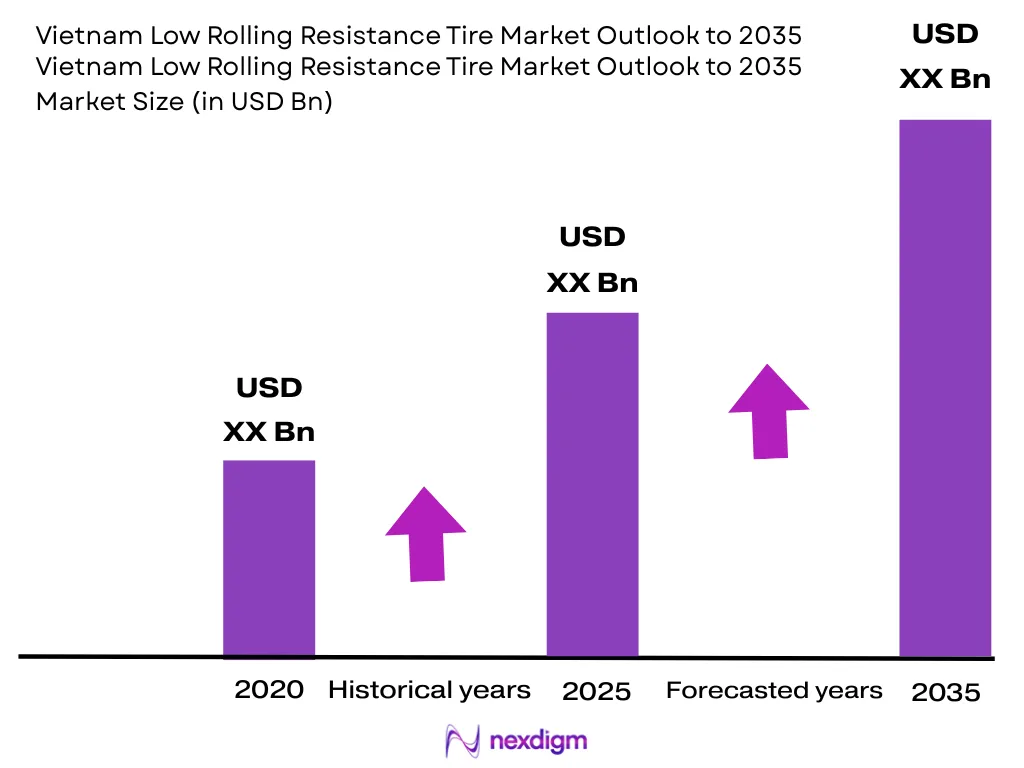
The Vietnam Low Rolling Resistance Tire Market is valued at USD ~ Billion in 2024 based on a five-year historical assessment, driven by expanding automobile manufacturing, rising exports of tires and vehicles, increasing demand for fuel-efficient mobility, and the growing adoption of electric vehicles. According to the Vietnam Automobile Manufacturers Association (VAMA), member companies sold 301,989 vehicles in 2023, while the General Statistics Office (GSO) reported domestic automobile production exceeded 388,500 vehicles during 2024. Vietnam also remains one of the world’s leading natural rubber producers, providing a strong raw material base for tire manufacturing. Increasing foreign direct investment in automotive manufacturing, stricter vehicle efficiency requirements, and the expansion of premium passenger vehicle production continue to support demand for low rolling resistance tires across both OEM and replacement markets.
Market Segmentation
By Vehicle Type
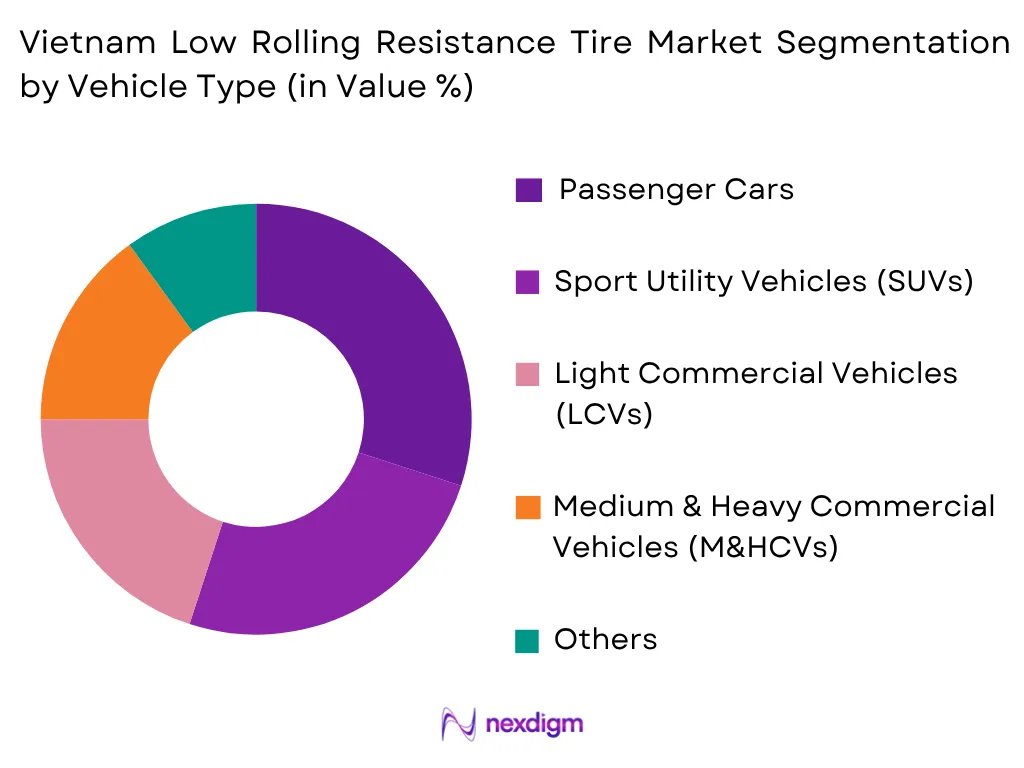
The Passenger Cars segment dominates the Vietnam Low Rolling Resistance Tire Market owing to increasing private vehicle ownership, rising urban incomes, and expanding domestic vehicle production. Automobile manufacturers are increasingly equipping passenger cars with low rolling resistance radial tires to improve fuel economy, reduce carbon emissions, and comply with tightening environmental standards. The rapid expansion of hybrid and battery electric passenger vehicles has further accelerated demand for specialized tires that offer lower rolling resistance, reduced road noise, and enhanced durability. Consumers are becoming increasingly aware of total vehicle operating costs, encouraging adoption of premium fuel-efficient tires that deliver long-term fuel savings. In addition, Vietnam’s growing middle-income population continues to support higher sales of passenger sedans, hatchbacks, and SUVs, strengthening OEM demand as well as replacement tire purchases. Continuous investments by global tire manufacturers in advanced silica-based tread compounds and lightweight tire technologies further reinforce the dominance of the passenger car segment.
By Sales Channel
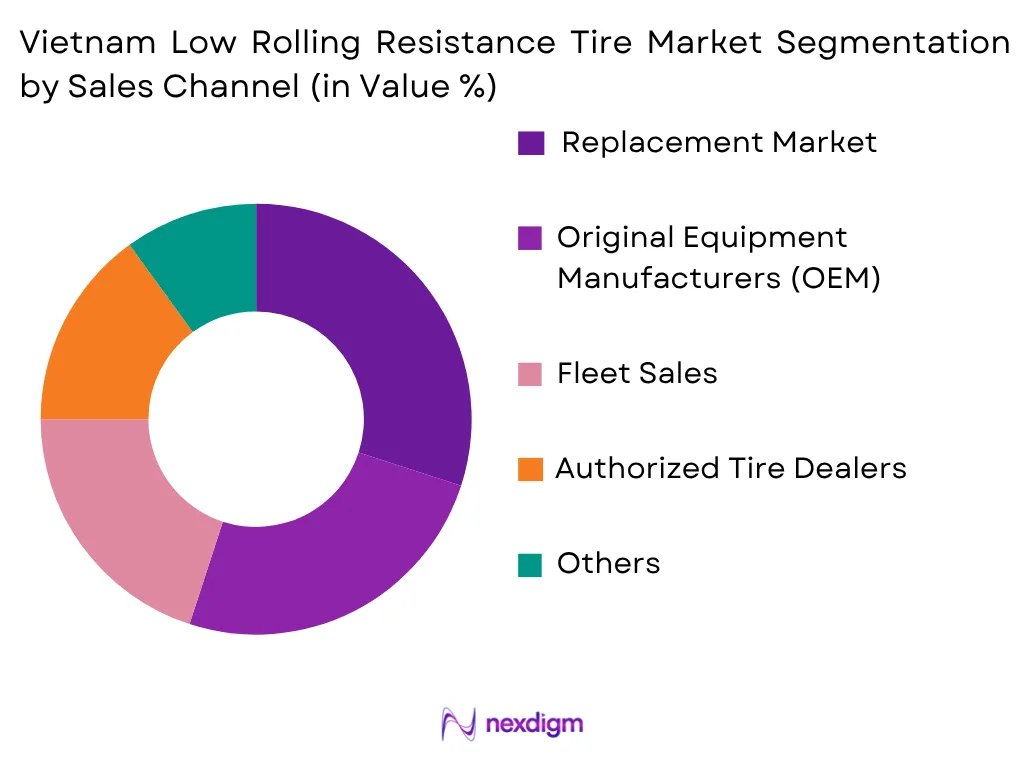
The Replacement Market accounts for the largest share of the Vietnam Low Rolling Resistance Tire Market because tires require periodic replacement throughout the operational life of every vehicle, creating recurring demand significantly larger than original equipment fitments. Rising vehicle ownership, expanding freight transportation, growing ride-hailing services, and increasing highway connectivity have accelerated tire replacement cycles across passenger and commercial vehicles. Fleet operators increasingly prefer low rolling resistance tires because improved fuel efficiency helps reduce long-term operating expenses while enhancing vehicle productivity. Growing awareness regarding premium tire performance, increasing availability of branded products through nationwide dealer networks, and expanding aftersales service infrastructure have further strengthened the replacement segment. Manufacturers are also launching vehicle-specific low rolling resistance tires for passenger cars, SUVs, commercial vehicles, and electric vehicles, allowing consumers to upgrade from conventional tires. These factors collectively ensure that the replacement market remains the primary revenue contributor within Vietnam’s low rolling resistance tire industry.
Competitive Landscape
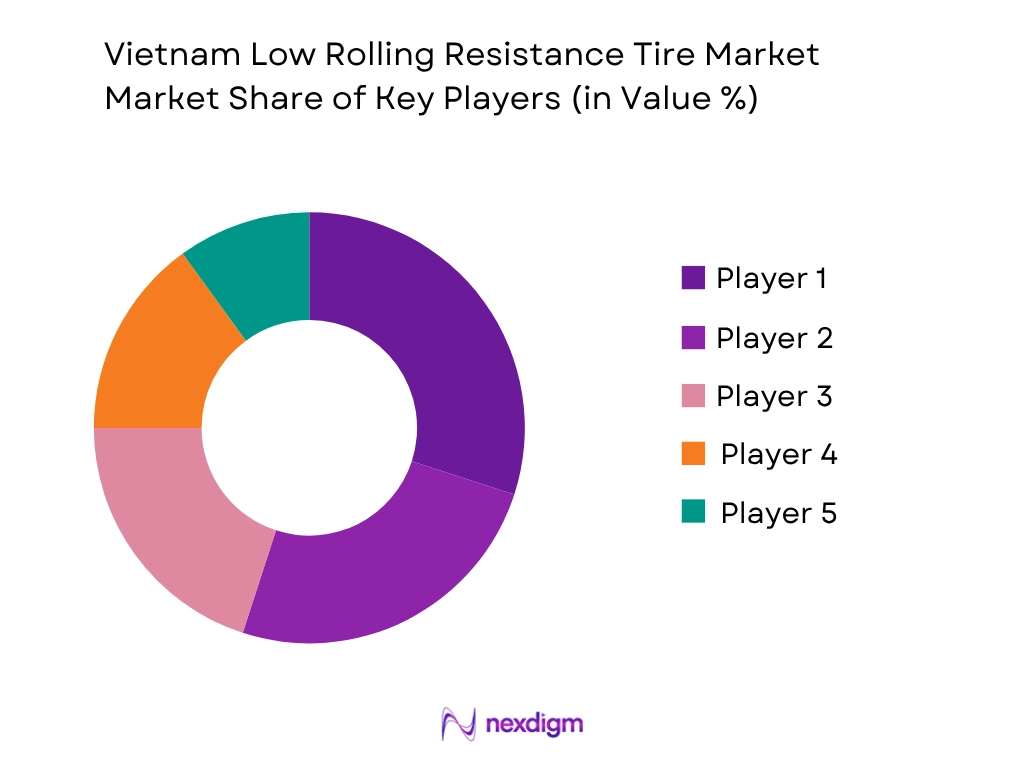
The Vietnam Low Rolling Resistance Tire Market is moderately consolidated, with domestic tire manufacturers competing alongside multinational companies that leverage advanced tire technologies, extensive OEM relationships, and export-oriented production facilities. Competition is driven by continuous investments in silica-based tread compounds, lightweight tire construction, EV-specific tire development, and sustainable manufacturing practices. Manufacturers are expanding production capacity to meet both domestic demand and international exports, while strengthening partnerships with automobile OEMs operating in Vietnam. Companies also compete through product innovation, research and development, dealer network expansion, quality certifications, and premium replacement tire offerings. The increasing localization of vehicle production and the rapid emergence of electric mobility are further encouraging manufacturers to introduce technologically advanced low rolling resistance tires optimized for fuel efficiency, durability, and reduced carbon emissions.
| Company | Establishment Year | Headquarters | OEM Partnerships | Low Rolling Resistance Tire Portfolio
|
Manufacturing Plants in Vietnam | Major End-Use Industries | Key Strategic Focus | Certifications & Compliance |
| Sailun Vietnam | 2005 | ~ | ~ | ~ | ~ | ~ | ~ | ~ |
| Bridgestone Vietnam | 2014 | ~ | ~ | ~ | ~ | ~ | ~ | ~ |
| Kumho Tire Vietnam | 2008 | ~ | ~ | ~ | ~ | ~ | ~ | ~ |
| Casumina (Southern Rubber Industry JSC) | 1976 | ~ | ~ | ~ | ~ | ~ | ~ | ~ |
| Danang Rubber Joint Stock Company (DRC) | 1975 | ~ | ~ | ~ | ~ | ~ | ~ | ~ |
Vietnam Low Rolling Resistance Tire Market Analysis
Growth Drivers
Expansion of Automobile Manufacturing and Tire Production
Vietnam’s rapidly expanding automotive manufacturing industry is a major driver for the Low Rolling Resistance Tire Market as increasing vehicle production directly stimulates OEM tire demand while enlarging the future replacement market. According to the General Statistics Office (GSO) of Vietnam, domestic automobile production exceeded 388,500 vehicles in 2024, reflecting continued expansion of local assembly operations. The Vietnam Automobile Manufacturers Association (VAMA) reported sales of 301,989 vehicles during 2023, while production capacity continued to increase through investments by VinFast, Toyota, Hyundai, Honda, Ford, and Kia. The International Monetary Fund (IMF) estimated Vietnam’s GDP at approximately USD 506 billion in 2024, supported by strong manufacturing and export activity. Vietnam has also become one of Southeast Asia’s major tire manufacturing hubs with extensive investments from Bridgestone, Kumho Tire, Sailun, Yokohama, and Casumina. Increasing domestic vehicle ownership, growing commercial transportation, expanding industrial production, and rising exports of automobiles continue to encourage OEMs to adopt fuel-efficient tire technologies. Manufacturers are increasingly integrating low rolling resistance tires into new passenger vehicles to improve fuel economy, reduce emissions, and comply with international vehicle efficiency standards while supporting export competitiveness.
Rising Electric Vehicle Adoption and Sustainable Mobility Initiatives
Vietnam’s transition toward cleaner transportation is creating substantial demand for low rolling resistance tires specifically engineered for electric and hybrid vehicles. According to the Ministry of Industry and Trade, electric vehicle manufacturing continues expanding through domestic investments led by VinFast and supporting component manufacturers. Electric vehicles require specialized tires capable of supporting higher battery weight while minimizing rolling resistance to maximize driving range and energy efficiency. The Vietnamese government continues encouraging sustainable transportation through industrial development strategies, localization of automotive manufacturing, and investments in charging infrastructure. At the same time, global automobile manufacturers operating production facilities within Vietnam are increasingly introducing hybrid and electric vehicle models equipped with advanced fuel-efficient tire technologies. Low rolling resistance tires incorporating silica-rich tread compounds, lightweight construction, and optimized tread patterns improve battery efficiency while reducing operational costs for vehicle owners. These technological developments, combined with expanding EV production capacity and increasing consumer awareness regarding environmentally sustainable mobility, continue creating favorable conditions for advanced tire adoption across Vietnam’s passenger vehicle and commercial transportation sectors.
Market Challenges
Dependence on Advanced Raw Materials and Premium Manufacturing Technologies
Although Vietnam is among the world’s largest producers of natural rubber, manufacturing high-performance low rolling resistance tires requires advanced raw materials including specialty silica, synthetic elastomers, functional polymers, reinforcing chemicals, and precision manufacturing technologies that are partially dependent on imported supply chains. Premium tire compounds require sophisticated formulation processes capable of balancing rolling resistance, wet grip, durability, heat generation, and tread wear. Disruptions in global logistics, fluctuations in specialty chemical availability, and dependence on imported processing technologies may affect production efficiency and product development timelines. Manufacturers must also continuously invest in automated production equipment, laboratory testing, quality assurance systems, and research facilities to remain internationally competitive. Advanced manufacturing requirements increase operational complexity for both domestic producers and multinational manufacturers operating in Vietnam. As international demand for premium fuel-efficient tires continues expanding, maintaining stable access to advanced production inputs and technological expertise remains an ongoing challenge for manufacturers seeking to produce globally competitive low rolling resistance tire products.
Consumer Price Sensitivity within the Replacement Tire Market
Price sensitivity continues to influence purchasing decisions across Vietnam’s replacement tire market, limiting the adoption of premium low rolling resistance tire products despite their long-term operational benefits. Many vehicle owners continue prioritizing lower initial purchase costs rather than evaluating lifetime fuel savings, durability, and reduced operating expenses associated with advanced tire technologies. Independent tire retailers frequently offer conventional tire alternatives that remain attractive to budget-conscious consumers, particularly within entry-level passenger vehicles and light commercial vehicle segments. Commercial fleet operators may also delay upgrading to premium fuel-efficient tires due to procurement budget limitations despite recognizing long-term fuel efficiency benefits. Tire manufacturers therefore face the challenge of educating customers regarding total lifecycle cost advantages while maintaining competitive pricing across increasingly crowded aftermarket distribution channels. Expanding awareness of fuel economy benefits, improving dealer education, and strengthening premium product positioning remain important priorities for manufacturers seeking to increase penetration of low rolling resistance tire technologies throughout Vietnam’s replacement market.
Market Opportunities
Expansion of Tire Exports and International Manufacturing Investments
Vietnam continues strengthening its position as one of Asia’s major tire manufacturing and export centers, creating significant opportunities for low rolling resistance tire production. According to the General Department of Vietnam Customs, tires remain an important export product supported by expanding manufacturing investments from global tire companies including Bridgestone, Kumho Tire, Sailun, Yokohama, and other international manufacturers. Vietnam’s strategic geographic location, competitive manufacturing costs, extensive trade agreements, and well-developed export infrastructure continue attracting additional foreign direct investment into automotive component production. Growing international demand for fuel-efficient passenger vehicles and electric vehicles encourages manufacturers to expand production of premium low rolling resistance tires meeting global performance standards. Export-oriented manufacturing also supports technology transfer, improved production quality, higher automation levels, and greater research investment across domestic manufacturing facilities. These developments create substantial opportunities for further expansion of advanced tire manufacturing within Vietnam while strengthening its role in global automotive supply chains.
Increasing Fleet Modernization and Commercial Transportation Growth
Vietnam’s rapidly expanding logistics, manufacturing, and e-commerce industries create favorable conditions for the adoption of low rolling resistance tires across commercial transportation fleets. According to the General Statistics Office (GSO), manufacturing, wholesale trade, transportation, and logistics continue contributing significantly to Vietnam’s economic expansion. Commercial vehicle operators increasingly prioritize fuel efficiency as transportation activity grows across domestic distribution networks and international trade corridors. Low rolling resistance tires help reduce fuel consumption, improve vehicle productivity, extend tire service life, and lower overall fleet operating costs, making them attractive for logistics companies, public transportation providers, and long-distance freight operators. Increasing investments in highway infrastructure, industrial parks, export processing zones, and cross-border transportation networks further strengthen demand for technologically advanced commercial vehicle tires. Fleet modernization initiatives, combined with digital fleet management systems and predictive maintenance technologies, create long-term opportunities for manufacturers supplying premium fuel-efficient tire solutions tailored to Vietnam’s expanding logistics and transportation industries.
Future Outlook
The Vietnam Low Rolling Resistance Tire Market is expected to witness robust growth over the coming years, supported by expanding automobile production, rising vehicle ownership, increasing exports, and stronger government initiatives promoting energy-efficient transportation. Growing investments in automotive manufacturing and the rapid development of electric vehicles are expected to accelerate the adoption of technologically advanced tire solutions that improve fuel economy while reducing emissions.
Major Players
- Sailun Vietnam
- Bridgestone Vietnam
- Kumho Tire Vietnam
- Yokohama Tire Vietnam
- Casumina (Southern Rubber Industry JSC)
- Danang Rubber Joint Stock Company (DRC)
- Sao Vang Rubber Joint Stock Company (SRC)
- Michelin
- Goodyear
- Continental AG
- Pirelli & C. S.p.A.
- Hankook Tire
- Toyo Tires
- Maxxis International
- Apollo Tyres
Key Target Audience
- Automobile Manufacturers (OEMs)
- Tire Manufacturers and Rubber Product Companies
- Automotive Component Suppliers
- Commercial Fleet Operators and Logistics Companies
- Automotive Aftermarket Distributors and Tire Retail Chains
- Investments and Venture Capitalist Firms
- Government and Regulatory Bodies (Ministry of Transport, Ministry of Industry and Trade, Vietnam Register, Ministry of Natural Resources and Environment)
- Electric Vehicle Manufacturers and Mobility Solution Providers
Research Methodology
Step 1: Identification of Key Variables
The initial phase involves constructing a comprehensive ecosystem map covering all major stakeholders operating within the Vietnam Low Rolling Resistance Tire Market. Extensive desk research is conducted using government publications, automotive industry statistics, tire manufacturing databases, customs trade data, company annual reports, and proprietary industry sources. The objective is to identify the key variables influencing market dynamics, including vehicle production, OEM tire fitment, replacement tire demand, tire export volumes, raw material availability, electric vehicle adoption, rolling resistance technology, fuel efficiency regulations, and consumer purchasing behavior.
Step 2: Market Analysis and Construction
In this phase, historical data relating to the Vietnam Low Rolling Resistance Tire Market are compiled and analyzed using both top-down and bottom-up methodologies. Market estimates are developed by assessing domestic tire production, vehicle parc, automobile manufacturing output, replacement cycles, import-export statistics, and OEM procurement patterns. Revenue calculations are validated through analysis of tire consumption by vehicle category, sales channels, and regional demand. Multiple independent datasets are compared to ensure consistency and improve the reliability of market estimates and future projections.
Step 3: Hypothesis Validation and Expert Consultation
Market hypotheses are developed using secondary research findings and subsequently validated through Computer-Assisted Telephone Interviews (CATI) with industry participants. Discussions are conducted with tire manufacturers, automobile OEMs, raw material suppliers, distributors, fleet operators, dealers, industry associations, and automotive engineers. These interviews provide valuable operational, commercial, and technical insights regarding production trends, technology adoption, procurement strategies, competitive positioning, and customer preferences. The findings are used to refine market assumptions and strengthen the accuracy of both historical analysis and forecast estimations.
Step 4: Research Synthesis and Final Output
The final stage integrates findings from secondary research, primary interviews, and quantitative analysis to develop a comprehensive assessment of the Vietnam Low Rolling Resistance Tire Market. Bottom-up market estimates are cross-validated through top-down analysis and multiple independent information sources to eliminate inconsistencies. The final report is further reviewed through discussions with tire manufacturers, OEMs, distributors, and industry experts covering product innovation, manufacturing capacity, export performance, consumer trends, and regulatory developments, ensuring a robust, reliable, and decision-ready market intelligence report.

- Executive Summary
- Research Methodology (Market Definitions and Assumptions, Abbreviations, Market Sizing Approach, Top-Down Analysis, Bottom-Up Analysis, Demand-Side Assessment, Supply-Side Assessment, Primary Industry Interviews, Data Triangulation, Forecasting Framework, Limitations and Future Conclusions)

- Definition and Scope
- Market Evolution and Industry Genesis
- Timeline of Major Industry Developments
- Low Rolling Resistance Tire Value Chain Analysis
- Raw Material Supply Chain Analysis
- OEM and Replacement Tire Ecosystem Analysis
- Tire Manufacturing and Distribution Framework

- Growth Drivers (Growth in Passenger Vehicle Production, Rising Fuel Efficiency Requirements, Expansion of Electric Vehicle Adoption, Increasing Tire Exports, Growing Logistics Sector, OEM Localization, Rising Highway Infrastructure Development, Demand for Premium Tires)
- Market Challenges (Volatility in Natural Rubber Prices, High Manufacturing Cost of Advanced Tire Compounds, Consumer Price Sensitivity, Dependence on Imported Specialty Chemicals, Counterfeit Tire Availability, Limited EV Tire Awareness, Supply Chain Disruptions, Performance Trade-offs)
- Market Opportunities (Expansion of Electric Vehicle Manufacturing, Growth in Tire Exports, Smart Tire Technology Adoption, Sustainable Tire Materials, Fleet Modernization, AI-Based Tire Monitoring, Premium Replacement Tire Demand, Advanced Tire Manufacturing Investments)
- Market Trends (Silica-Rich Tread Compounds, Lightweight Tire Construction, EV-Specific Tire Development, Smart Tire Sensors, Sustainable Rubber Compounds, Connected Tire Monitoring, High Mileage Tire Technologies, AI-Based Tire Design)
- Government Regulations (Vietnam Vehicle Fuel Efficiency Standards, Ministry of Transport Automotive Regulations, National Technical Regulations for Tires, Vietnam Register Certification Requirements, Environmental Protection Law, Circular Economy Policies, Import-Export Regulations for Tires, Industrial Manufacturing Standards)
- SWOT Analysis
- PESTLE Analysis
- Porter’s Five Forces Analysis
- Stakeholder Ecosystem
- Competition Ecosystem

- By Market Value (2020-2025)
- By Tire Volume (Units) (2020-2025)
- By Average Selling Price (2020-2025)

- By Vehicle Type (In Value %)
Passenger Cars
Sport Utility Vehicles (SUVs)
Light Commercial Vehicles (LCVs)
Medium & Heavy Commercial Vehicles (M&HCVs)
Electric Vehicles (EVs)
Buses - By Tire Construction (In Value %)
Radial Tires
Bias Tires
Tubeless Tires
Run-Flat Tires - By Sales Channel (In Value %)
Original Equipment Manufacturers (OEM)
Replacement Market
Fleet Sales
Authorized Tire Dealers
Online Tire Retail - By Material Technology (In Value %)
Silica-Based Compound Tires
Advanced Synthetic Rubber Compound Tires
Nano Silica Compound Tires
Hybrid Rubber Compound Tires
Bio-Based Rubber Compound Tires - By Region (In Value %)
Northern Vietnam
Central Vietnam
Southern Vietnam
Mekong Delta
Red River Delta

- Market Share of Major Players (By Revenue, Tire Volume, Vehicle Type, Sales Channel, OEM Partnerships)
- Cross Comparison Parameters (OEM Supply Partnerships, Low Rolling Resistance Tire Portfolio, Manufacturing Capacity, Silica Compound Technology, EV Tire Portfolio, R&D Capability, Distribution Network Strength, Export Presence)
- SWOT Analysis of Major Players
- Pricing Analysis (Passenger Vehicle Tire SKU, Commercial Vehicle Tire SKU, EV Tire Pricing, OEM Tire Pricing, Replacement Tire Pricing)
- Detailed Profiles of Major Companies
Sailun Vietnam
Bridgestone Vietnam
Kumho Tire Vietnam
Yokohama Tire Vietnam
Casumina (Southern Rubber Industry JSC)
Danang Rubber Joint Stock Company (DRC)
Sao Vang Rubber Joint Stock Company (SRC)
Michelin
Goodyear
Continental AG
Pirelli & C. S.p.A.
Hankook Tire
Toyo Tires
Maxxis International
Apollo Tyres

- Fleet Utilization Assessment (Average Distance Travelled, Tire Replacement Cycle, Fuel Consumption Optimization, Fleet Productivity)
- Consumer Purchase Behavior (Brand Preference, Fuel Economy Preference, Replacement Frequency, Price Sensitivity)
- Technology Adoption Assessment (Low Rolling Resistance Tire Awareness, Smart Tire Adoption, EV Tire Penetration, Connected Tire Technologies)
- Investment and Procurement Analysis (Fleet Procurement Budget, OEM Sourcing, Lifecycle Cost Analysis, ROI Assessment)
- Needs, Desires and Pain Point Analysis (Fuel Savings, Tire Durability, Wet Grip, Rolling Resistance Performance, Noise Reduction)
- Vendor Selection Criteria (Brand Reputation, Warranty Coverage, OEM Approval, Distribution Reach, Product Availability)
- Decision-Making Process (Performance Evaluation, Cost-Benefit Analysis, Dealer Recommendation, OEM Compatibility)

- By Market Value (2026-2035)
- By Tire Volume (Units) (2026-2035)
- By Average Selling Price (2026-2035)


 Request a Sample
 Ask for Customization
 Get a Quote
 Enquire Now